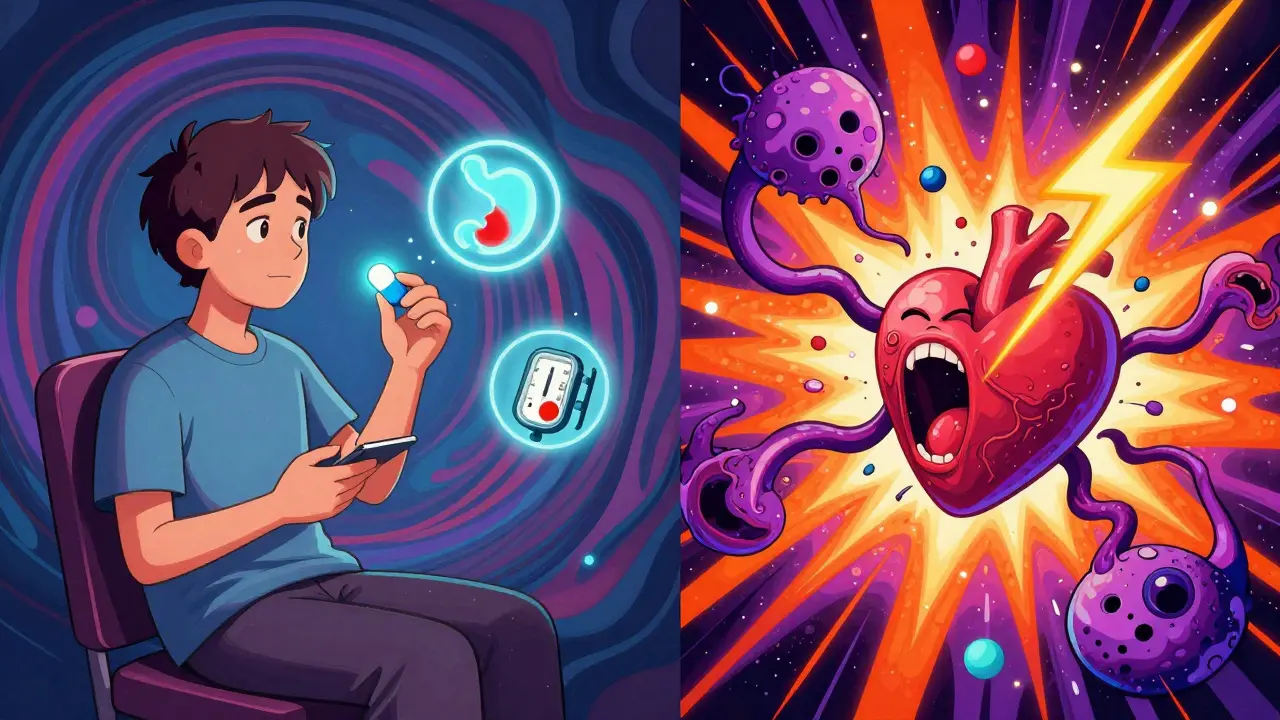
Adverse Drug Reaction Type Classifier
This tool helps you understand if your reaction to medication is likely Type A (predictable, dose-related) or Type B (unpredictable, idiosyncratic). Type A reactions are common (85-90% of cases) and often manageable by dose adjustment. Type B reactions are rare (5-10%) but can be severe.
Reaction Classification
Likely Type A Reaction
Type A reactions are predictable, dose-related, and common (85-90% of all adverse reactions).
Examples: Stomach upset from ibuprofen, low blood pressure from blood pressure medications, constipation from opioids.
Reaction Classification
Likely Type B Reaction
Type B reactions are unpredictable, idiosyncratic, and rare (5-10% of all adverse reactions).
Examples: Anaphylaxis from penicillin, Stevens-Johnson syndrome, drug-induced liver failure without dose relationship.
When you take a medication, you expect it to help-not hurt. But sometimes, drugs cause harm even when taken exactly as prescribed. These harmful effects are called adverse drug reactions (ADRs). Not all side effects are the same. Some are common, predictable, and tied to the dose. Others are rare, strange, and come out of nowhere. Understanding the difference between Type A and Type B adverse drug reactions is one of the most important skills for anyone managing medications-whether you're a doctor, pharmacist, or just someone trying to stay safe on prescriptions.
What Are Type A Adverse Drug Reactions?
Type A reactions are the most common. About 85 to 90% of all adverse drug reactions fall into this category. They’re called intrinsic or augmented reactions because they’re basically an extension of the drug’s normal action. If you know how the drug works, you can predict these side effects.Take ibuprofen, for example. It reduces pain and inflammation by blocking certain enzymes. But those same enzymes protect the stomach lining. So, it’s no surprise that 15 to 30% of people who take ibuprofen regularly get stomach upset or ulcers. That’s a Type A reaction-direct, predictable, and dose-related.
Other classic examples:
- Low blood pressure after starting a new blood pressure pill-happens in 10 to 20% of patients.
- Liver damage from taking too much acetaminophen (over 4 grams a day).
- Sedation from benzodiazepines like diazepam.
- Constipation from opioids like oxycodone.
These reactions aren’t random. They follow a clear pattern: the higher the dose, the worse the side effect. That’s why doctors often start with low doses and go up slowly. If you’re getting too many Type A side effects, the fix is usually simple: lower the dose, switch drugs, or add a protective medication (like a stomach acid blocker for NSAIDs).
They’re also usually not life-threatening. Less than 5% of Type A reactions lead to hospitalization. But because they’re so common, they still cause the most total harm across populations.
What Are Type B Adverse Drug Reactions?
Type B reactions are the opposite. They’re rare-only 5 to 10% of all adverse reactions-but they’re responsible for about 30% of serious cases that land people in the hospital. They’re called idiosyncratic or bizarre because they make no sense based on the drug’s known effects.There’s no dose relationship. You could take one pill and have a deadly reaction. Or take the same dose for years and never react. It’s not about how much you take-it’s about who you are.
Think about penicillin. For most people, it’s safe. But for about 1 in 1,000, it triggers anaphylaxis-a sudden, full-body allergic reaction that can kill in minutes. That’s Type B. It’s not the drug being too strong. It’s your immune system going haywire.
Other Type B examples:
- Stevens-Johnson syndrome from sulfonamides (like Bactrim)-about 1 to 6 cases per million prescriptions.
- Malignant hyperthermia from anesthesia drugs-1 in every 15,000 to 50,000 exposures.
- Drug-induced lupus from hydralazine or procainamide.
- Severe skin rashes from allopurinol.
These reactions often involve the immune system or unusual metabolic pathways. Some are genetic. For example, people with a specific variant in the HLA-B*57:01 gene are at high risk of a dangerous skin reaction from abacavir, an HIV drug. Testing for that gene before prescribing has almost eliminated this reaction.
Type B reactions are scary because they’re unpredictable. You can’t screen everyone for every possible reaction. But knowing the red flags-like sudden fever, rash, swelling, or unexplained organ failure-can save lives.
Why the Difference Matters in Real Life
The difference between Type A and Type B isn’t just academic. It changes how doctors think, prescribe, and monitor.For Type A reactions, the strategy is simple: adjust the dose. If a patient gets dizzy on a blood pressure pill, reduce the dose. If they get constipated on opioids, add a laxative. These are manageable risks.
For Type B, the strategy is avoidance. If someone had a severe reaction to penicillin, they never get it again. No dose adjustment helps. No monitoring prevents it. The only safe move is to choose a different drug entirely.
Here’s a real case: A 68-year-old woman on warfarin (a blood thinner) develops bruising and bleeding. Is it Type A or Type B? It’s Type A-warfarin’s whole job is to thin the blood. If the dose is too high, bleeding happens. The fix? Check the INR (a blood test), lower the dose. Simple.
Now, another patient on the same drug develops sudden, severe liver failure. No dose changes. No signs of overdose. No other explanation. That’s Type B-an idiosyncratic reaction. No amount of monitoring would have predicted it. The only answer: stop the drug and find an alternative.

The Expanded Six-Type System (A to F)
The basic Type A and Type B system is useful, but it’s not enough. In clinical practice, we see reactions that don’t fit neatly into those two boxes.That’s why experts developed the six-type classification system:
- Type C: Chronic effects from long-term use. Example: osteoporosis from years of high-dose corticosteroids. About 20 to 30% of patients on prednisone over 20 mg/day for more than three weeks develop bone loss.
- Type D: Delayed reactions that show up months or years later. Example: clear cell vaginal cancer in daughters of women who took diethylstilbestrol (DES) during pregnancy-risk was 1 in 1,000 to 1 in 10,000.
- Type E: Withdrawal effects. Example: opioid withdrawal symptoms in 80 to 90% of dependent patients within 12 to 30 hours of stopping.
- Type F: Therapeutic failure. Example: birth control pills failing because the patient is also taking rifampin (an antibiotic), which speeds up the metabolism of hormones. Failure rates jump to 5 to 10% in these cases.
These categories matter because they change how we think about risk over time. Type C and D reactions are why we monitor patients on long-term medications. Type E explains why quitting some drugs suddenly is dangerous. Type F reminds us that a drug not working isn’t always the patient’s fault-it could be another drug interfering.
Today, 92% of European pharmacovigilance centers use this six-type system for serious reaction reporting. In Australia and the U.S., major hospitals and drug safety teams are moving toward it too.
Immunological Classification: Another Layer
For reactions involving the immune system, a different system is used: Types I to IV. It’s more detailed than Type B and helps pinpoint the exact mechanism.- Type I (IgE-mediated): Immediate allergic reactions. Think anaphylaxis from penicillin. Happens within minutes to hours. Rare-0.01 to 0.05% of courses-but life-threatening.
- Type II (Cytotoxic): Antibodies attack your own cells. Example: penicillin causing hemolytic anemia-your immune system destroys your red blood cells. About 1 in 8,000 to 10,000 courses.
- Type III (Immune complex): Drug-antibody complexes build up and inflame tissues. Example: serum sickness from cefaclor (an antibiotic). Seen in 0.05 to 0.1% of pediatric cases-fever, joint pain, rash.
- Type IV (Delayed, cell-mediated): T-cells react slowly. Example: the common maculopapular rash from amoxicillin. Affects 5 to 10% of kids. Appears days after starting the drug.
This system is gold for diagnosing allergies and rashes. But it doesn’t cover non-immune Type B reactions like malignant hyperthermia. That’s why both systems are used together.
What the Experts Say
Dr. Alasdair M. Dearman from the University of Manchester says the Type A/B system is essential for prescribing-but modern safety needs more. Dr. Robert S. Hoffman from the New England Journal of Medicine points out that genetics are changing the game. What we once called “Type B” (unpredictable) is now often “Type B with a genetic cause”-and we can test for it.But there’s a problem. About 15% of reactions don’t fit cleanly into Type A or B. Some have features of both. A 2023 Reddit thread had 42 doctors arguing whether carbamazepine-induced low sodium was Type A (dose-related) or Type B (idiosyncratic). Evidence showed it was dose-dependent-but only in people with certain genes. So it’s both.
The World Health Organization says only 65% of serious reactions can be clearly classified. That’s a gap. But we’re closing it. By 2027, experts predict 60% of “Type B” reactions will have known genetic links.
How to Use This Knowledge
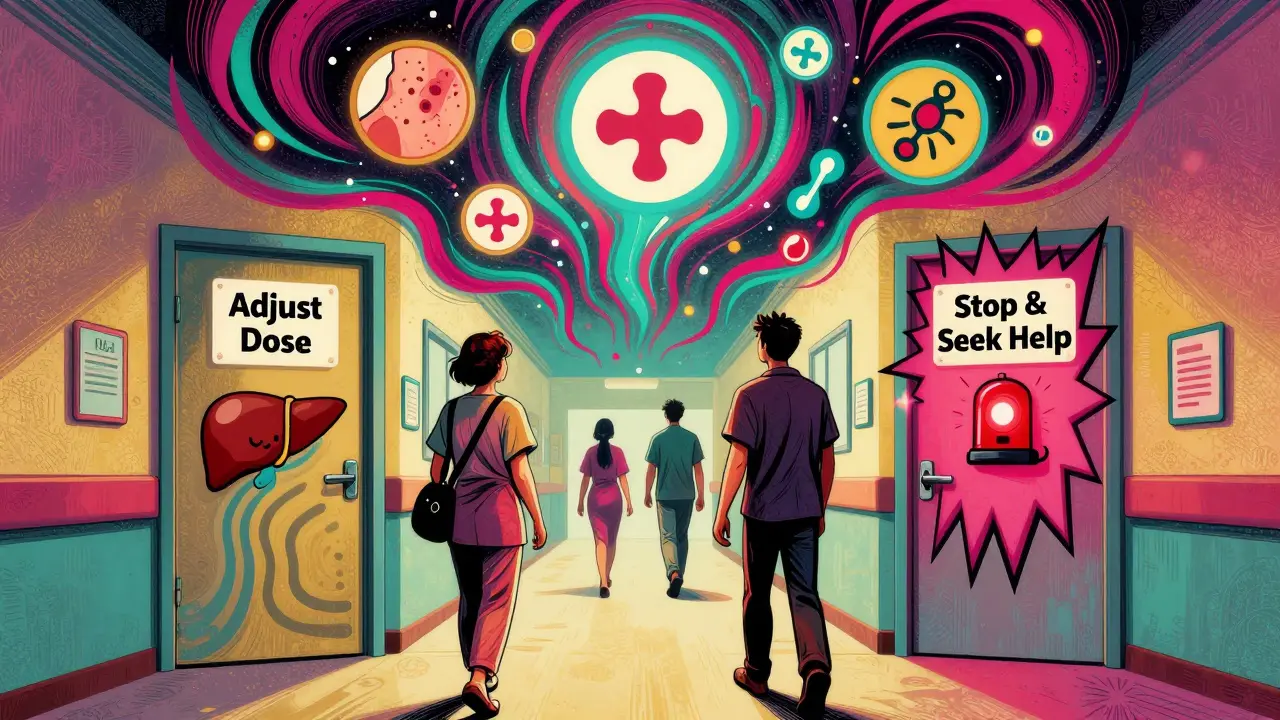
If you’re a patient:- Know your common side effects. If you get them, talk to your doctor about adjusting the dose.
- Watch for sudden, unusual symptoms-rash, swelling, fever, trouble breathing. These could be Type B. Stop the drug and get help.
- Ask if you need genetic testing before starting certain drugs (like abacavir or carbamazepine).
If you’re a healthcare provider:
- Use Type A/B to anticipate common side effects and set realistic expectations.
- Use the six-type system for complex cases, long-term therapy, or when a reaction doesn’t make sense.
- Always consider Type F-did the drug fail because of another drug, poor absorption, or non-adherence?
- Report all serious reactions. The FDA’s MedWatch system processed over 1.2 million in 2022. Your report could prevent harm to someone else.
Final Thoughts
Type A and Type B adverse drug reactions aren’t just labels. They’re tools. Type A helps you manage the expected. Type B helps you survive the unexpected.As medicine gets more personalized-with genetic testing, better monitoring, and smarter algorithms-we’ll get better at predicting even the rarest reactions. But the core idea remains: some side effects are part of the drug’s job. Others are a betrayal of the body’s trust.
Knowing the difference saves lives. And it starts with asking the right question: Is this expected… or is this something else?
Are Type A adverse drug reactions always harmless?
No. While Type A reactions are predictable and usually mild, they can still be serious or even deadly. For example, taking too much acetaminophen causes liver failure, and high doses of blood thinners can cause fatal bleeding. Their predictability doesn’t mean they’re safe-they just mean we know how to prevent them by adjusting the dose.
Can Type B reactions be tested for in advance?
Sometimes. For certain drugs, genetic tests exist. For example, people with the HLA-B*57:01 gene should not take abacavir due to high risk of severe skin reaction. Testing for this gene is now standard before prescribing. But for most Type B reactions, no test exists yet-so we rely on awareness and early detection.
Why are Type B reactions more dangerous even though they’re rare?
Because they’re unpredictable and often affect vital organs. Type B reactions like Stevens-Johnson syndrome or toxic epidermal necrolysis can destroy skin and mucous membranes. Others, like drug-induced liver failure or anaphylaxis, can kill within hours. Even though they affect only 5-10% of all reactions, they cause about 30% of hospitalizations and 25-30% of drug-related deaths.
Can a reaction be both Type A and Type B?
Yes. Some reactions have features of both. For example, carbamazepine can cause low sodium levels in a dose-dependent way (Type A), but only in people with specific genetic variants (Type B). These mixed reactions are why experts are moving toward more nuanced classification systems that include genetics and metabolism, not just dose and predictability.
What should I do if I think I’m having a Type B reaction?
Stop taking the medication immediately and seek medical help. Type B reactions can worsen quickly. Don’t wait to see if it gets better. Bring the drug name, dosage, and when you started it. If possible, take a photo of any rash or swelling. This helps doctors identify the reaction and report it to safety systems.
Is one classification system better than the other?
No single system is perfect. Type A/B is simple and great for prescribing. The six-type (A-F) system gives a fuller picture for long-term or complex cases. The immunological (I-IV) system is best for allergies and rashes. Most experts use all three depending on the situation. The key is understanding the strengths and limits of each.
15 Comments
Robert Gilmore December 25, 2025 AT 09:40
Just wanted to say this is one of the clearest breakdowns of ADRs I’ve ever read. Seriously, if your med school didn’t teach this well, you’re getting gypped. Type A? Yeah, we all know the drill. But Type B? That’s where the real horror stories live. Thanks for laying it out like this.
Robert Gilmore December 27, 2025 AT 00:35
This is the kind of post that makes me feel hopeful about medicine. 🙌 We’re finally getting better at separating ‘this is normal’ from ‘this is a red flag.’ And yeah, genetic testing is a game-changer-my cousin got tested for HLA-B*57:01 before starting abacavir and it saved her life. Thank you for sharing this.
Robert Gilmore December 28, 2025 AT 12:43
Type B = bad news.
Robert Gilmore December 29, 2025 AT 05:52
I’ve been a clinical pharmacist for 18 years, and I still get chills reading about Type B reactions-especially when they hit kids. I remember a 7-year-old who got Stevens-Johnson from a single dose of sulfamethoxazole. No history of allergies. No red flags. Just… boom. That’s why I now tell every parent: if your kid breaks out in a rash after a new med, don’t wait. Don’t ‘see if it clears.’ Stop it. Call poison control. Go to the ER. Type B doesn’t negotiate. And honestly? We still underreport these. The FDA’s numbers are just the tip of the iceberg. We need better surveillance, better education, and honestly, better funding for pharmacovigilance. This isn’t just academic-it’s life or death for families who never saw it coming.
Robert Gilmore December 29, 2025 AT 21:47
So let me get this straight-you’re telling me that if I take a drug for 10 years and suddenly my liver explodes, it’s not my fault? It’s just… my body being a traitor? 😂 I love this. Finally, a medical explanation that doesn’t blame the patient. Also, carbamazepine and sodium? That’s wild. So it’s like… dose-dependent but only if you have the genetic glitch? That’s basically the universe saying ‘lol, you got the special version.’
Robert Gilmore December 30, 2025 AT 08:46
It’s funny how we treat drugs like they’re magic wands-take one, feel better. But the body’s got its own rules, its own secrets. Type A reactions are like the price of admission-you know the cost upfront. But Type B? That’s the universe whispering, ‘you weren’t supposed to be here.’ It’s not just medicine-it’s biology playing chess with our DNA. And honestly? That’s beautiful, in a terrifying way. We’re learning to read the board. Slowly. But we’re learning.
Robert Gilmore December 30, 2025 AT 11:45
typo in the post: "1 in every 15,000 to 50,000 exposurs". also, who the f wrote this? 60% of type b reactions will have genetic links by 2027? where’s the source? i read a reddit thread from 2023 and now this is gospel? also, why no mention of the pharma industry suppressing data on type b? they don’t wanna know what kills people. they wanna sell more pills.
Robert Gilmore December 30, 2025 AT 21:44
As someone who’s lived in three countries and worked in three different healthcare systems, I’ve seen how wildly inconsistent ADR reporting is. In the UK, we’d flag a rash within hours. In the States? You wait until the ER. In India? You pray. But this six-type system? It’s the first real attempt at a global language for harm. I’ve trained nurses in Nairobi using this framework-it’s like giving them a flashlight in a dark room. We’re not just classifying reactions anymore. We’re giving people the power to speak up before it’s too late. And honestly? That’s the most powerful thing in medicine right now.
Robert Gilmore December 31, 2025 AT 13:12
They’re lying. Type B isn’t ‘idiosyncratic.’ It’s the body rejecting the poison. Big Pharma doesn’t want you to know that all drugs are toxic. They just want you to think some are ‘safe’ if you take them ‘correctly.’ The real answer? Don’t take any of it. Natural remedies. Diet. Sleep. That’s the only way to avoid these reactions. The system is rigged. Genetic testing? That’s just the next step to patent your DNA and charge you extra. Wake up.
Robert Gilmore January 1, 2026 AT 13:49
Love this breakdown. Seriously. I’m a nurse in rural Iowa, and half my patients are on 5+ meds. I use Type A/B all the time to explain side effects-‘This is the drug doing its job too hard, not your body breaking.’ But I’ve also seen Type B. A guy got toxic epidermal necrolysis from a single dose of allopurinol. He was fine the day before. Three days later, his skin was peeling off. We almost lost him. This isn’t theory. This is Tuesday in ER. Thank you for making this real.
Robert Gilmore January 2, 2026 AT 00:47
I’ve been thinking a lot about Type F lately-therapeutic failure. My mom’s on birth control, takes rifampin for TB, and got pregnant. She blamed herself. Said she ‘forgot a pill.’ But no. It was the antibiotic. We didn’t know. And now? We do. This post made me realize how many people are quietly failing on meds because of interactions nobody told them about. We need warning labels that scream, not whisper. And we need pharmacists to actually talk to patients, not just hand out pills. This isn’t just about side effects-it’s about trust. And we’re failing at that too.
Robert Gilmore January 3, 2026 AT 10:57
type b is just big pharma’s way of saying ‘oops we didn’t test on enough people’ and then charging you extra for the genetic test to prove you’re not one of the unlucky ones. meanwhile, the same company that made the drug also owns the test. classic. also, why is this even a thing? why not just ban all drugs that can kill you randomly? oh right, because money. sad.
Robert Gilmore January 4, 2026 AT 18:19
Had a patient last week with drug-induced lupus from hydralazine. Took 18 months to diagnose. She thought she had MS. We missed it because we were looking for the obvious. This post reminded me: sometimes the answer isn’t in the textbook. It’s in the silence between the symptoms. Thanks for the clarity.
Robert Gilmore January 6, 2026 AT 05:34
I appreciate the nuance here. I used to think Type A = bad, Type B = worse. But now I see it’s more like: Type A is the storm you can see coming-you pack an umbrella. Type B is the lightning strike out of a clear sky. You can’t predict it, but you can learn to recognize the smell of ozone before it hits. And that’s something we can teach. I’m a parent now, and I’m printing this out for my kid’s pediatrician. Just in case.
Robert Gilmore January 8, 2026 AT 04:50
The author’s assertion that 60% of Type B reactions will have genetic links by 2027 is not substantiated by peer-reviewed literature. The WHO’s 2022 pharmacovigilance report indicates that only 12% of Type B reactions have currently identifiable genetic biomarkers. Furthermore, the claim that the six-type system is adopted by 92% of European centers is misleading-this figure conflates awareness with implementation. The data presented lacks methodological transparency and risks promoting overconfidence in clinical decision-making. A more cautious interpretation is warranted.