Insulin Stacking Safety Calculator
Important: This tool helps estimate safe insulin dosing intervals based on the article's guidelines. Individual insulin action times vary. Always consult your healthcare provider for personalized advice.
Based on 4 hours of insulin activity (article recommendation). If your insulin lasts longer, adjust the duration above.
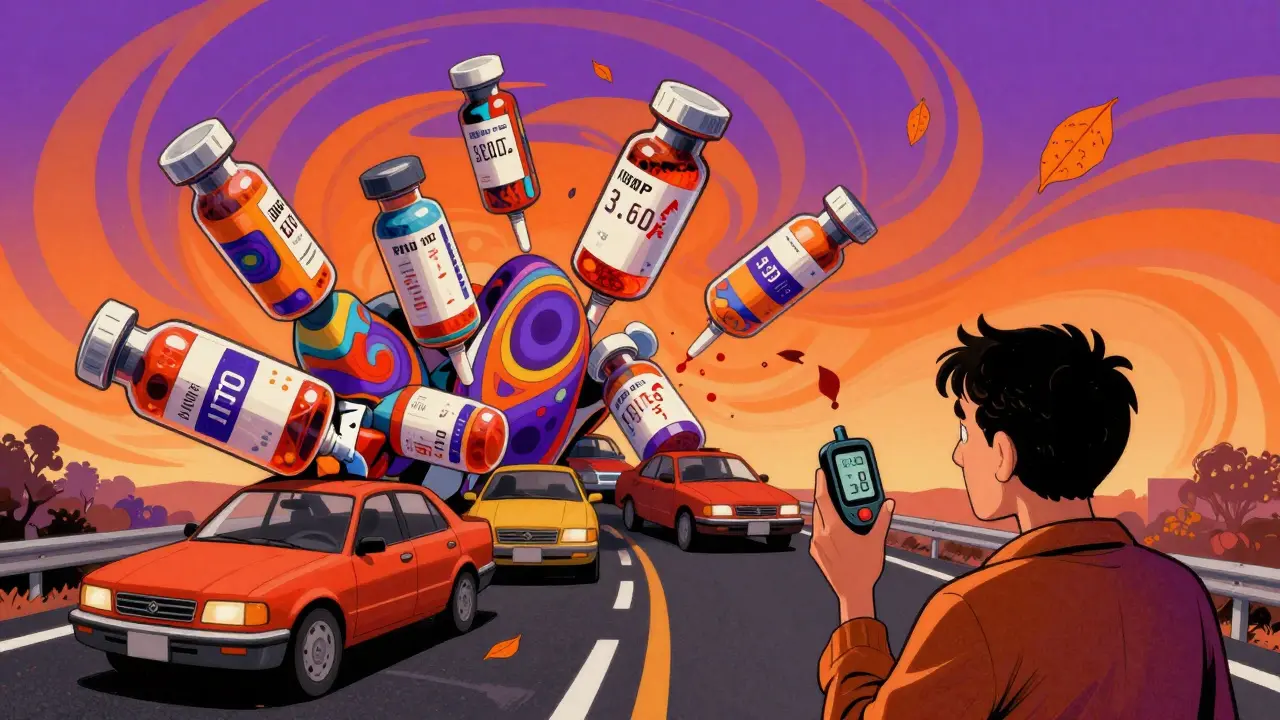
Every year, thousands of people with diabetes end up in the emergency room because their blood sugar dropped too low-not from skipping meals or over-exercising, but from something many don’t even know they’re doing: insulin stacking. It sounds technical, but it’s simple: giving another insulin dose before the last one has finished working. And when that happens, the insulin builds up in your system like traffic on a highway with no exits. The result? A sudden, dangerous crash in blood sugar. This isn’t a rare mistake. It’s one of the most common-and preventable-causes of severe hypoglycemia.
What Exactly Is Insulin Stacking?
Insulin stacking happens when you take a second (or third) dose of rapid-acting insulin-like insulin lispro, aspart, or glulisine-before the first dose has fully done its job. These insulins start working in 15 minutes, peak around 60 to 90 minutes, and keep lowering your blood sugar for 3 to 5 hours. If you check your blood sugar two hours after eating, see it’s still high, and give another correction shot, you’re doubling up on insulin that’s still active. That extra insulin doesn’t just add on-it stacks on top, pushing your blood sugar down too far, too fast.
This isn’t just theory. A 2022 study from the Veterans Affairs Greater Los Angeles Healthcare System found that 37% of overnight hypoglycemia events in hospitalized patients were directly caused by correction doses given within four hours of the previous insulin shot. People often don’t realize they’re doing it. They think, “I need to fix this now,” not knowing the insulin they took earlier is still working hard.
Why 4 Hours? The Science Behind the Rule
Why four hours? Because that’s when 95% of rapid-acting insulin has done its job. Studies using glucose clamp tests-the gold standard for measuring insulin action-show that after four hours, most of the glucose-lowering effect is gone. But here’s the catch: not everyone is the same. Some people’s bodies process insulin slower. Others, especially those with kidney issues, may still have insulin circulating after five or even six hours. The 4-hour window is a safe general rule, but your personal insulin action time might be longer.
Compare that to long-acting basal insulins like insulin glargine (Lantus) or degludec (Tresiba). These are designed to work slowly and steadily over 24 hours or more. You don’t need to worry about stacking with these-they’re meant to be taken once daily. The real danger comes when people confuse the two. You can’t treat a high blood sugar with a basal insulin like it’s a fast-acting one. And you can’t give a correction dose too soon after a bolus and expect it to be safe.
Who’s at Risk-and How Often It Happens
Anyone using rapid-acting insulin is at risk. That includes people on multiple daily injections (MDI) and those using insulin pumps. The problem is especially common among people who don’t use continuous glucose monitors (CGMs). According to the T1DX-QI registry, non-CGM users experience insulin stacking-related hypoglycemia 3.2 times more often than those who monitor their levels continuously.
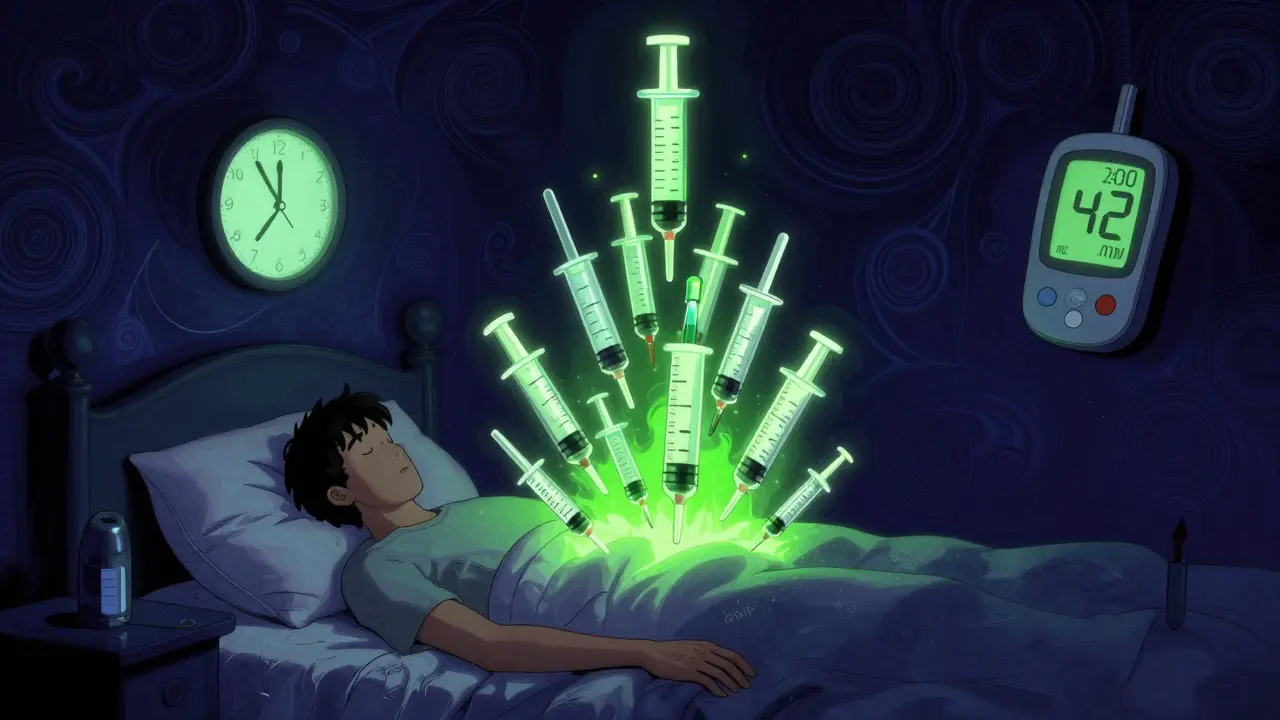
Real stories from online diabetes communities show how easily this happens. One user on Diabetes Daily described taking a correction dose 90 minutes after dinner, then waking up at 2 a.m. with a blood sugar of 42 mg/dL. Another Reddit user said they gave three correction boluses within three hours trying to bring down a high reading-and woke up shaking with a blood sugar of 50. These aren’t rare cases. They’re textbook examples of stacking.
Even healthcare providers sometimes miss it. The same VA study found that 68% of nurses didn’t initially recognize insulin stacking as the cause of overnight lows. That means patients aren’t just making mistakes-they’re not always being warned.
How to Prevent Insulin Stacking
Preventing stacking isn’t complicated, but it does require awareness and a system. Here’s how to stay safe:
- Know your insulin’s duration. If you’re using rapid-acting insulin, assume it’s active for at least 4 hours. Some people need 5 or 6. Track your blood sugar patterns over weeks to see how long your insulin lasts.
- Check your insulin on board (IOB). Modern insulin pumps like Tandem t:slim X2 and Omnipod 5 automatically calculate how much insulin is still working in your body. If your pump says you have 2 units of IOB, don’t give another full correction-adjust for what’s already there.
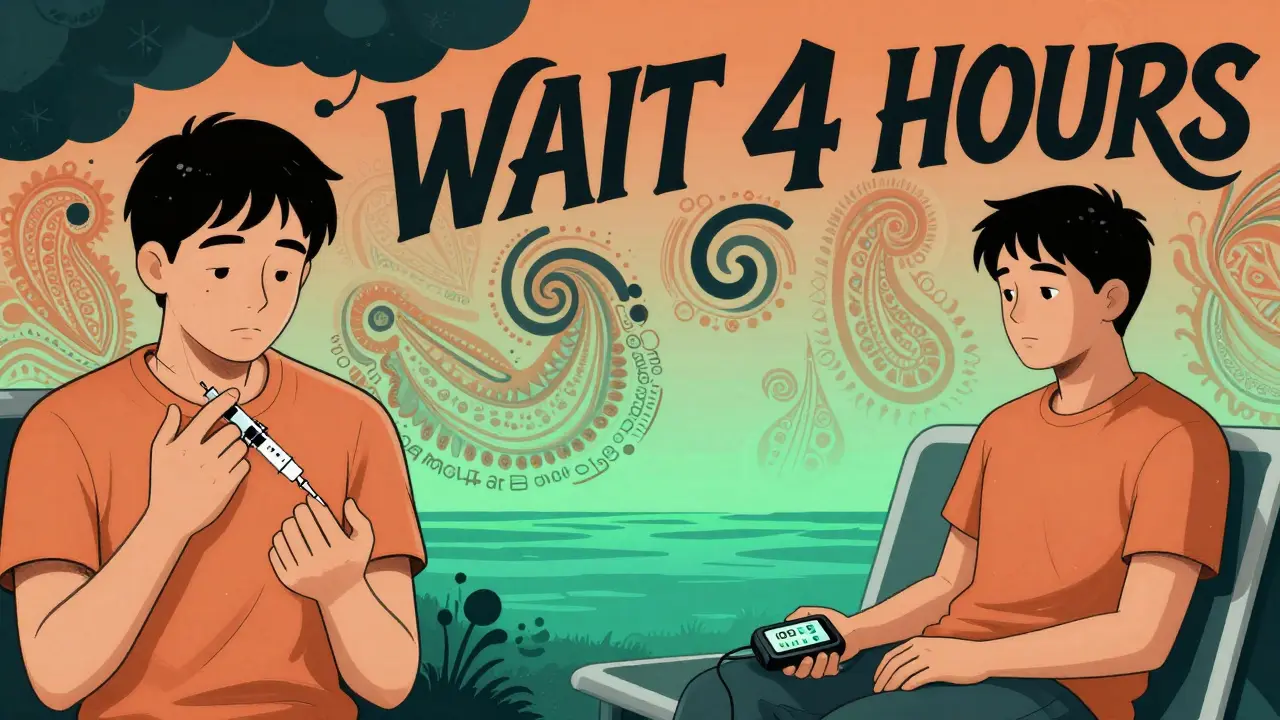
- Wait at least 4 hours between correction doses unless you’re certain the previous dose has worn off. If you’re unsure, wait longer.
- Use a log or app. If you’re on MDI, write down every bolus time and dose. Some apps let you track IOB manually. Seeing the pattern helps you avoid repeating mistakes.
- Don’t treat high blood sugar like a race. It takes time for insulin to work. Trying to fix it all at once with multiple doses is like slamming the brakes on a car going 60 mph. Slow and steady works better.
Technology Is Making It Easier
The good news? Technology is catching up. The FDA now requires all new insulin delivery systems to include stacking prevention features. That means insulin pumps and smart pens must show your insulin on board and warn you if you’re about to give a dose too soon. The InPen system, approved in 2023, uses Bluetooth to sync with your phone and gives real-time alerts if stacking is likely.
At the VA, hospitals that added automated alerts to their electronic health records saw a 50% drop in hypoglycemia events within a year. These systems prevent a correction dose if it’s given within four hours of the last one. That’s not just convenient-it’s life-saving.
For people without pumps, standalone bolus calculators like the BolusGuard device cost $200-$300 and help calculate IOB manually. But even without tech, awareness alone can cut your risk. A 2023 study in the Journal of Diabetes Science and Technology showed that just teaching patients about stacking reduced hypoglycemia episodes by 41% in six months.
The Cost of Ignoring It
Insulin stacking isn’t just a personal health risk-it’s a financial one too. In the U.S., hypoglycemia-related hospitalizations cost $1.1 billion annually. About 35% of those cases are directly tied to stacking errors. That’s more than $385 million spent each year on avoidable emergencies. The cost isn’t just money. It’s sleep lost, anxiety built, trust in insulin shaken, and sometimes, lives lost. A 2021 JAMA Internal Medicine analysis found that people who experience severe hypoglycemia have a 2.5-fold higher risk of death.
But here’s the hopeful part: if you learn how to avoid stacking, you’re not just protecting yourself-you’re cutting your risk of these events dramatically. The American Diabetes Association estimates that proper dosing intervals could prevent over 300,000 hypoglycemic events in the U.S. every year.
Final Thought: It’s Not About Perfect Numbers
You don’t need to hit a blood sugar of 100 every time. You need to stay safe. If your blood sugar is 200 after a meal, don’t panic. Wait. Give your insulin time to work. Check again in an hour. If it’s still high, then consider a small correction-and always check your IOB first. Your goal isn’t to fix it right now. It’s to avoid crashing later.
Insulin stacking is silent. It doesn’t make noise. It doesn’t warn you. But if you know how to spot it, you can stop it before it starts.
14 Comments
Robert Gilmore March 14, 2026 AT 22:59
I used to stack insulin all the time until I started using my pump's IOB feature. Now I just wait. It's not perfect, but it's saved me from so many lows. Seriously, if you're not checking IOB, start. Your future self will thank you.
Robert Gilmore March 16, 2026 AT 13:03
OMG I DID THIS SO MANY TIMES 😭 I thought I was being proactive! Now I know I was just setting myself up for disaster. My CGM screamed at me one night and I cried. 42 mg/dL. I'm never doing that again. 🙏💉
Robert Gilmore March 17, 2026 AT 20:02
The science here is solid, but I wonder if we're over-simplifying. Insulin kinetics vary wildly between individuals. Some people have delayed absorption due to adipose tissue, others have renal clearance issues. The 4-hour rule is a guideline, not a law. Personalized data beats blanket advice every time.
Robert Gilmore March 18, 2026 AT 07:09
This whole post is just fear-mongering. People have been managing diabetes for decades without CGMs or fancy pumps. You don't need tech to be safe-you need discipline. Stop blaming insulin and start blaming poor habits. I've never had a stacking incident because I don't panic when my sugar's 200.
Robert Gilmore March 20, 2026 AT 00:32
I love how this article doesn't just say 'don't do it' but explains why. I used to think waiting meant I was being lazy. Now I see it as being strategic. Small changes, big results. 💛
Robert Gilmore March 21, 2026 AT 05:37
so i just started using insulin last year and i didnt even know this was a thing like wtf why is no one talking about this more seriously like i almost passed out once and no one told me this could happen
Robert Gilmore March 21, 2026 AT 06:57
You're not wrong about the 4-hour rule-but you're missing the bigger picture. The real danger isn't stacking. It's the panic that causes it. People treat glucose like a video game boss. You don't rush the final hit. You wait for the opening. That's the mindset shift needed.
Robert Gilmore March 22, 2026 AT 16:28
i live in the uk and we dont have access to half the tech mentioned here. my pump doesnt even do io b. so the 4 hour rule is all i have. and honestly? it works. just wait. simple.
Robert Gilmore March 23, 2026 AT 11:59
Interesting read. I've been on insulin for 12 years and never heard the term 'stacking' before. In India, most people just guess doses. Maybe awareness is the real breakthrough here.
Robert Gilmore March 25, 2026 AT 11:28
As a certified diabetes care and education specialist, I applaud this article. The emphasis on personalization over dogma is critical. Many patients are taught rigid rules, but biology is not a spreadsheet. Encourage tracking, not just compliance.
Robert Gilmore March 25, 2026 AT 13:12
i wish this was taught in schools or at least in basic diabetes classes. so many young people are scared to use insulin because theyve heard horror stories. if we normalize this kind of education early we could save lives
Robert Gilmore March 26, 2026 AT 03:17
why are we even talking about this like its new? i remember my grandma telling me this in 2008. we had paper logs. no apps. no pumps. we just knew. now everyone needs a device to tell them not to overdose on their own medicine. sad.
Robert Gilmore March 26, 2026 AT 23:37
Let’s be real-this whole '4-hour rule' is a corporate ploy to sell more CGMs and smart pens. I’ve been stacking for years. I’ve had lows. I’ve had highs. I’m still here. The system wants you dependent on tech. I choose autonomy. And yes, I’m still alive. 😎
Robert Gilmore March 28, 2026 AT 19:13
I must say, this is one of the most meticulously researched, clinically grounded, and compassionately articulated pieces on insulin management I have encountered in recent memory. The integration of empirical data from the Veterans Affairs study, coupled with the nuanced acknowledgment of individual variability in pharmacokinetics, elevates this beyond mere patient education-it becomes a public health imperative. The assertion that 37% of overnight hypoglycemia events stem from correction doses administered within four hours is not merely statistically significant-it is profoundly alarming. Furthermore, the economic argument-$385 million annually in avoidable hospitalizations-transforms this from a personal health concern into a systemic failure of education and access. The fact that 68% of nurses failed to recognize insulin stacking underscores a critical gap in provider training. This is not a patient problem. It is a healthcare system problem. And while technology offers solutions, true change requires cultural shift. We must stop pathologizing 'mistakes' and start designing systems that anticipate human error. Thank you for this. It is, without hyperbole, life-saving.