Steroid Taper Recovery Estimator
Based on 2024 Endocrine Society guidelines: 1 month recovery for every month on steroids
ACTH testing is required when reaching 4-6 mg prednisone or 15-25 mg hydrocortisone
Important: Adrenal crisis risk increases if tapering without ACTH testing. Never stop steroids based on symptoms alone.
When someone takes steroids for months or years-whether for asthma, rheumatoid arthritis, or Duchenne muscular dystrophy-their body stops making its own cortisol. It’s not just a side effect; it’s a full shutdown of the adrenal glands. Stopping steroids too fast can trigger an adrenal crisis, a life-threatening drop in blood pressure, severe fatigue, vomiting, and even coma. The solution isn’t just slowing down the taper. It’s testing. Specifically, ACTH stimulation testing is now the gold standard for knowing when the adrenal glands are ready to wake up again.
Why Your Body Stops Making Cortisol
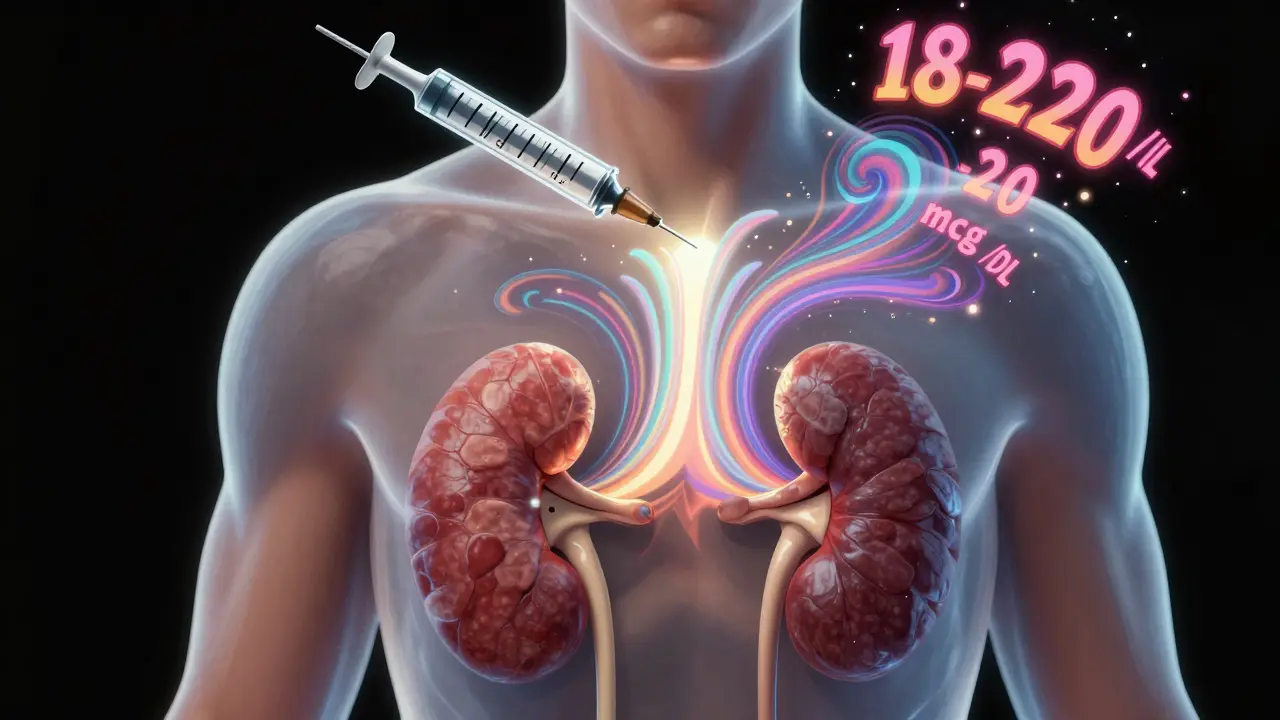
Your adrenal glands sit on top of your kidneys and produce cortisol, the body’s natural stress hormone. When you take synthetic glucocorticoids like prednisone or hydrocortisone for more than a few weeks, your brain gets the message: "We’ve got plenty. No need to make more." So it shuts off the signal (ACTH) that tells the adrenals to produce cortisol. Over time, the glands shrink from disuse. This isn’t temporary-it’s structural. Studies show that after 12 months of steroid use, the adrenals can take up to a year to fully recover, even after the dose is lowered.What Is ACTH Stimulation Testing?
ACTH stimulation testing is a simple blood test that checks if your adrenal glands can still respond. Here’s how it works: A small dose of synthetic ACTH (called cosyntropin) is injected into your arm. Then, your blood is drawn before the shot and again at 30 and 60 minutes after. The lab measures how high your cortisol levels climb. If your cortisol jumps to 18-20 mcg/dL or higher, your adrenals are back in business. If it stays below 14 mcg/dL, you still need replacement steroids.This test isn’t optional anymore. The 2024 joint guideline from the Endocrine Society and European Society of Endocrinology made it clear: if you’ve been on steroids for more than 3-4 weeks, you need a structured taper-and ACTH testing should be used to guide when to stop.
How Tapering Works: Two Paths
There’s no one-size-fits-all taper. It depends on how long you’ve been on steroids.- 3 to 12 months of therapy: Follow the PJ Nicholoff Protocol. Reduce your dose by 2.5-5 mg of prednisone every 1-2 weeks until you hit around 10-15 mg/day. Then cut by 20-25% each week. Test your cortisol when you reach a physiologic dose (4-6 mg prednisone).
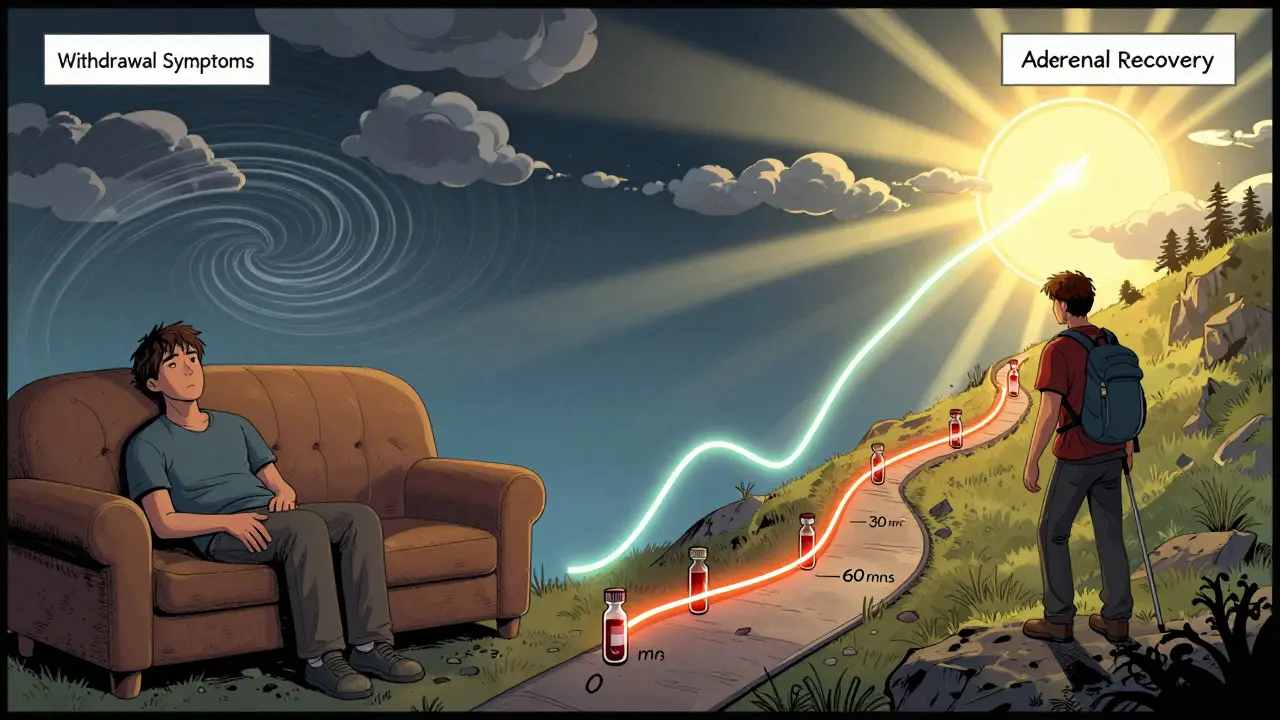
- More than 12 months: Recovery takes longer. Experts say one month of recovery for every month on steroids. If you were on high-dose steroids for 18 months, expect at least 18 months of tapering. Testing every 2-3 months during this phase is critical.
Physiologic replacement means mimicking your body’s natural rhythm: 10 mg of hydrocortisone in the morning, 5 mg at noon, and 5 mg in the early afternoon. This avoids the energy crash most people feel when they take one big dose.
Why Testing Beats Guessing
Many doctors used to rely on symptoms: "You feel tired? Keep taking it." But that’s dangerous. Glucocorticoid withdrawal syndrome-fatigue, joint pain, nausea, low mood-is common and often mistaken for adrenal insufficiency. The difference? Withdrawal symptoms get worse with rest and improve with activity. True adrenal insufficiency gets worse with activity and doesn’t respond to rest.Here’s the data: A 2024 study at Mayo Clinic tracked 1,200 patients over five years. Those who followed a protocol with ACTH testing had an adrenal crisis rate of just 1.2%. Those who tapered based on symptoms alone? 8.5%. That’s a 86% reduction in life-threatening events.
The Real-World Problem: Access
The science is clear. The protocols are detailed. But in rural clinics, getting an ACTH test isn’t easy. The test requires a specialist, a lab with cortisol timing capabilities, and a patient who can travel. A 2023 survey found that 61% of patients waited over four weeks for testing. Some ended up in the ER because they couldn’t get scheduled in time.Primary care doctors are caught in the middle. A 2022 study in Endocrine Practice found that 68.3% of GPs felt unprepared to manage these tapers. They don’t have the time, the training, or the access to endocrinologists. That’s why the 2024 guidelines stress: "Until the patient reaches physiologic replacement, tapering must be supervised by a specialist."

What Happens If You Skip Testing?
Skipping ACTH testing doesn’t just mean you might feel lousy. It means you risk adrenal crisis. Symptoms include:- Sudden dizziness or fainting
- Severe abdominal pain
- Low blood pressure
- Confusion or loss of consciousness
It’s rare-but deadly. And it’s preventable. The American Association of Clinical Endocrinology says every patient on long-term steroids should carry a steroid alert card. But only 47% of community practices actually hand them out. That’s a gap.
What’s New in 2026
The field is moving fast. The Endocrine Society is rolling out a mobile app in late 2024 to help patients and providers track taper progress and test dates. The NIH has funded a $4.2 million project to build a point-of-care ACTH test-something you could get in a doctor’s office in 10 minutes, not a week. And Epic’s EHR system is adding HPA axis tracking modules in 2025, so your doctor’s computer will remind you when to test.Researchers are also exploring salivary cortisol as a less invasive alternative. But for now, blood testing is still the gold standard.
What You Should Do
If you’re on long-term steroids:- Don’t stop or cut your dose without medical supervision.
- Ask your doctor: "When should I have my first ACTH stimulation test?"
- Make sure you’re on a physiologic dose before testing (4-6 mg prednisone or 15-25 mg hydrocortisone).
- Carry a steroid alert card. Know your emergency dose.
- If you get sick, injured, or have surgery, double your dose. Your body still needs cortisol.
Adrenal recovery isn’t fast. It’s not glamorous. But it’s life-saving. The science has caught up. Now, the system just needs to catch up with the patients.
How long does it take for adrenal glands to recover after stopping steroids?
Recovery time depends on how long you were on steroids. For 3-12 months of use, it usually takes 6-12 months. For over a year of therapy, experts say it takes about one month of recovery for every month you were on steroids-so up to 9-12 months or longer. The adrenal glands physically shrink and need time to regrow and respond to ACTH again. ACTH stimulation testing is the only reliable way to know when they’re ready.
Is ACTH stimulation testing painful or risky?
No. The test involves a small injection of synthetic ACTH (cosyntropin), which is not a steroid. It’s safe and well-tolerated. You might feel a quick pinch, and some people report mild flushing or nausea for a few minutes. Blood draws are routine. There’s no risk of addiction or long-term side effects. The real risk is skipping the test-because without it, you might stop steroids too soon and trigger an adrenal crisis.
Can I do this test at my local clinic?
Not always. ACTH stimulation testing requires a lab that can measure cortisol levels at precise time points (0, 30, and 60 minutes after injection). Many community clinics don’t have this capability. You’ll likely need to go to a hospital lab or endocrinology center. Wait times can be 4 weeks or more. If you’re in a rural area, talk to your doctor about arranging a referral early in your taper. Some academic centers now offer mobile testing units for patients who can’t travel.
What if my cortisol level is borderline-say, 16 mcg/dL?
A level between 14-18 mcg/dL is considered borderline. In this case, experts recommend holding your taper for another 2-4 weeks and repeating the test. Some patients with borderline results show recovery on the second test. Never stop steroids based on a single borderline result. Your doctor may also consider your symptoms, stress levels, and history before deciding.
Do I need to keep taking steroids even after I feel fine?
Yes-until testing confirms your adrenals are working. Feeling fine doesn’t mean your body can make cortisol. Many patients stop steroids when they feel better, only to crash weeks later. The goal isn’t to feel good now; it’s to ensure your body can handle stress in the future. ACTH testing tells you when it’s safe to stop, not how you feel.
9 Comments
Robert Gilmore March 6, 2026 AT 04:26
Ugh, I’ve been through this. My endo told me to taper slow, but my PCP was like ‘you look fine, just stop.’ I nearly died in the ER at 3am with vomiting and a BP of 70/40. No one listens until it’s too late. ACTH testing isn’t optional-it’s your lifeline. If your doctor doesn’t know about the 2024 guidelines, fire them. I’m not mad, I’m just… disappointed.
And yes, I carry my steroid card. It’s laminated. I have a backup in my purse. I even gave one to my dog walker. You don’t mess with cortisol.
Also-why is this still not in EHR alerts? My pharmacy knows I’m on prednisone, but my doctor’s system doesn’t flag it. We’re still in the Stone Age.
Robert Gilmore March 6, 2026 AT 23:44
Testing saves lives. Period.
Stop guessing. Stop relying on ‘how you feel.’
86% fewer crises with ACTH tests. That’s not data-that’s a moral obligation.
Doctors who skip it are negligent. Patients who don’t ask for it are putting their lives on a coin flip.
Carry the card. Know your dose. Don’t be a statistic.
Robert Gilmore March 7, 2026 AT 11:43
Okay but what if you’re in a rural town with no endo and your only option is a 3-hour drive to the nearest hospital? Do you just keep taking prednisone forever? That’s not a solution. The guidelines are great on paper. In real life? We’re stuck. I’ve been at 5mg for 18 months. My test is scheduled in 6 weeks. Meanwhile, I can’t work, can’t sleep, and my kid’s school says I’m ‘unreliable’ because I’m always tired.
So yeah, testing is great. But who’s fixing the system?
Robert Gilmore March 8, 2026 AT 15:24
Yessss this is so important!! 🙌 I’ve been tapering for 2 years and my doc finally ordered the ACTH test after I begged. Got my cortisol at 21.5-first time in 4 years I didn’t feel like a zombie after a nap.
Also-YES to the mobile app. I’ve been tracking my doses and symptoms in a Google Sheet. Would LOVE an app that auto-logs and reminds me. My partner even made me a little sticker: ‘Cortisol Level: Alive & Kicking’ 🌞
Also-tell your doctor to give you the card. I got mine at my last visit. It’s in my wallet next to my insurance card. Small thing. Big deal.
Robert Gilmore March 10, 2026 AT 01:53
Thank you for writing this. I’ve been on steroids for 14 months for my autoimmune condition, and I’ve been terrified to taper. This gave me clarity.
I’m going to ask my doctor for the ACTH test next week. I didn’t know about the physiologic dosing schedule-morning 10mg, noon 5, afternoon 5. That makes so much sense. I’ve been taking it all at once and wondering why I crash by 3pm.
Also-I got my steroid card last month. I carry it in my wallet like a badge. I feel safer now.
You’re not alone. We’re all just trying to survive this.
Robert Gilmore March 11, 2026 AT 15:21
Agreed. Testing is non-negotiable.
My GP didn’t know about the 2024 guidelines either.
Had to send him the link.
He apologized.
Now we’re on track.
18 months on → 18 months taper.
Patience isn’t passive.
It’s strategic.
Robert Gilmore March 12, 2026 AT 09:40
Let me tell you about my cousin. She stopped prednisone cold turkey because ‘she felt fine.’ Two days later, she was in ICU. They pumped her full of dexamethasone like a damn IV drip. She’s fine now, but she’s got PTSD from it. She won’t even take ibuprofen without checking with her endo.
Here’s the truth: Your body doesn’t care how ‘good’ you feel. It cares about ACTH. It cares about cortisol. It cares about survival. If you’re not testing, you’re gambling with your life. And if your doctor says ‘we’ll just watch you’-that’s not medicine. That’s negligence wrapped in a white coat.
Robert Gilmore March 13, 2026 AT 06:19
I appreciate the thoroughness of this post. It is clear and well-structured. I have been managing steroid tapering for a patient with chronic illness, and the emphasis on objective testing over subjective symptoms is vital. The data cited is compelling. I will be sharing this with my clinical team.
Thank you for the clarity.
Robert Gilmore March 14, 2026 AT 09:59
I’m an endo fellow. I just want to say: we see this. Every day. The patients who come in after a crisis. The ones who didn’t get tested. The ones who were told ‘it’s just fatigue.’
We’re trying. We’re pushing for point-of-care tests. We’re lobbying for EHR integration. But we’re 100 people trying to fix a system designed for volume, not vigilance.
If you’re tapering-ask for the test. Ask for the card. Ask for the protocol.
We’re on your side. We just need you to ask.