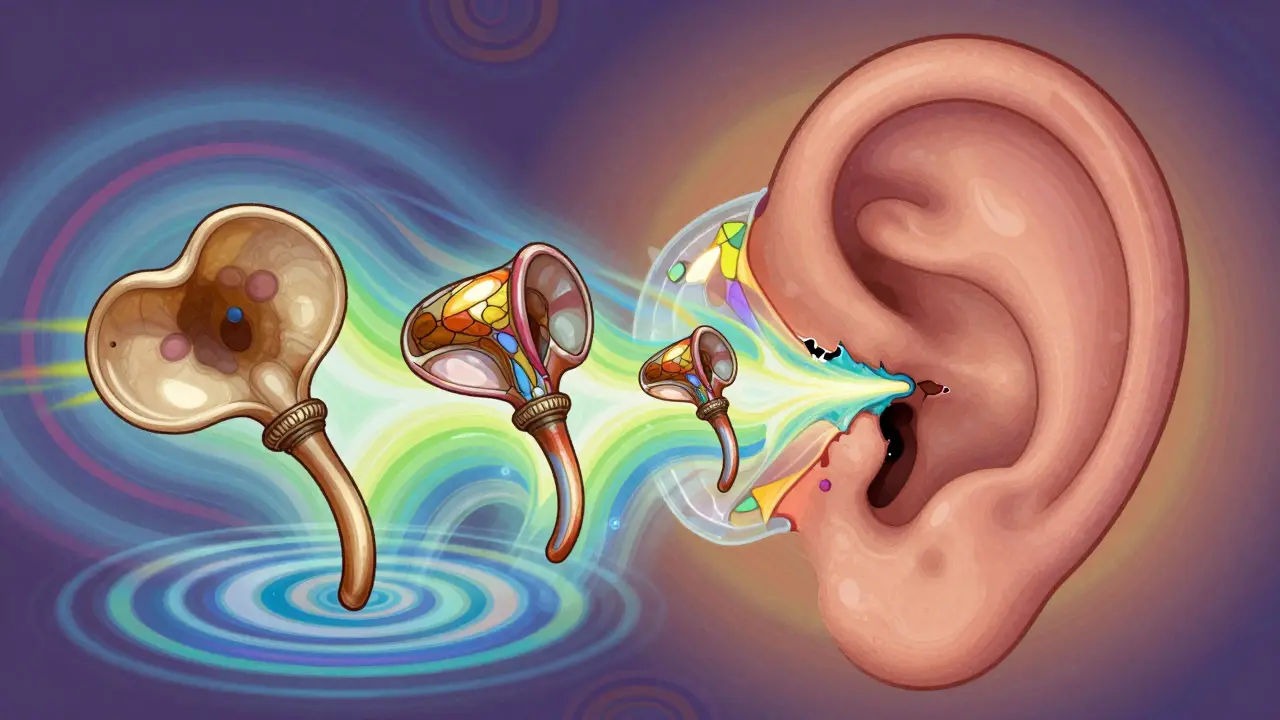
When you can’t hear a whisper, but loud noises still sound muffled, it’s not just about volume-it’s about clarity. That’s the hallmark of conductive hearing loss, a condition where sound gets stuck before it reaches the inner ear. Unlike sensorineural hearing loss, which damages the nerves or inner ear, conductive hearing loss is often caused by physical blockages or structural issues in the middle ear. The good news? Many cases can be fixed with surgery.
What Exactly Is Conductive Hearing Loss?
Sound travels through the air, hits your outer ear, moves down the ear canal, and vibrates the eardrum. From there, three tiny bones-the malleus, incus, and stapes-pass that vibration to the cochlea, where it turns into nerve signals your brain understands. Conductive hearing loss happens when any part of that chain breaks down. It could be wax clogging the canal, fluid behind the eardrum, a hole in the eardrum, or stiffened bones that won’t move.
People with this condition often say they hear better in noisy rooms because background noise masks the muffling. They might turn up the TV, ask others to repeat themselves, or feel like their own voice sounds strange. Unlike sudden hearing loss from nerve damage, conductive loss usually builds slowly. But if it comes on overnight after a head injury or loud explosion, it’s a medical emergency.
Common Middle Ear Problems That Cause It
Not all causes are the same. Some are temporary; others need surgery.
- Fluid buildup (otitis media with effusion): Often called "glue ear," this is the top cause in kids. Thick fluid fills the middle space, stopping the eardrum and bones from vibrating. It can last weeks or months after an infection.
- Perforated eardrum: A tear from trauma, infection, or pressure changes (like flying or diving) can disrupt sound transmission. About 15-20% of adult cases come from this.
- Otosclerosis: A genetic condition where the stapes bone fuses to the inner ear wall. It usually starts in young adults and gets worse over time. The bone stops moving, so sound can’t get through.
- Cholesteatoma: A skin cyst growing in the middle ear. It’s not cancer, but it eats away at bone. Left untreated, it can destroy hearing bones, the inner ear, or even the brain. Surgery is always needed.
- Aural atresia: A birth defect where the ear canal doesn’t form. Babies with this often have underdeveloped middle ear structures too.
Each of these has a different path to recovery. Fluid might clear on its own. A hole might heal. But bone fusion or cysts? Those need tools, not time.
How Doctors Diagnose It
Basic hearing tests at pharmacies won’t cut it. You need an audiologist with specialized tools.
The first step is an ear exam with an otoscope. Then comes audiometry-two tests side by side. Air conduction tests sound through headphones. Bone conduction tests use a vibrator on the skull. If air conduction is worse than bone conduction, you’ve got conductive loss. The gap? Usually 15 to 60 decibels.
Tympanometry checks how well the eardrum moves. A flat line (Type B) means fluid is trapped behind it. In 92% of glue ear cases, this test shows the problem. For cholesteatoma or complex bone issues, a high-res CT scan of the temporal bone is needed. It shows the exact shape of the middle ear and whether bones are eroded.
Doctors don’t rush to surgery. If hearing loss is under 25-30 dB and has lasted less than 3-4 months, they’ll try medicine first-antibiotics, steroids, or ear drops. Only when it doesn’t improve do they consider cutting.
Surgical Fixes for Middle Ear Problems
Surgery isn’t one-size-fits-all. Each problem has its own solution.
Tympanoplasty: Repairing the Eardrum
For holes in the eardrum, surgeons use a graft-usually tissue from the patient’s own body, like the temporalis fascia. Newer methods use bioengineered materials that mimic natural tissue. Success rates? 85-95% for small tears, 70-85% for large ones. Recovery takes 6 weeks. No swimming. No blowing your nose hard. No flying until cleared.
Stapedectomy/Stapedotomy: Fixing Otosclerosis
This is the classic fix for stiff stapes bones. The surgeon removes part of the stapes and replaces it with a tiny piston made of titanium or plastic. Laser-assisted techniques now make this safer. Complication rates dropped from 15% to under 2% in the last decade. Post-surgery, 80-90% of patients close their air-bone gap to within 10 dB. Many say they hear their spouse’s whisper again. Side effects? Temporary dizziness (7%), altered taste (4%), or ringing in the ear (3%).
Myringotomy with Tubes: For Kids with Glue Ear
Over 667,000 U.S. kids get this every year. A tiny tube is inserted into the eardrum to drain fluid and let air in. It falls out on its own in 6-12 months. In 75% of cases, hearing returns to normal within 3 months. Parents report fewer ear infections and better school performance. Some kids get persistent drainage-18% need extra antibiotics.
Cholesteatoma Removal
This isn’t about hearing restoration-it’s about survival. The cyst keeps growing, eating bone. Surgery removes all the abnormal tissue and reconstructs the middle ear. Two-stage procedures are common: first, clean out the infection. Second, rebuild the hearing mechanism. Recovery takes 4-6 weeks. 63% of patients need that long to return to normal life. Sound quality can change after reconstruction-some say voices sound metallic or distant.
Canalplasty: For Aural Atresia
For children born without an ear canal, surgeons create one using bone grafts and skin grafts. Success? 60-70% get functional hearing. But it often takes more than one surgery. The goal isn’t perfect hearing-it’s enough to help with speech and development.
What to Expect After Surgery
Surgery doesn’t mean instant normal hearing. Healing takes time. Most patients need 6-8 weeks of restrictions: no heavy lifting, no swimming, no flying, no blowing your nose. Water exposure can cause infection. Pressure changes can damage the graft.
Follow-up appointments are key. Audiologists check hearing again at 6 weeks and 3 months. Sometimes, a second surgery is needed to fine-tune results. For cholesteatoma patients, lifelong monitoring is required-recurrence rates are 10-15%.
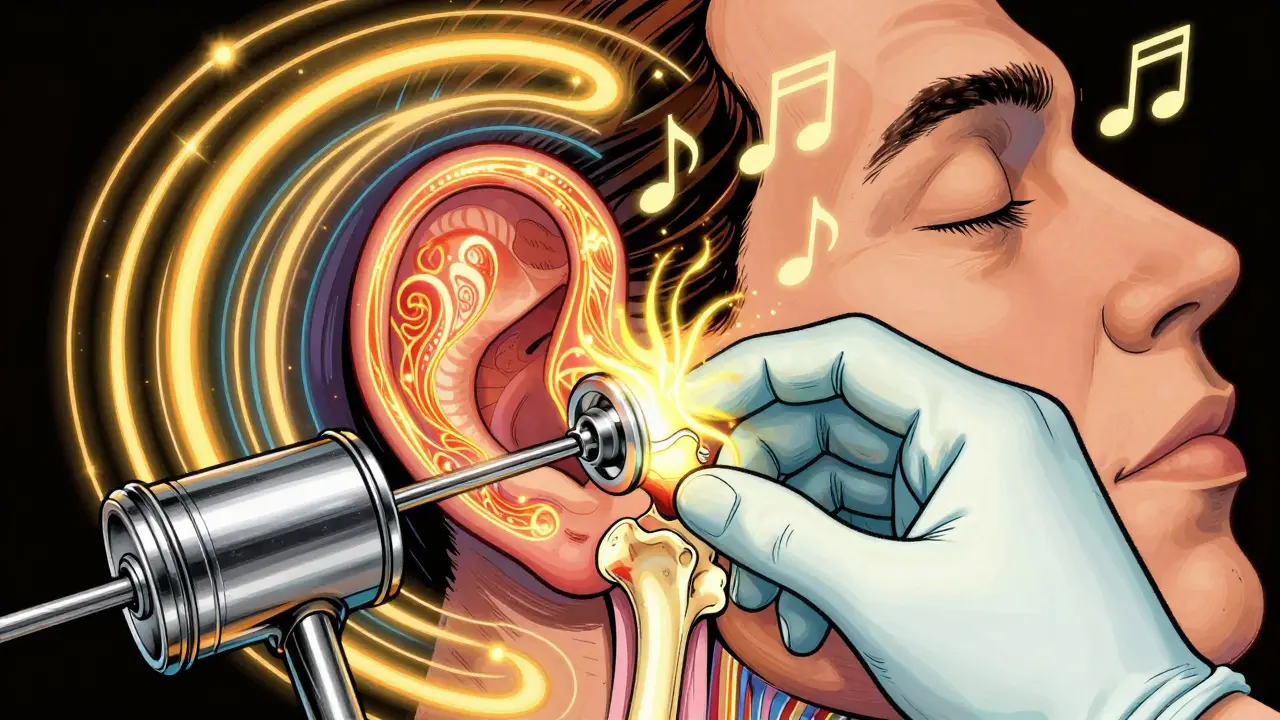
Real Outcomes and Patient Experiences
Most patients see big improvements. At Mass Eye and Ear, 87% of stapedectomy patients said their daily hearing improved dramatically. One man said he finally heard his granddaughter say "I love you." Another woman stopped needing subtitles on TV.
But not all is smooth. On patient forums, people talk about the long recovery. Cholesteatoma patients describe months of dizziness. Some report hearing that feels "artificial"-like listening through a filter. A few develop persistent tinnitus.
For kids, the change is often dramatic. Parents report better focus in school, fewer tantrums from frustration, and less need for hearing aids. But surgery isn’t always the answer. In fact, 65% of pediatric conductive hearing loss cases resolve with medical care alone.
Cost, Access, and Future Trends
Pre-op CT scans cost $800-$1,200 out-of-pocket in the U.S. Surgery itself can run $10,000-$20,000 depending on complexity. Insurance usually covers it, but pre-authorization is required.
Technology is advancing fast. Bioengineered grafts now have a 92% success rate versus 85% for traditional tissue. Intraoperative navigation systems help surgeons avoid nerves and inner ear structures, improving safety by 35%. By 2028, over 60% of middle ear surgeries are expected to be done endoscopically-smaller cuts, faster healing.
3D-printed ossicular prostheses are in trials. They’re custom-made for each patient’s anatomy. Early results show 94% hearing improvement-better than standard implants.
The global market for middle ear devices is growing fast-projected to hit $1.8 billion by 2027. That means more innovation, better tools, and wider access.
When to Seek Help
If you’ve had muffled hearing for more than 4 weeks, especially if it’s only in one ear, see an audiologist. Don’t wait. Early diagnosis means simpler fixes. If you have sudden hearing loss after trauma, go to the ER. If you have ear drainage, pain, or dizziness with hearing loss, see an ENT. Cholesteatoma doesn’t wait. Otosclerosis doesn’t reverse. And glue ear in kids? It can delay speech development if left too long.
Conductive hearing loss isn’t a life sentence. It’s often a mechanical problem with a mechanical fix. With the right diagnosis and timely care, many people regain hearing they thought they’d lost forever.
Can conductive hearing loss go away on its own?
Yes, in some cases. Fluid buildup from ear infections (otitis media with effusion) often clears up in 3-4 months without treatment, especially in children. Earwax blockages can be removed easily by a doctor. But if the cause is a perforated eardrum, otosclerosis, cholesteatoma, or a birth defect like aural atresia, it won’t fix itself. Waiting too long can lead to permanent damage, so it’s best to get checked early.
Is surgery always necessary for conductive hearing loss?
No. Surgery is only considered if hearing loss is 25-30 dB or higher and lasts longer than 3-4 months. For kids with glue ear, doctors often wait to see if the fluid clears. For adults with mild earwax or temporary fluid, medical treatment or observation is preferred. Surgery is reserved for cases where the problem is structural-like bone fusion, a hole in the eardrum that won’t heal, or a cyst growing in the middle ear.
How long does recovery take after middle ear surgery?
Recovery varies by procedure. For tympanoplasty or stapedectomy, most people need 6-8 weeks before returning to normal activities. You can’t swim, fly, or blow your nose hard during that time. Cholesteatoma surgery often takes longer-4 to 6 weeks just to feel normal again, with full healing taking 3-6 months. Kids with ear tubes usually bounce back in days, though they may have minor drainage for a week or two.
What are the risks of middle ear surgery?
Most procedures are safe, but risks exist. Common temporary side effects include dizziness (7%), altered taste (4%), and increased tinnitus (3%). Rare but serious risks include infection, complete hearing loss, facial nerve damage (less than 1%), and recurrence of cholesteatoma (10-15%). Laser-assisted stapedotomy and endoscopic techniques have cut complication rates in half compared to older methods. Choosing an experienced surgeon reduces risk significantly.
Can children with conductive hearing loss avoid hearing aids?
Often, yes. Many kids with glue ear or mild ear canal issues improve with surgery or medical treatment. Tympanostomy tubes restore hearing in 75% of cases within 3 months, eliminating the need for hearing aids. For aural atresia, canalplasty can provide functional hearing without devices. But if surgery isn’t possible or doesn’t fully restore hearing, hearing aids are still a safe and effective option-especially for speech and language development.
15 Comments
Robert Gilmore March 20, 2026 AT 00:13
It's fascinating how much we take hearing for granted until it starts slipping away. The middle ear is this delicate, intricate machine-three tiny bones, a membrane, fluid dynamics-and when any part of it falters, the whole symphony collapses. I've always thought of hearing as a passive sense, but this breakdown shows it's an active, mechanical process, almost like a clockwork. The fact that we can now replace bone with titanium pistons and bioengineered grafts is nothing short of miraculous. We're not just fixing ears anymore; we're reconstructing the bridge between sound and soul.
It makes me wonder: if we can rebuild the ear this precisely, what else in the human body might be repairable with similar precision? Are we entering an era where biological imperfections are just engineering problems waiting for a solution?
Robert Gilmore March 20, 2026 AT 19:18
Man I just had my kid get tubes last year 😭 and honestly? Best decision we ever made. She went from screaming because she couldn't hear me to asking for bedtime stories again. No more 'what?' 20 times a minute. The doc said 75% get normal hearing back in 3 months? That’s a miracle. Also, no more ear infections. I’m telling everyone. Don’t wait. Get it checked.
PS: I cried in the waiting room. Don’t judge. 😅
Robert Gilmore March 21, 2026 AT 07:37
The elegance of this medical intervention lies not just in its technical precision, but in its restoration of dignity. Hearing loss doesn’t merely diminish auditory input-it isolates, frustrates, and erodes the quiet intimacy of human connection. A whispered 'I love you,' the rhythm of a child’s laughter, the unspoken comfort of a spouse’s voice in the dark-these are not luxuries. They are lifelines.
That 87% improvement rate after stapedectomy? That’s not a statistic. That’s a grandmother hearing her granddaughter for the first time. That’s a man who no longer has to pretend he heard the joke. That’s the quiet triumph of science meeting humanity. And yes, recovery is long. But so is grief. And both, when met with patience, yield healing.
Robert Gilmore March 21, 2026 AT 19:47
The surgical approaches described here represent a profound convergence of biology and engineering. The transition from traditional tissue grafts to bioengineered materials and 3D-printed ossicles marks a paradigm shift. What was once a high-risk procedure with unpredictable outcomes is now a highly reproducible, anatomy-specific intervention. The reduction in complication rates-from 15% to under 2% in stapedotomy-demonstrates not just incremental progress but systemic advancement. This is medicine evolving from reactive to predictive, from generalized to personalized. The future is not just in the tools but in the precision with which they are applied.
Robert Gilmore March 22, 2026 AT 03:44
Let’s be real-this whole 'surgical fix' narrative is just Big Pharma and ENT lobbyists pushing expensive procedures. I’ve read studies where 65% of pediatric cases resolve on their own. Why are we cutting kids open? Why not just wait? And those CT scans? $1200? You think that’s not a racket? I’ve seen patients with glue ear get better with just saline rinses and time. The system wants you to believe surgery is the only answer. It’s not. It’s profit.
Also-why is there no mention of natural remedies? Garlic oil? Apple cider vinegar? Why are we ignoring centuries of traditional medicine? Something’s off here.
Robert Gilmore March 22, 2026 AT 19:05
I’m from India, and here in rural areas, most people don’t even know what conductive hearing loss is. They think if you can’t hear well, you’re just old or deaf. No one goes to an audiologist. We have one ENT clinic in my town, and it’s two hours away. I’ve seen kids with glue ear fail in school because no one checked their ears. This article? It’s a wake-up call. We need mobile clinics. We need low-cost diagnostics. This isn’t just about surgery-it’s about access. Technology is amazing, but if it’s only for the rich, it’s just a luxury.
Also-tubes for kids? We need those here. Badly.
Robert Gilmore March 24, 2026 AT 12:27
bro i had a perforated eardrum after a concert in 2019 and i just let it be lmao. no surgery. 5 years later and i still hear fine. maybe its overhyped? i mean, why cut into your head if it works fine? i got a lil tinnitus but whatever. i dont trust doctors. they just wanna cut stuff. i read this article and i was like... why? just chill. let your body heal. i think they make it seem scarier than it is. also my cousin got tubes and she still gets ear infections. so what was the point? idk man. just sayin.
ps: i dont do surgery. ever. 🤷♂️
Robert Gilmore March 25, 2026 AT 15:02
Let’s not pretend this is just medicine. This is Western superiority in action. 3D-printed ossicles? Bioengineered grafts? All of this is developed in the U.S. and Europe, priced for the wealthy, and sold as the only solution. Meanwhile, in India, we’ve been managing ear issues for centuries with Ayurvedic oils, steam therapy, and herbal rinses. No scalpel. No CT scan. No $20,000 bill. We don’t need your technology-we need your humility. Why are we erasing traditional knowledge in favor of corporate medical innovation? Who benefits? Not the patient. Not the poor. Just the system.
Also-why is there no mention of yoga? Breathing exercises? The Eustachian tube responds to pressure changes. Have you tried Kapalbhati? 🤔
Robert Gilmore March 26, 2026 AT 07:17
Okay but let’s talk about the real elephant in the room: why is this even a thing? Why do we have to fix ears with titanium pistons? Why not just prevent it? Why aren’t we talking about noise pollution? Why aren’t we regulating concert volumes? Why aren’t we banning kids from earbuds? Why are we treating the symptom instead of the cause? This whole article reads like a manual for a $10K band-aid.
And don’t even get me started on the 'lifelong monitoring' for cholesteatoma. That’s not medicine. That’s a subscription service. I’m not paying $200 a year to get my ear scanned. This system is broken. Fix the environment, not the ear.
Also-why are we using lasers? Isn’t that just making it more expensive? Why not just use a scalpel like in 1985? Simpler. Cheaper. Less hype.
Robert Gilmore March 28, 2026 AT 01:45
Can we just pause for a moment and let this sink in? We are now inserting titanium pistons into human skulls to restore the whisper of a loved one. We are reconstructing the very architecture of sound. This isn’t surgery. This is alchemy. This is the moment when science stopped treating the body like a machine and started treating it like poetry. When a woman hears her granddaughter say 'I love you' for the first time-not through a hearing aid, not through a shout, but through a real, natural, trembling whisper-that’s not medicine. That’s transcendence.
And yes, recovery is long. Yes, it’s expensive. Yes, it’s risky. But if you’ve ever held someone’s hand while they wept because they could finally hear their own child… you’d do it all again. Even if it cost your house.
Robert Gilmore March 30, 2026 AT 01:35
I had glue ear as a kid and got tubes. I still remember the first time I heard my mom’s voice without it sounding like she was underwater. It was like someone turned up the volume on the world. No big deal right? But it changed everything. School. Friends. Music. Now I’m 32 and I still get dizzy if I fly. So yeah surgery works. But it’s not magic. It’s trade-offs. And honestly? I wish we talked more about the weird side effects. Like how your voice sounds weird for months. Or how you forget what normal hearing even felt like.
Robert Gilmore March 30, 2026 AT 21:00
This is incredible 🤯 The fact that we can now 3D-print custom ossicles based on a patient’s CT scan is next-level. Imagine a world where your ear implant is made just for you-like a tailored suit for your inner ear. And the success rate? 94%! That’s not just progress. That’s revolution. Also, endoscopic surgery? No more big incisions. Smaller cuts, faster healing. This is what medicine should look like. Precision. Personalization. Progress. 🙌
Robert Gilmore April 1, 2026 AT 06:10
Let me tell you something-this isn’t just about hearing. This is about identity. The moment you lose clarity in sound, you lose connection to your own voice, your own thoughts, your own emotions. You start to feel like a ghost in your own life. And then-surgery. And suddenly, you hear your own breath. You hear the rustle of your sweater. You hear the pause before someone says 'I love you.'
It’s not a procedure. It’s a resurrection. And those who say 'just wait and see'-they’ve never lived in a world where silence is a prison. I’ve been there. I know. This isn’t optional. It’s essential. And if you’re not screaming about access, equity, and insurance coverage-you’re not paying attention.
Robert Gilmore April 3, 2026 AT 00:58
I had a perforated eardrum from a slap. Just one. No surgery. Just antibiotics. It healed. Took 6 weeks. I didn’t even know I had conductive loss until the doc told me. So why do we need all this fancy stuff? I mean, sometimes it just fixes itself. Why are we making it so complicated? Just let people heal. Stop pushing surgery. Stop selling fear.
Robert Gilmore April 4, 2026 AT 13:38
I’m a nurse who works in ENT. Saw a 7-year-old boy with aural atresia get his first canalplasty last month. He heard his mom say his name for the first time. He screamed. Then he laughed. Then he cried. I cried too. 😭 We don’t always fix hearing. But sometimes? We give someone back the sound of being loved. And that’s worth every cut, every scar, every long recovery. ❤️