People take St. John’s Wort for mild to moderate depression because it works-without the nausea, weight gain, or sexual side effects that often come with prescription antidepressants. But here’s the catch: it doesn’t just affect your mood. It can wreck the effectiveness of medications you’re already taking. And you might not even know it until it’s too late.
How St. John’s Wort Changes How Your Body Handles Medications
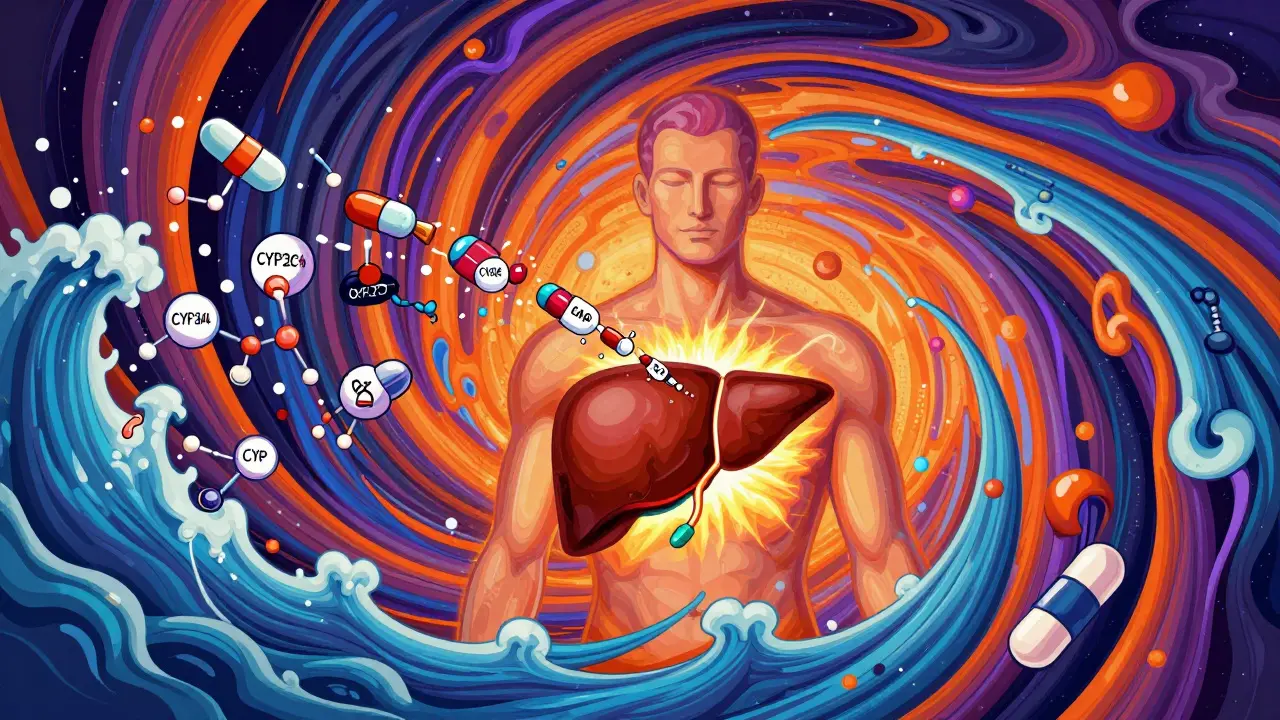
St. John’s Wort doesn’t just float through your system. It actively rewires how your body processes drugs. The key player is hyperforin, a compound in the plant that turns on a switch in your liver called the pregnane-X-receptor (PXR). When this switch flips, your liver starts producing more of certain enzymes-mainly CYP3A4, CYP2C9, and CYP1A2-and pumps out more of a protein called P-glycoprotein. These are the same tools your body uses to break down and get rid of prescription drugs.
Think of it like this: your medications are passengers on a train. St. John’s Wort doesn’t block the train-it speeds up the engine. The drugs get processed and flushed out of your body way faster than they should. That means they never reach the level needed to work properly.
The effects aren’t instant. It takes about 10 days of daily use for St. John’s Wort to fully kick in. And even after you stop taking it, the enzyme boost can stick around for two weeks. So if you quit St. John’s Wort and then start a new medication, you might still be at risk.
Medications That Can Fail Because of St. John’s Wort
There are over 50 documented drug interactions with St. John’s Wort. Some are minor. Others are deadly. Here are the big ones:
- Immunosuppressants like cyclosporine, tacrolimus, and sirolimus: These keep your body from rejecting a transplanted organ. St. John’s Wort can drop their levels by 30-70%. There are real cases of kidney and heart transplant patients rejecting their new organs after starting this herb.
- HIV medications like protease inhibitors and non-nucleoside reverse transcriptase inhibitors: If these drugs don’t stay at effective levels, the virus can bounce back-and become resistant to treatment.
- Birth control pills: At least 17 documented cases of unintended pregnancy have been linked to St. John’s Wort. The herb reduces estrogen levels enough to make the pill ineffective, even if you take it perfectly.
- Anticoagulants like warfarin: One patient’s INR (a measure of blood thinning) dropped from 2.5 to 1.4 in just 10 days. That’s the difference between safe protection and a stroke or internal bleeding.
- Antidepressants like SSRIs and SNRIs: Mixing St. John’s Wort with these can cause serotonin syndrome-a dangerous spike in serotonin that leads to high fever, seizures, irregular heartbeat, and even death.
- Painkillers like oxycodone, methadone, and tramadol: These rely on CYP3A4 to activate. St. John’s Wort speeds up their breakdown, leaving you in pain despite taking your dose.
The European Medicines Agency says St. John’s Wort shouldn’t be used with any drug that has a narrow therapeutic index-that means the difference between a helpful dose and a toxic one is tiny. These are the drugs you can’t afford to mess with.
Why So Many People Don’t Realize the Risk
Most people don’t think of St. John’s Wort as a drug. It’s sold in health food stores, labeled as a “natural supplement,” and often marketed as “safe.” But the FDA doesn’t require pre-market approval for herbal products like it does for prescription pills. That means companies don’t have to prove safety or interaction risks before selling it.
Labels vary wildly. In the EU, products must list specific warnings for 12 types of medications. In the U.S., you might find a tiny disclaimer buried in fine print-or nothing at all. A 2023 FDA update specifically called St. John’s Wort a “high-risk supplement for drug interactions,” but many consumers still don’t know.
And doctors? They often don’t ask. A 2017 study found that only 38% of patients taking herbal supplements told their physician. People assume it’s harmless. Or they’re embarrassed. Or they don’t think it matters. But when a patient’s transplant rejection or unplanned pregnancy happens, the link to St. John’s Wort becomes painfully clear.
What Happens When You Combine It With Other Supplements
St. John’s Wort isn’t the only herbal mood booster out there. SAM-e and 5-HTP are popular alternatives. But here’s the difference: SAM-e has maybe two or three known interactions-mostly with MAO inhibitors. 5-HTP has a few with SSRIs. St. John’s Wort? It has over 50 major interactions. It’s the most dangerous herbal supplement when it comes to drug mixing.
Even mixing it with other herbs can be risky. For example, combining it with ginkgo biloba might increase bleeding risk. Taking it with melatonin could worsen drowsiness. There’s no safety net here. Every addition stacks the risk.
Who Should Avoid It Completely
If you’re taking any of these, don’t touch St. John’s Wort:
- Anyone who’s had an organ transplant
- People on HIV or hepatitis C treatment
- Women using hormonal birth control
- Patients on blood thinners like warfarin
- Anyone taking antidepressants, anti-anxiety meds, or painkillers like tramadol
- People with a history of serotonin syndrome
Even if you’re healthy and not on meds, you should still talk to a pharmacist before starting. Many people don’t realize they’re on a medication that interacts until they’re already taking the herb. And once you start, stopping isn’t easy-because you might need to wait two weeks before your other drugs start working again.
What to Do Instead
If you want to treat mild depression without risking drug interactions, there are safer options:
- SAM-e: Works for some people with fewer interactions. Dose is usually 400-800 mg daily.
- 5-HTP: May help with mood and sleep. Start low-50 mg daily-and watch for nausea.
- Cognitive behavioral therapy (CBT): Proven to be as effective as antidepressants for mild depression. Many online programs are affordable.
- Exercise: Just 30 minutes of walking five days a week can boost serotonin and reduce depressive symptoms.
- Prescription alternatives: If you need medication, ask your doctor about SSRIs with lower interaction risk, like escitalopram or sertraline.
And if you’re already taking St. John’s Wort? Don’t quit cold turkey. Talk to your pharmacist or doctor. They can help you taper off safely and monitor your other medications.
How to Stay Safe
Here’s a simple checklist if you’re considering or already using St. John’s Wort:
- Make a full list of every medication and supplement you take-including vitamins, OTC painkillers, and herbal teas.
- Take it to your pharmacist. They’re trained to spot interactions. Most will check for free.
- If you’re on a critical medication (transplant, HIV, birth control, blood thinners), don’t use St. John’s Wort. Period.
- If you’re not on anything risky, monitor yourself for changes: Did your anxiety get worse? Did your pain return? Did your period come early? These could be signs your meds aren’t working.
- Always tell your doctor if you start or stop any supplement-even if you think it’s “just herbal.”
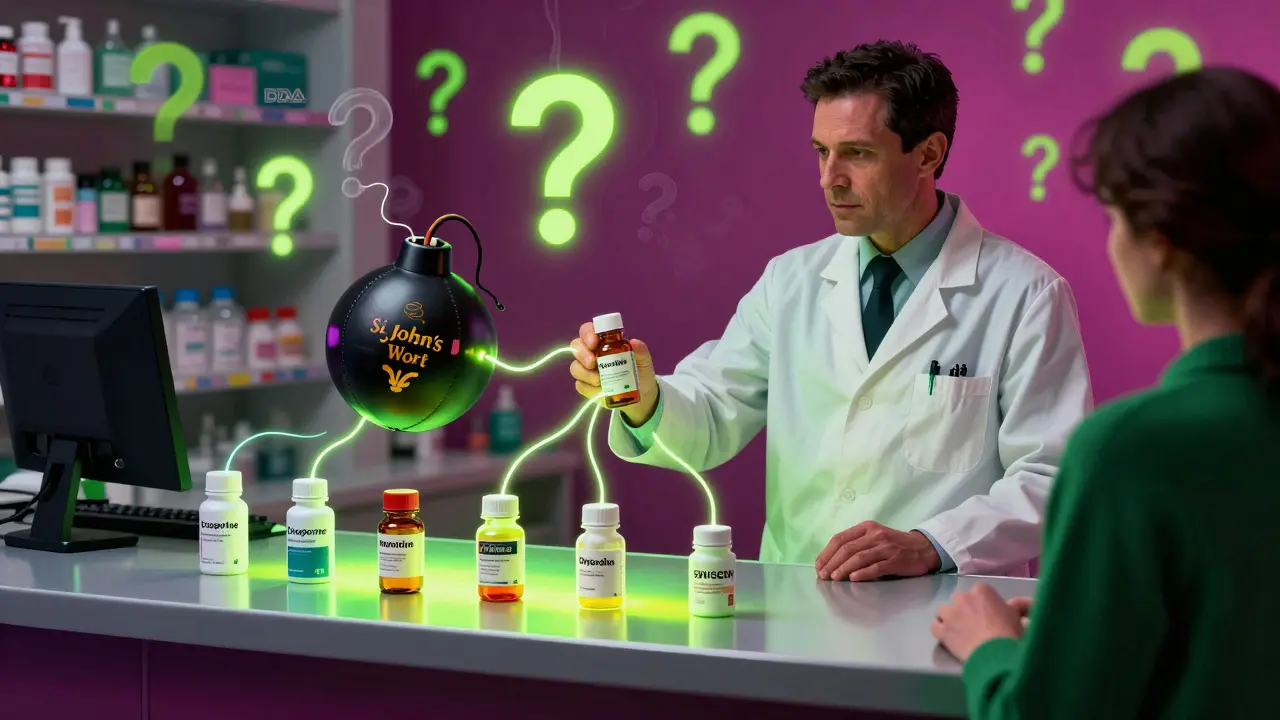
St. John’s Wort isn’t evil. It helped people before modern medicine existed. But today, with the complexity of our drug regimens, it’s a ticking time bomb. The same herb that lifts your mood could be silently undermining your life-saving treatment.
Can I take St. John’s Wort if I’m not on any medications?
If you’re not taking any prescription drugs, vitamins, or other supplements, St. John’s Wort is generally safe for short-term use to treat mild depression. But even then, watch for side effects like dry mouth, dizziness, or increased sun sensitivity. And remember: you might start a new medication later-so always keep your doctor and pharmacist informed about everything you take.
How long does it take for St. John’s Wort to affect other drugs?
The enzyme-inducing effects start building after about 5-7 days of daily use. Peak effect happens around day 10. Even after you stop taking it, the impact can last up to two weeks. That’s why timing matters-if you stop the herb and start a new drug too soon, it might not work right.
Are there any St. John’s Wort products that don’t interact with drugs?
Researchers are testing low-hyperforin versions of St. John’s Wort that reduce enzyme induction by up to 90%. These aren’t widely available yet, and they’re not labeled as “safe.” Until they’re proven and regulated, assume all St. John’s Wort products carry the same risks.
Why is St. John’s Wort still sold if it’s so dangerous?
In the U.S., herbal supplements aren’t regulated like drugs. Companies don’t need FDA approval to sell them, only to follow basic safety rules. As long as they don’t claim to cure diseases, they can market St. John’s Wort as a “mood support” supplement. The burden of safety falls on the consumer-and that’s why awareness is so low.
What should I do if I think St. John’s Wort is affecting my medication?
Stop taking it immediately and contact your doctor or pharmacist. If you’re on a life-saving drug like cyclosporine or warfarin, don’t wait. Go to urgent care. Symptoms like sudden pain, swelling, unusual bleeding, mood changes, or worsening depression could mean your medication levels have dropped dangerously low.
9 Comments
Robert Gilmore January 15, 2026 AT 18:42
St. John’s Wort? Please. People think natural means safe, but that’s just ignorance wrapped in yoga pants. You wouldn’t take raw foxglove for heart problems, so why this? It’s not a supplement-it’s a silent saboteur. Your doctor didn’t warn you? That’s their job. You didn’t ask? That’s your fault. End of story.
Robert Gilmore January 16, 2026 AT 09:44
Actually, the enzyme induction mechanism is more nuanced than just CYP3A4. Hyperforin also upregulates PXR, which in turn activates not only CYP3A4 but also UGT1A1 and MDR1. The half-life extension for drugs like cyclosporine is well-documented in clinical pharmacokinetic studies-this isn’t anecdotal. And yes, the two-week washout period is critical. Most people don’t realize that even after stopping, their liver’s still in overdrive.
Robert Gilmore January 17, 2026 AT 17:08
Big Pharma hates this because it’s cheap and works. They don’t want you to know that a $10 herb can replace their $200/month antidepressant. But they also don’t want you to know it kills transplant patients. So they bury the warnings. The FDA? Bought and paid for. The real danger? They’re letting you think you’re safe because it’s ‘natural.’ It’s a trap. Wake up.
Robert Gilmore January 17, 2026 AT 20:22
I had a friend who took this for anxiety and ended up in the ER because her blood thinner stopped working. She didn’t even think to tell her doctor because she ‘didn’t think it counted.’ I’m so glad this post exists. Please, if you’re taking anything-even vitamins-talk to your pharmacist. They’re the real heroes. No judgment. Just safety.
Robert Gilmore January 18, 2026 AT 07:01
For anyone thinking of trying this for mild depression-please, start with walking. Just 20 minutes outside every day. Sunlight + movement = natural serotonin boost. No interactions. No risk. And if you still feel stuck after a month? Then talk to a therapist. CBT is cheaper than this herb and actually works long-term. You’ve got this.
Robert Gilmore January 19, 2026 AT 01:47
In India, we’ve used St. John’s Wort for generations-called ‘hypericum’ in Ayurveda, sometimes mixed with ashwagandha for mood. But we also knew: never with allopathic meds. Our grandmas didn’t need FDA warnings-they knew respect for power. This isn’t about ‘natural vs synthetic.’ It’s about ignorance masquerading as empowerment. Knowledge is the real supplement.
Robert Gilmore January 20, 2026 AT 01:16
Let me be clear. If you’re on birth control and taking this herb you’re not just risking pregnancy-you’re risking your future. This isn’t a lifestyle choice. It’s negligence. And if you think your doctor should’ve known you’re taking it-no. It’s your responsibility. Period. Stop blaming the system. Start taking charge of your health.
Robert Gilmore January 21, 2026 AT 07:43
I took this for a month last year. Felt better. Then I got sick and started antibiotics. My anxiety came back worse than ever. Turns out the antibiotic didn’t work right because my liver was still processing everything too fast. I didn’t know. Now I tell everyone. Just… ask your pharmacist. They’ll thank you.
Robert Gilmore January 23, 2026 AT 06:15
Wow. So we’re supposed to trust a system that lets a $5 herb with 50+ deadly interactions be sold next to energy bars? Meanwhile, a $500 prescription needs 17 forms and a blood test? Yeah. I’m not surprised people die. The real question is: who profits from your ignorance? And why do we still let them?