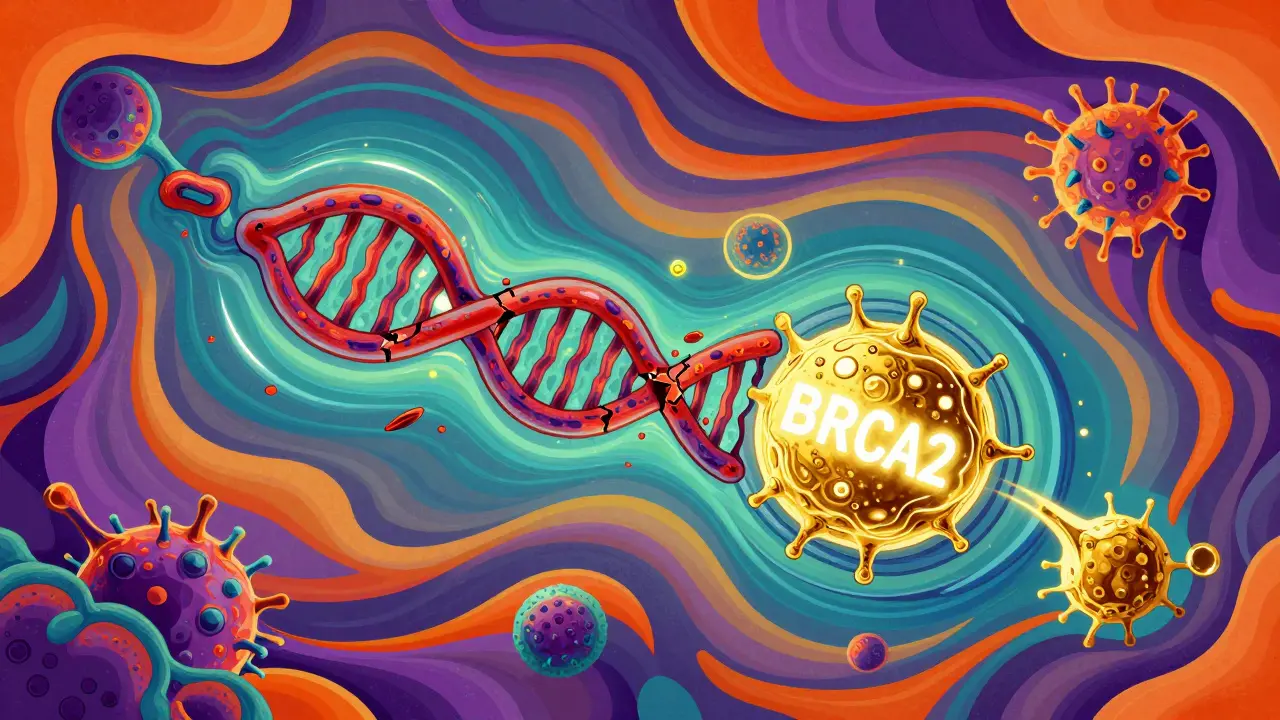
When you hear the word genetic testing, you might think of ancestry kits or fun DNA selfies. But for people with a family history of cancer, it’s something far more serious-and potentially life-saving. Genetic testing for cancer risk isn’t about predicting the future. It’s about giving you power over it. If you carry a mutation in BRCA1, BRCA2, or one of the Lynch syndrome genes, your risk for certain cancers isn’t just slightly higher-it’s dramatically higher. And knowing that changes everything.
What BRCA Mutations Really Mean
BRCA1 and BRCA2 aren’t just genes. They’re tumor suppressors. When they work normally, they help fix broken DNA. When they’re broken, cells start to grow out of control. A harmful mutation in either gene can send your lifetime risk for breast cancer soaring from the average 13% to as high as 65%. Ovarian cancer risk jumps from under 2% to nearly 40% with BRCA1. These aren’t theoretical numbers. They come from tracking over 12,000 people in long-term studies published in JAMA Oncology.What’s often misunderstood is that BRCA mutations don’t guarantee cancer. They just make it far more likely. That’s why testing matters. A woman who finds out she carries a BRCA1 mutation can choose to have her breasts and ovaries removed before cancer ever develops. Studies show this cuts her risk of dying from breast or ovarian cancer by up to 80%. That’s not a small win. That’s a near-total prevention.
Men aren’t off the hook either. BRCA2 mutations raise prostate cancer risk significantly-and not just any prostate cancer. These tend to be more aggressive, diagnosed younger, and harder to treat. Men with BRCA mutations also have a higher chance of male breast cancer, which is rare but deadly if missed.
Lynch Syndrome: The Silent Threat in the Colon
While BRCA gets the spotlight, Lynch syndrome is the quiet giant of hereditary cancer. It’s caused by mutations in MLH1, MSH2, MSH6, PMS2, or EPCAM genes. These genes clean up DNA copying errors. When they fail, mutations pile up fast-especially in the colon.Someone with Lynch syndrome has a 10% to 80% lifetime risk of colorectal cancer, depending on which gene is mutated. That’s far higher than the 4% risk in the general population. But here’s the kicker: colon cancer from Lynch doesn’t just happen faster. It happens younger. People are often diagnosed in their 30s or 40s, sometimes even in their 20s.
And it doesn’t stop at the colon. Lynch syndrome also raises the risk of endometrial, ovarian, stomach, small bowel, pancreatic, urinary tract, and even brain cancers. That’s why screening isn’t just about colonoscopies every few years. People with Lynch need annual endometrial biopsies, urine tests, and sometimes even upper endoscopies. Catching a precancerous polyp early can prevent cancer entirely.
There’s another layer: immunotherapy. People with Lynch-related cancers often respond incredibly well to drugs like pembrolizumab. One 2025 case study from Fred Hutchinson Cancer Center showed a 42-year-old with stage III colon cancer went into complete remission after just six months of treatment-because their tumor had the telltale signs of Lynch syndrome. That wouldn’t have been possible without genetic testing.
Testing Beyond BRCA and Lynch
For years, doctors tested one gene at a time. If you had a strong family history of breast cancer, you got BRCA tested. If you had colon cancer in multiple relatives, you got Lynch tested. That’s outdated now.Today, multigene panel testing is the standard. A single blood or saliva sample can check 30 to 80+ genes linked to cancer risk. This includes genes like PALB2, ATM, CHEK2, and RAD51C-each tied to different cancer patterns. The 2025 NCCN guidelines upgraded PALB2 and ATM to tier 1 status because the evidence is now solid: these mutations carry real risk.
Why does this matter? Because 30% to 50% of people with hereditary cancer syndromes don’t have BRCA or Lynch mutations. They have something else. If you only test for BRCA, you miss them. A 2023 study of nearly 40,000 people found that multigene panels found actionable mutations in one out of every six people who tested negative for BRCA alone.
But there’s a trade-off. The more genes you test, the more likely you are to get a result you can’t interpret: a variant of uncertain significance, or VUS. This used to be a huge problem. About 1 in 8 people got a VUS result. Now, thanks to breakthroughs like the 2025 Mayo Clinic study using CRISPR to analyze nearly 7,000 BRCA2 variants, that number has dropped to just 1.1% for the most critical part of the gene. That’s a game-changer. VUS results are still possible, but they’re becoming rarer-and more understandable.

What the Tests Actually Show
Not all genetic tests are created equal. There’s a big difference between what you get from a doctor and what you get from a 23andMe kit.23andMe’s FDA-authorized test checks for only three specific BRCA mutations-ones common in people of Ashkenazi Jewish descent. That’s it. It misses over 97% of harmful BRCA variants in everyone else. It’s like checking only one lock on a house with ten doors. You might feel safe, but you’re not.
Medical-grade testing, on the other hand, uses next-generation sequencing to scan the entire sequence of multiple genes. It looks for tiny changes, large deletions, and complex rearrangements. Accuracy is over 99.5%. These tests are ordered by a doctor, interpreted by a certified genetic counselor, and backed by clinical guidelines.
Costs vary. Medicare and most private insurers cover testing if you meet NCCN criteria-like having breast cancer before 45, ovarian cancer at any age, or multiple relatives with related cancers. Out-of-pocket costs can range from $250 to $500 if you’re uninsured or your insurance denies coverage. Some labs offer payment plans. Others will retest for free if new evidence changes a VUS result.
Who Should Get Tested?
You don’t need to have cancer to qualify. You just need a pattern.- Diagnosed with breast cancer before age 50
- Have triple-negative breast cancer before 60
- Have ovarian, fallopian tube, or primary peritoneal cancer at any age
- Have colorectal or endometrial cancer before 50
- Have two or more close relatives with breast, ovarian, pancreatic, or prostate cancer
- Have Ashkenazi Jewish ancestry and a family history of breast, ovarian, or pancreatic cancer
- Have a known mutation in your family
Even if you’re healthy, if your parent or sibling has a known mutation, you should get tested. That’s called cascade testing. It’s one of the most effective public health tools we have. One person’s test can protect an entire family.
The Real Challenges
Testing isn’t magic. It comes with real emotional and practical hurdles.One major issue is insurance. GINA, the federal law that prevents health insurers from discriminating based on genetic data, doesn’t cover life, disability, or long-term care insurance. Some people have been denied life insurance after testing positive-even though they’ve never had cancer.
Then there’s the psychological weight. A VUS result can cause months of anxiety. A positive result can trigger guilt: “Did I pass this on to my kids?” A negative result can bring false reassurance-especially if the family’s mutation hasn’t been identified yet.
And access isn’t equal. In academic cancer centers, over 48% of eligible patients get tested. In community clinics, it’s under 22%. Black patients are tested at less than half the rate of white patients. This isn’t just a gap in care. It’s a gap in survival.
What Happens After the Results
Testing doesn’t end with a report. It starts there.If you test positive:
- For BRCA: Start annual breast MRIs and mammograms at 25. Consider risk-reducing mastectomy and/or removal of ovaries by 35-40. Talk to your doctor about PARP inhibitors if you’re diagnosed with cancer.
- For Lynch: Get a colonoscopy every 1-2 years starting at 20-25. Take aspirin daily (under medical supervision-it lowers colorectal cancer risk by 60%). Women should consider hysterectomy and ovary removal after childbearing.
- For other genes: Guidelines vary. Your genetic counselor will map out a plan based on your specific mutation and family history.
If you test negative:
- If a mutation was found in your family, a true negative means your risk is back to population level. That’s a relief.
- If no mutation was found in your family, a negative result doesn’t rule out hereditary risk. You might have a gene we haven’t identified yet. Keep screening based on your family history.
And if you get a VUS? Don’t panic. Don’t make drastic decisions. Most VUS are reclassified as benign within a few years. Stay in touch with your counselor. Your result might change.
The Future Is Here
The next wave isn’t just about finding more genes. It’s about understanding how they interact.Researchers at Stanford have identified 380 gene variants that control how cancer-related genes turn on and off. These aren’t mutations that break genes-they’re switches that turn risk up or down. In the next decade, we’ll start combining these with traditional gene testing to create polygenic risk scores. Imagine knowing your risk isn’t just “high” or “low,” but “62% over your lifetime.” That’s precision.
And the goal? Universal testing for everyone diagnosed with cancer. By 2025, two-thirds of oncologists support this. Why? Because if you have cancer, your genes might tell your doctor what drug will work best. They might tell your kids if they’re at risk. They might save lives beyond your own.
Genetic testing for cancer risk isn’t about fear. It’s about clarity. It’s about turning uncertainty into action. And in medicine, that’s the most powerful thing of all.
Who should consider genetic testing for cancer risk?
Anyone with a personal or family history suggesting hereditary cancer should consider testing. This includes people diagnosed with breast cancer before 50, ovarian cancer at any age, colorectal cancer before 50, multiple relatives with related cancers, or those with Ashkenazi Jewish ancestry and a family history of breast, ovarian, or pancreatic cancer. Even healthy individuals with a known mutation in the family should be tested.
Can I get tested without seeing a doctor?
You can buy direct-to-consumer tests like 23andMe, but they’re extremely limited. They only check for three specific BRCA mutations common in Ashkenazi Jewish populations and miss over 97% of harmful variants in others. Medical-grade testing requires a doctor’s order and genetic counseling to interpret results properly. DIY tests can give false reassurance and miss critical risks.
What’s a variant of uncertain significance (VUS), and should I worry?
A VUS means a genetic change was found, but scientists don’t yet know if it increases cancer risk. It’s not a positive or negative result-it’s unknown. In the past, 7-12% of people got a VUS. Thanks to new research, that number is dropping, especially for BRCA genes. Don’t make medical decisions based on a VUS. Stay in contact with your genetic counselor; many VUS are reclassified as benign over time.
Does insurance cover genetic testing?
Yes, if you meet NCCN clinical criteria. Medicare covers testing with a 98.7% approval rate for eligible patients. Most private insurers follow the same guidelines. If you’re uninsured, some labs offer self-pay pricing between $250-$500. Many also provide financial aid or payment plans. Always confirm coverage before testing.
Can genetic testing affect my ability to get health insurance?
No. The Genetic Information Nondiscrimination Act (GINA) prohibits health insurers and employers from using genetic test results to deny coverage or employment. However, GINA doesn’t cover life, disability, or long-term care insurance. Some people have been denied those types of insurance after testing positive. Always discuss potential implications with your genetic counselor before testing.
If I test negative, does that mean I won’t get cancer?
No. A negative result means you don’t carry a known hereditary mutation in the genes tested. But cancer can still happen due to lifestyle, environment, or undiscovered genes. If a mutation was found in your family and you test negative, your risk returns to average. If no mutation was found in your family, your risk is still based on your personal and family history-so continue recommended screenings.
9 Comments
Robert Gilmore December 28, 2025 AT 12:57
this is why canada needs to stop outsourcing our genetic data to usa labs. my cousin got a vus result and the lab took 18 months to reclassify it. meanwhile she had a double mastectomy because she was scared. we have the tech here. why are we paying for american overpricing?
Robert Gilmore December 29, 2025 AT 18:18
Thank you for this comprehensive overview. It is imperative that we approach genetic testing with both scientific rigor and compassionate support. The psychological burden of uncertain results cannot be overstated. I urge all healthcare providers to ensure that genetic counseling is not an afterthought, but a cornerstone of the process. 🙏
Robert Gilmore December 31, 2025 AT 01:55
Let’s be real. This whole ‘prevention through surgery’ thing is just corporate medicine’s way of selling more procedures. You test positive, you get scared, you get cut. Meanwhile, the real issue is environmental toxins, processed food, and sedentary lifestyles. But hey, let’s just slice people open instead of fixing the system.
Robert Gilmore January 1, 2026 AT 00:50
brca testing is just a money grab. i know 3 people who got positive results and never got cancer. meanwhile my uncle smoked 2 packs a day for 50 years and lived to 87. genetics is a scam.
Robert Gilmore January 1, 2026 AT 23:00
So you’re telling me I can avoid cancer by cutting off my boobs and ovaries? Cool. Next you’ll tell me to stop breathing to avoid lung cancer. 😅
Robert Gilmore January 3, 2026 AT 16:14
i got tested after my mom got ovarian cancer. got a vus on brca2. spent 6 months crying then googling. finally my counselor said 'it probably means nothing' and i cried again but this time from relief. pls if you get a vus just breathe. it's not a death sentence.
Robert Gilmore January 5, 2026 AT 08:13
The profound ethical failure of this system lies in its commodification of human biology. We reduce existential vulnerability to a binary result-positive or negative-while ignoring the ontological weight of genetic determinism. A VUS is not merely a statistical anomaly; it is a metaphysical limbo imposed by a medical-industrial complex that prioritizes scalability over soul. The fact that we permit such ambiguity to dictate life-altering decisions is not progress-it is hubris dressed in lab coats.
Robert Gilmore January 5, 2026 AT 11:22
in india we dont even have access to basic cancer screening why are we talking about multigene panels. my sister died at 32 from breast cancer no test no hope no money. this article is for rich countries only
Robert Gilmore January 6, 2026 AT 00:11
I’m so glad someone finally wrote this. My mom tested positive for Lynch and now our whole family gets colonoscopies every year. We caught a polyp in my cousin at 24. He’s fine now. Genetic testing isn’t fear-it’s family. ❤️