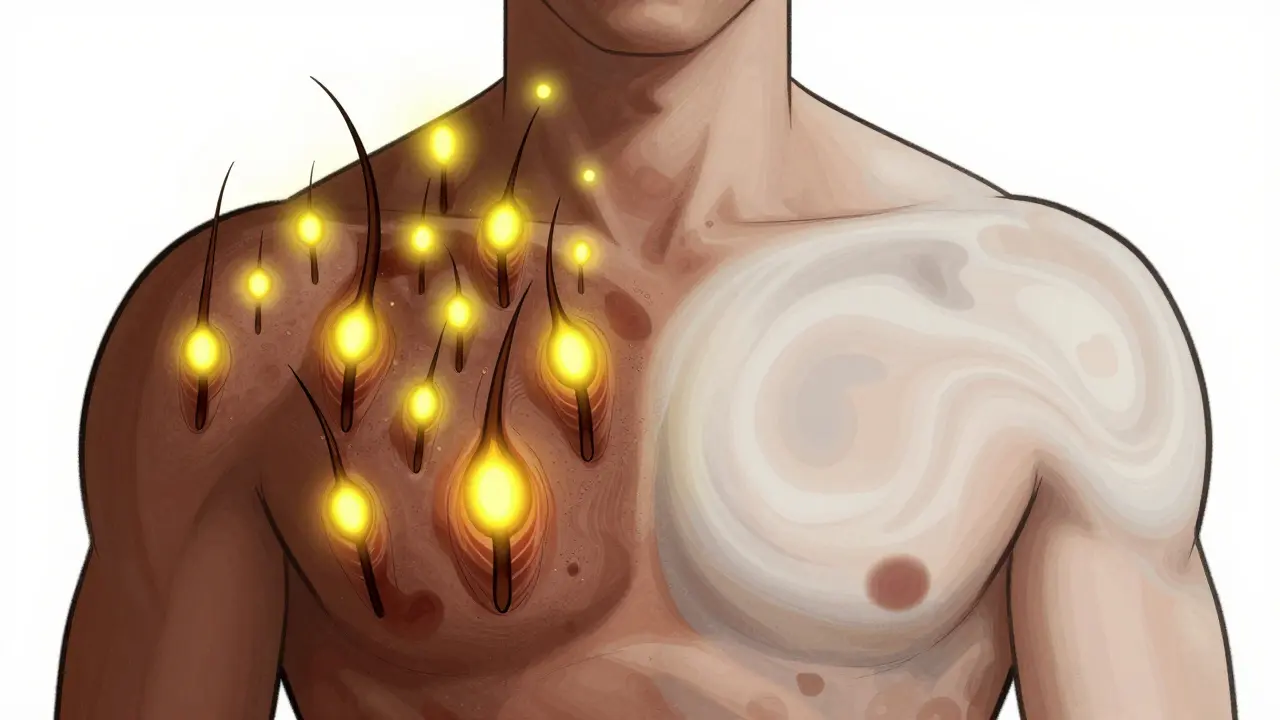
Many people assume that if vitiligo causes white patches on the skin, then the goal is to remove all pigment to match those areas. But that’s not how it works. Phototherapy and depigmentation are two completely different strategies - one rebuilds color, the other removes it. They’re never used together. Mixing them would be like trying to fill a leaky bucket while also drilling holes in it.
What Vitiligo Really Is
Vitiligo isn’t just a cosmetic issue. It’s an autoimmune condition where the body’s own immune system attacks and destroys melanocytes - the cells that make skin pigment. About 0.25% to 2.5% of people worldwide have it, with higher rates in places like India. It can show up at any age, but often starts before 20. The patches appear where pigment is lost, usually on the face, hands, arms, feet, or around body openings. Some people get it in patches; others see it spread across large areas.Phototherapy: The Gold Standard for Repigmentation
If you have vitiligo covering less than 80% of your body, the first-line treatment is almost always phototherapy. This isn’t tanning. It’s precise, controlled exposure to specific wavelengths of ultraviolet light that wake up dormant melanocytes hiding in your hair follicles. The most common type is narrowband ultraviolet B (NB-UVB), which uses light at 311-313 nanometers. It’s safer than older methods, doesn’t require chemicals, and works for most body areas. You typically get treated 2-3 times a week. Each session lasts from seconds to a few minutes, depending on your skin type and how much light your skin can handle. Studies show that after 6 months of consistent NB-UVB treatment, about 37% of people see at least half their pigment return. After a full year, that number jumps to over 56%. On the face and neck, results are even better - up to 80% of patients get strong repigmentation. But hands and feet? Those are tough. Even after a year, only 15-20% see noticeable color return. That’s why many people with vitiligo on their fingers give up - the progress is too slow.Why Depigmentation Is a Separate Path
Depigmentation is not a treatment for early-stage vitiligo. It’s a last-resort option for people who have lost pigment on more than 80% of their body. If you’re mostly white already, and the remaining patches of normal skin are causing you distress, your dermatologist might suggest removing the last bits of color to make your skin look even. This is done with a topical cream called monobenzone. It permanently destroys melanocytes in pigmented areas. It’s not reversible. You’ll need to use it daily for months. Your skin becomes permanently lighter, and you’ll need lifelong sun protection because your skin loses its natural defense against UV damage. The key point: you don’t do phototherapy and depigmentation at the same time. One tries to bring color back. The other tries to take it away. They’re opposites.Other Phototherapy Options
There are two other types of light therapy, but they’re used less often. PUVA combines a plant-derived chemical called psoralen (taken orally or applied to the skin) with UVA light. It’s effective, but it comes with side effects - nausea in up to 30% of users, and a higher risk of skin cancer over time. Studies show PUVA carries a 13-fold increased risk of squamous cell carcinoma after more than 200 treatments. Because of this, most doctors now choose NB-UVB instead. The excimer laser (308 nm) is great for small patches - say, less than 10% of your body. It targets only the white spots, sparing healthy skin. You might see results in as little as 8-12 weeks. But if you have vitiligo across your back, legs, and arms? This becomes impractical. You’d need hundreds of laser sessions. It’s like using a paintbrush to color a whole wall.
Home vs. Clinic Phototherapy
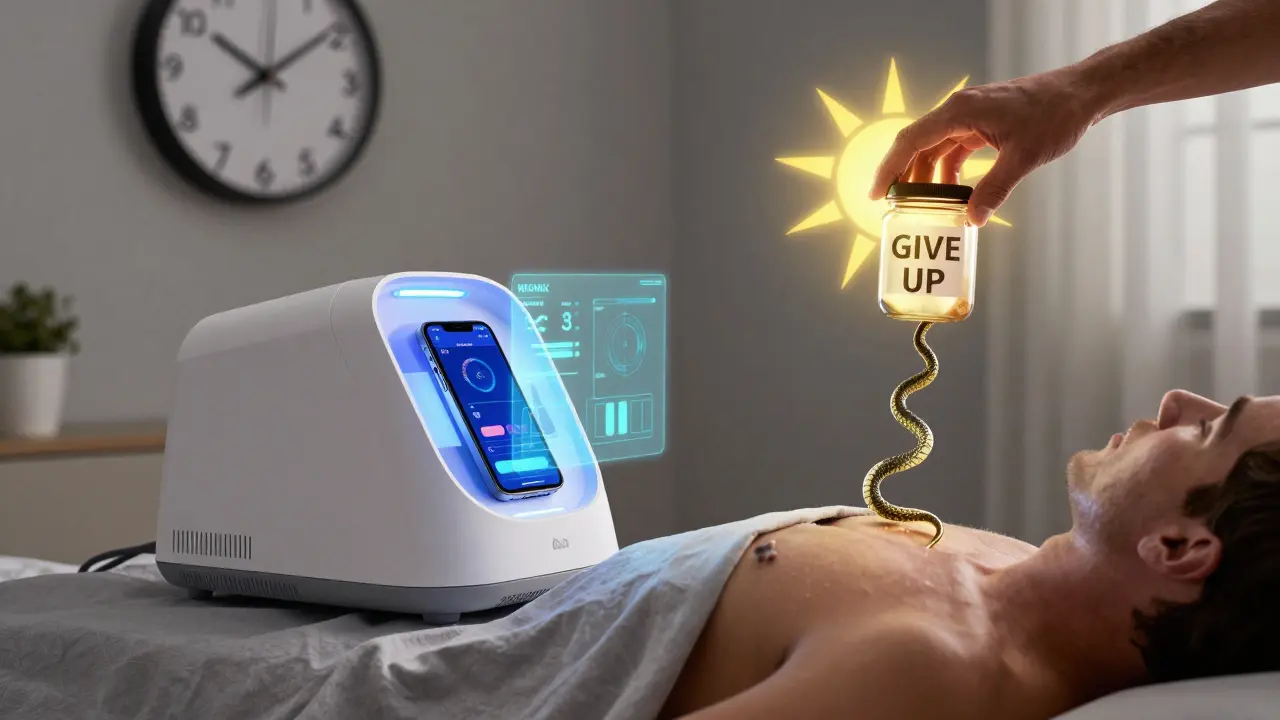
You don’t have to go to a clinic every time. Home phototherapy units are FDA-approved and widely used. A 2020 study found they work just as well as clinic treatments - 78% of home users got over 50% repigmentation compared to 82% in clinics. The big advantage? Compliance. People using home units missed fewer sessions because they didn’t have to drive to a center twice a week. But there’s a catch. About 22% of home users had minor burns because they misjudged the dose. That’s why proper training matters. Some devices now come with smartphone apps that track your sessions and adjust light levels automatically. One such device, Vitilux AI, cleared by the FDA in October 2023, cuts dosing errors by 37% using image analysis. Home units cost between $2,500 and $5,000. Medicare covers 80% of the cost for qualifying patients. Private insurance varies - 43% of insured patients still pay over $1,000 a year out of pocket.Combining Phototherapy With Other Treatments
Phototherapy works better when paired with other therapies. Topical calcineurin inhibitors like tacrolimus or pimecrolimus boost repigmentation by 25-30%. These are often applied right before or after light sessions. A newer option is ruxolitinib cream (Opzelura), an FDA-approved JAK inhibitor. A 2023 trial showed that combining it with NB-UVB led to 54% of patients achieving over 50% repigmentation in just 24 weeks - compared to 32% with phototherapy alone. This could mean shorter treatment times and better results on stubborn areas like hands and feet. There’s also emerging research into afamelanotide implants - tiny rods placed under the skin that stimulate pigment production. Early trials are testing whether they can speed up phototherapy results.What You Need to Know Before Starting
Phototherapy isn’t a quick fix. You need to commit for at least 6 months just to see if it’s working. Most people don’t see real results until month 4 or 5. That’s why so many quit early. You’ll need to:- Protect your eyes with special goggles during every session
- Shield genitals and other sensitive areas
- Avoid sun exposure on treatment days
- Track your sessions - apps help
- Expect some redness - it’s normal, but burning isn’t
Who Shouldn’t Use Phototherapy
Phototherapy isn’t for everyone. Avoid it if you:- Have a history of skin cancer
- Have lupus or other photosensitive conditions
- Are pregnant and not under close supervision
- Have a genetic condition like xeroderma pigmentosum
The Real Challenge: Sticking With It
The biggest reason people fail at phototherapy isn’t lack of results - it’s lack of consistency. A Reddit survey from early 2023 found 68% of users missed at least a quarter of their scheduled sessions. The top reasons? Time and travel. If you’re working full-time, have kids, or live far from a clinic, sticking to 2-3 weekly visits is hard. That’s why home units are changing the game. People who use them are 35% more likely to finish their treatment. Support helps too. Organizations like Vitiligo Support International have over 15,000 members sharing tips, progress photos, and encouragement. The American Academy of Dermatology’s Vitiligo Navigator tool lets you build a personalized treatment calendar - something that keeps people on track.What’s Next for Vitiligo Treatment
The future is personalization. Researchers are looking at genetic markers to predict who will respond best to phototherapy. New devices are being developed to adjust light doses based on real-time skin analysis. Combination therapies with JAK inhibitors are becoming standard in top clinics. But the core hasn’t changed: for most people, NB-UVB phototherapy remains the most effective, safest, and most affordable way to restore pigment. It’s not magic. It’s science - and it works if you stick with it.Can phototherapy and depigmentation be used together for vitiligo?
No, they cannot and should not be used together. Phototherapy aims to restore pigment in white patches by stimulating remaining melanocytes. Depigmentation removes the last remaining pigment from normal skin to create a uniform appearance. These are opposite goals. Using both at the same time would cancel out any benefit and could damage your skin. Depigmentation is only considered when over 80% of the body is already depigmented.
How long does it take to see results from phototherapy for vitiligo?
Most people start seeing small changes after 2-3 months, but meaningful repigmentation usually takes 6 months or longer. The 2017 JAMA Dermatology meta-analysis confirmed that 6 months is the minimum time needed to assess if phototherapy is working. For best results, treatment should continue for 12-18 months, especially on areas like the face and neck where response is strongest.
Which areas of the body respond best to phototherapy?
The face and neck respond best, with 70-80% of patients seeing significant repigmentation within 6 months. The chest, back, and arms also respond well. Hands, feet, lips, and areas with no hair follicles respond poorly - often less than 20% repigmentation even after a year. This is because melanocytes are mostly found in hair follicles, and these areas have fewer of them.
Is home phototherapy as effective as clinic-based treatment?
Yes, studies show home phototherapy is just as effective as clinic treatments. A 2020 study found 78% of home users achieved over 50% repigmentation after 6 months, compared to 82% in clinics. The main advantage is better adherence - people using home units missed fewer sessions. However, home users have a 22% higher risk of minor burns if they don’t follow dosing instructions properly.
What are the risks of phototherapy for vitiligo?
The most common side effect is temporary redness or mild sunburn-like irritation. Long-term risks are low with NB-UVB - studies with 15-year follow-ups show no increased risk of melanoma. PUVA carries a higher risk of skin cancer and nausea. All phototherapy requires eye protection and shielding of sensitive areas. Home devices increase the risk of burns if used incorrectly, so proper training is essential.
Can children use phototherapy for vitiligo?
Yes, phototherapy is the most common first-line treatment for children with vitiligo. NB-UVB is considered safe for kids, with no evidence of long-term harm. It’s preferred over oral medications because it doesn’t affect the immune system systemically. About 85% of pediatric vitiligo cases in the U.S. are treated with NB-UVB, according to Mayo Clinic data.
How much does phototherapy cost for vitiligo?
Clinic-based NB-UVB typically costs $1,200-$2,500 per year. Home phototherapy units cost $2,500-$5,000 upfront but may be partially covered by Medicare (80%) or private insurance. Topical treatments like ruxolitinib cream cost over $5,000 annually. Phototherapy is significantly more cost-effective for treating large areas of vitiligo compared to newer drugs.
11 Comments
Robert Gilmore December 26, 2025 AT 03:57
ive been doing nb-uvb for 8 months and honestly i thought i wasnt making progress till my sister pointed out my neck looked less patchy
now i dont skip sessions even if im tired. its a grind but worth it.
Robert Gilmore December 26, 2025 AT 12:00
hands are the worst i spent a year on it and got maybe 10% back
gave up and got a tattoo to cover the patches
now i dont care anymore
Robert Gilmore December 27, 2025 AT 08:20
phototherapy and depigmentation are opposites dont mix them
Robert Gilmore December 28, 2025 AT 02:06
as someone who grew up in a culture where vitiligo was seen as a curse i want to say this: you are not broken
phototherapy isnt magic but it is science and you deserve to feel whole again
keep going even when it feels slow. your skin tells a story and its yours to rewrite
Robert Gilmore December 28, 2025 AT 22:00
One must ask: is the pursuit of pigmentation not, in essence, a performative capitulation to the hegemony of normative aesthetics? The very notion of 'repigmentation' implies an ontological deficiency in the depigmented state-wherein the individual becomes a site of colonialist dermatological ideology. Depigmentation, conversely, is not destruction-it is liberation. The body, unshackled from chromatic expectation, becomes a canvas of radical neutrality. To combine therapies is to entrap the self in dialectical contradiction: a metaphysical bucket with both plug and perforation.
Robert Gilmore December 29, 2025 AT 13:16
lol phototherapy works? my cousin tried it for 2 years and now his skin is more patchy than before
maybe the light just makes it worse? 🤔
also why do they always show face results? no one cares about the face, it's the hands and feet that ruin your life 😭
Robert Gilmore December 30, 2025 AT 05:17
you people are delusional
you think this works? my dermatologist said 60% of people quit because it's pointless
and now you're gonna spend 5k on a machine that burns you?
just get a tan and call it a day
Robert Gilmore December 30, 2025 AT 09:15
home units are a game changer. i got mine through insurance after a 3-month battle
the app tracks your dose and even reminds you to wear goggles
yes i burned my ankle once but i learned. now i’m at 70% repigmentation on my arms
you can do this. just don’t rush it
Robert Gilmore December 31, 2025 AT 00:33
my aunt did depigmentation… she looked like a ghost
not in a cool way. like… a sad ghost
she said it felt like losing part of herself
so i’m sticking with phototherapy even if it takes forever
at least i still have my color somewhere
and yes i cry sometimes. sue me 😔
Robert Gilmore January 1, 2026 AT 13:09
just started ruxolitinib with nb-uvb and wow the spots on my fingers are actually getting lighter
not much yet but its something
and no i didnt spend 5k on the cream i got it through a trial
if you can find one do it
Robert Gilmore January 2, 2026 AT 06:17
the data on NB-UVB efficacy is robust. the 2020 home vs clinic study had a sample size of over 400 participants with a 95% confidence interval.
the adherence rates were statistically significant (p<0.01).
also, the FDA clearance of Vitilux AI in october 2023 was based on a multicenter trial with real-time skin spectroscopy.
these are not anecdotal solutions. they are evidence-based.