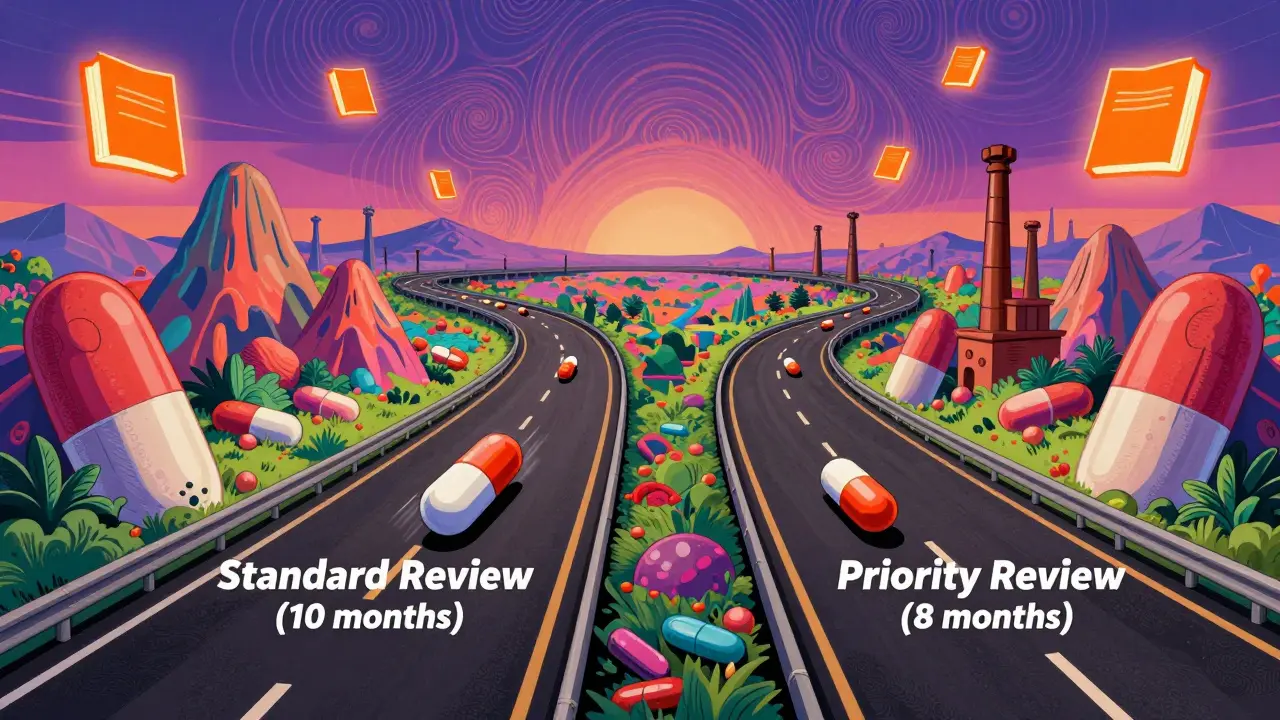
When a generic drug company submits an application to the FDA, it doesn’t just wait in line like everyone else. The agency has two lanes: one for most applications, and another for the ones that matter most right now. Understanding the difference between priority review and standard review isn’t just about paperwork-it’s about when patients get access to affordable medicine, how much money a company makes, and whether a drug is made in the U.S. or overseas.
What’s the difference between priority and standard review?
The FDA sets clear deadlines for reviewing generic drug applications, called Abbreviated New Drug Applications (ANDAs). For standard review, the clock starts ticking the day the application is officially filed. The agency has 10 months to finish its evaluation. That’s the baseline. Most applications fall into this category. Priority review cuts that time down to 8 months. It’s not just faster-it’s strategically targeted. The FDA doesn’t hand out priority status lightly. It’s reserved for cases where speed makes a real difference: first generics, drugs in short supply, or complex products that improve patient outcomes. The difference isn’t just 2 months on paper. For a first generic, those 60 days can mean the difference between $200 million and $500 million in revenue. That’s because the first company to get approval gets 180 days of exclusive marketing rights. No other generic can enter the market during that time. That’s a huge incentive to get your application in early and make sure it’s perfect.Who qualifies for priority review?
Not every generic drug gets priority. The FDA has specific rules. To qualify, an ANDA must meet one of these criteria:- It’s the first generic version of a brand-name drug after all patents and exclusivity periods have expired.
- The drug is listed on the FDA’s Drug Shortages list under Section 506C of the Federal Food, Drug, and Cosmetic Act.
- The product represents a medically important advance over existing generics-like a new delivery system or improved stability.
The new U.S. manufacturing priority pilot
In October 2023, the FDA launched something new: the ANDA Prioritization Pilot Program. This isn’t just about speed-it’s about reshaping the entire supply chain. To qualify, a generic drug application must prove three things:- The bioequivalence studies were done in the United States.
- The finished dosage form (the actual pill or injection) is manufactured in the U.S.
- All active pharmaceutical ingredients (APIs) come from U.S.-based suppliers.

Why do so many applications get rejected or delayed?
Even if you qualify for priority review, you’re not guaranteed approval. In 2022, over 31% of ANDAs received a Complete Response Letter (CRL)-meaning the FDA found problems that needed fixing. The biggest issue? Chemistry, manufacturing, and controls (CMC). That’s the technical part of the application where companies prove their generic is identical to the brand drug in how it’s made. Poorly written CMC sections account for nearly half (47.2%) of all review delays. Each CRL adds about 4.2 months to the timeline. And the average ANDA needs 1.7 review cycles to get approved. That means even a priority application can stretch past 10 months if it’s not perfect the first time. To fix this, the FDA now encourages pre-submission meetings. Companies can meet with regulators months before filing to get feedback on their data. In 2020, only 41% of sponsors did this. By 2023, that number jumped to 63%. And the results? First-cycle approval rates rose from 24% to 39%.What about complex generics?
Not all generic drugs are created equal. A simple tablet? Easy. An inhaler? A topical cream? A slow-release capsule? Those are complex generics. They’re harder to copy because their performance depends on how they’re made-not just what’s inside. In 2022, complex generics made up 18.3% of pending applications but only 9.7% of approvals. The FDA launched a dedicated pilot in January 2023 to help with these. Companies get early scientific advice, which reduces the chance of costly mistakes later. This matters because complex generics are where the next wave of savings will come from. They’re often used for chronic conditions like asthma, diabetes, and heart disease. Getting them approved faster means more patients get affordable treatment.
What’s next for FDA generic reviews?
The FDA isn’t slowing down. By late 2024, they plan to roll out AI tools to help review straightforward ANDAs. In internal tests, AI reduced review times by nearly 19% for simple applications. That means reviewers can focus more time on complex cases. The agency also expects 1,275 ANDA submissions in FY 2024-a 12.5% increase from the year before. Priority reviews are expected to make up 32.8% of those, up from 28.4% in 2022. Long-term, experts predict these changes could cut the average time from patent expiry to generic approval from 2.7 years to under 2.3 years by 2026. That could save the U.S. healthcare system over $18 billion annually.What does this mean for patients and pharmacies?
For patients, it means more affordable options arrive faster. For pharmacies, it means fewer shortages and more choices on the shelf. For manufacturers, it’s a race-between speed, cost, and location. The system isn’t perfect. Some companies still struggle to meet U.S. manufacturing demands. Some applications still get bogged down in technical details. But the direction is clear: the FDA is pushing for faster, safer, and more resilient access to generic drugs. The bottom line? Priority review isn’t a favor. It’s a tool. And the rules are changing-not just to speed things up, but to make sure the medicines we rely on are made where we can trust them.What’s the difference between priority and standard review for generic drugs?
Standard review takes 10 months from the date the FDA accepts the application. Priority review takes 8 months and is given to first generics, drugs in shortage, or products that offer a meaningful improvement over existing options. The faster timeline helps get critical medications to patients sooner.
How do I know if my generic drug qualifies for priority review?
Your application qualifies for priority review if it’s the first generic version of a brand-name drug after patents expire, addresses a drug shortage, or represents a medically important advance. The FDA uses its Orange Book database to verify patent status and tracks shortage listings to determine eligibility.
What is the new U.S. manufacturing pilot program?
The ANDA Prioritization Pilot, launched in October 2023, gives faster review to applications that use U.S.-based bioequivalence testing, U.S. manufacturing of the finished product, and U.S.-sourced active ingredients. The goal is to strengthen domestic supply chains after global disruptions during the pandemic.
Why do so many generic applications get rejected?
The most common reason is issues with chemistry, manufacturing, and controls (CMC)-the technical section proving the generic matches the brand drug in quality and performance. Nearly half of all delays come from CMC deficiencies. Many companies now use pre-submission meetings with the FDA to avoid these mistakes.
Can complex generics like inhalers or creams get priority review?
Yes. Complex generics qualify for priority review if they meet the standard criteria (first generic, shortage, or medical advance). The FDA also runs a separate pilot program to help sponsors with complex products by offering early scientific advice, which improves approval chances.
How long does it take to get a generic drug approved after patent expiration?
On average, it takes 2.7 years from patent expiry to first generic approval. Delays come from patent litigation, complex technical requirements, and regulatory review cycles. New initiatives like the U.S. manufacturing pilot and AI-assisted reviews aim to reduce this to under 2.3 years by 2026.
12 Comments
Robert Gilmore December 19, 2025 AT 10:01
This is huge for us in India. We make APIs for 80% of US generics. Hope they don't cut us out completely.
Robert Gilmore December 20, 2025 AT 13:38
Let me guess-next they'll require every pill to be made by a veteran with a US flag stitched into the capsule. Pure nationalism dressed as policy.
Robert Gilmore December 21, 2025 AT 06:34
CMC failures are 47.2% of delays? That's not a regulatory issue-that's a competence crisis. Half these companies shouldn't be allowed near an ANDA.
Robert Gilmore December 23, 2025 AT 02:17
This is actually one of the most thoughtful policy updates I've seen from the FDA in years. Patients win. Supply chains win. Even manufacturers win-if they're willing to adapt.
Robert Gilmore December 23, 2025 AT 05:29
I work in a pharmacy. The difference between a 10-month and 8-month review? We see it in the stockroom. Patients ask every day when the generic will be here. This matters.
Robert Gilmore December 24, 2025 AT 02:52
The U.S. manufacturing pilot? That’s not just policy-it’s a wake-up call. We’ve outsourced too much. Time to rebuild. It’s hard, but it’s necessary.
Robert Gilmore December 25, 2025 AT 03:08
I read the whole thing. Honestly? I didn’t know any of this. Thanks for explaining it so clearly.
Robert Gilmore December 25, 2025 AT 09:48
Let’s be real-the FDA’s ‘priority’ lane is just a VIP pass for big pharma. The little guys? They’re still stuck in the 10-month purgatory while Teva sips champagne.
Robert Gilmore December 27, 2025 AT 04:44
The assertion that domestic manufacturing enhances safety is empirically unsubstantiated. The quality control frameworks of GMP-certified facilities in India and China are, in many instances, superior to those observed in under-resourced U.S. contract manufacturers.
Robert Gilmore December 27, 2025 AT 13:50
The convergence of regulatory prioritization, supply-chain nationalism, and AI-driven review efficiency represents a paradigmatic shift in pharmaceutical governance-yet the underlying structural tension-between cost-efficiency and sovereign resilience-remains unresolved. The FDA is attempting to optimize for multiple, often conflicting, objectives: speed, security, and scalability. But without a unified metric for 'value,' this remains a policy in search of a theory.
Robert Gilmore December 29, 2025 AT 05:07
I just want to say thank you for writing this it really helped me understand why my meds are taking so long to come out and i hope more companies can meet the usa standards because i dont want to run out of my heart medicine again
Robert Gilmore December 30, 2025 AT 00:00
The real win here? The 180-day exclusivity window. That’s the engine driving all this. Not patriotism. Not patient care. Profit.