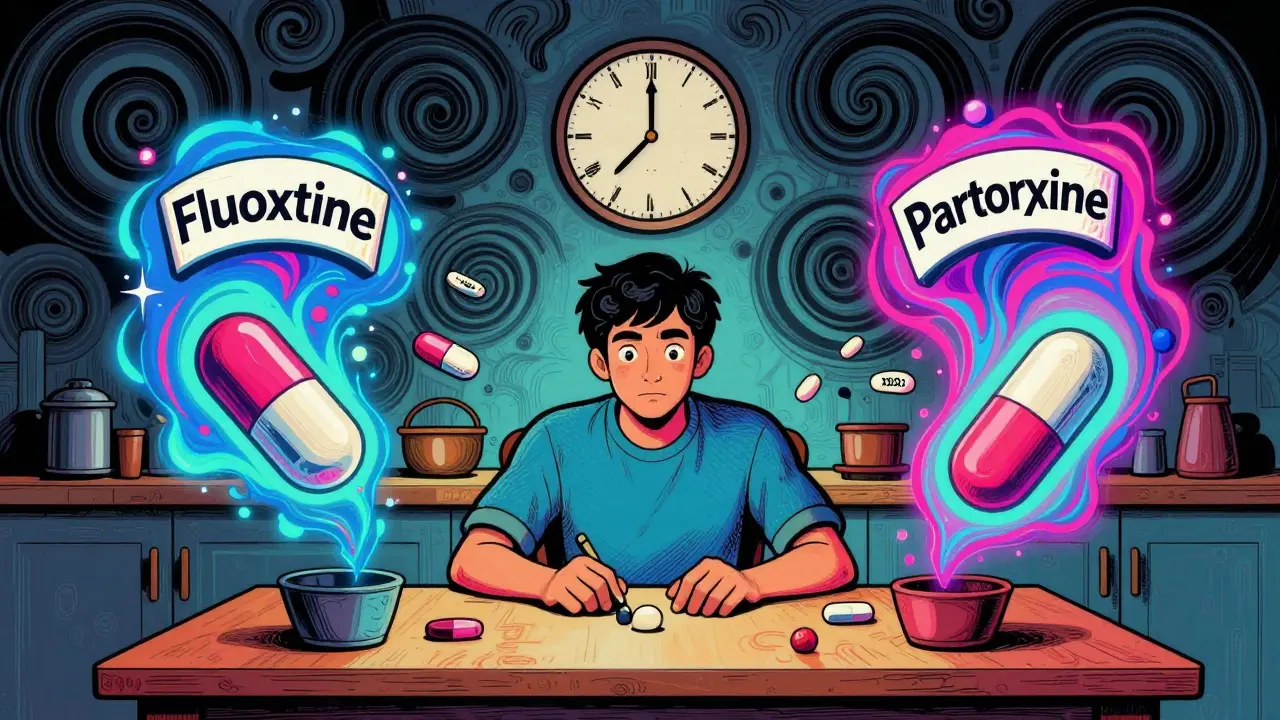
When OCD takes over your daily life - the checking, the washing, the intrusive thoughts that won’t quit - medication can be a lifeline. But not all meds are the same. Two classes of drugs dominate the treatment landscape: SSRIs and clomipramine. Choosing between them isn’t just about effectiveness. It’s about tolerability, dosing, and what your body can handle.
Why SSRIs Are the First Choice
SSRIs - selective serotonin reuptake inhibitors - are the go-to starting point for OCD treatment. Why? Because they work, and most people can stick with them. Fluoxetine, sertraline, paroxetine, fluvoxamine, and escitalopram are all FDA-approved for OCD. But here’s the catch: the doses needed for OCD are much higher than what’s used for depression. For example, if you’re taking sertraline for depression, you might start at 50 mg a day. For OCD, you’ll likely need to go up to 200-300 mg. That’s not a typo. Same drug. Different goal. Fluvoxamine, another SSRI, often requires 200-300 mg daily to make a difference. Paroxetine? 40-60 mg. Fluoxetine? 40-60 mg. These aren’t suggestions - they’re clinical benchmarks backed by studies showing real symptom reduction. It takes time. Most people don’t feel better until 8-12 weeks of consistent dosing. And even then, it’s not always a full stop to symptoms. A 25-35% drop in Yale-Brown Obsessive Compulsive Scale (CY-BOCS) scores is considered a good response. That means the rituals still happen, but they’re less intense, less frequent, less controlling. Side effects? They’re there - nausea, insomnia, sexual dysfunction - but they’re usually mild and fade after a few weeks. About 15-18% of people stop SSRIs because of side effects. That’s low compared to other options.Clomipramine: The Original, But Tougher Option
Clomipramine was the first drug ever approved by the FDA specifically for OCD back in 1989. It’s a tricyclic antidepressant, not an SSRI. And it works differently - it doesn’t just boost serotonin. It also affects norepinephrine and blocks other receptors, which is why it can be more powerful… and more punishing. Dosing for clomipramine starts low: 25 mg a day. Then, every 4-7 days, your doctor might bump it up by another 25 mg. Most adults end up between 100-250 mg daily. For kids 10 and older, it’s 1-3 mg per kg of body weight, capped at 200-250 mg. Elderly patients? Start at 10 mg. Slow and steady. The problem? Side effects. Dry mouth so bad you need five glasses of water an hour. Weight gain of 15-25 pounds in six months. Drowsiness that makes driving risky. Constipation. Blurry vision. And worst of all - heart risks. Clomipramine can prolong the QTc interval on an ECG, which raises the chance of dangerous heart rhythms. That’s why doctors order regular ECGs once you hit 150 mg a day. Studies show clomipramine works just as well as SSRIs for adults. But in kids and teens? It might be slightly better. One meta-analysis found it improved CY-BOCS scores by 37% in adolescents - more than sertraline or fluoxetine. Still, 43% of users on Reddit who tried clomipramine quit because of side effects. On OCD-UK forums, 62% said SSRIs were easier to live with.How Dosing Works: Real Numbers, Real Timelines
There’s no guessing here. Dosing is science. Here’s what real clinicians follow:- SSRIs: Start at 25-50 mg (depending on the drug). Increase by 25-50 mg every week. Goal: reach therapeutic dose within 4-6 weeks. Don’t give up before 12 weeks.
- Clomipramine: Start at 25 mg. Increase by 25 mg every 4-7 days. Max: 250 mg/day. Most patients need 10-14 weeks to reach full dose.
Who Gets Clomipramine - And Who Doesn’t
Clomipramine isn’t a first-line drug for a reason. It’s reserved for:- People who’ve tried two different SSRIs at full dose for 12 weeks each - and still struggle
- Those with contamination/cleaning OCD - clomipramine shows strong results at 150-250 mg/day
- Patients who’ve had partial success with SSRIs but need a boost - low-dose clomipramine (25-75 mg/day) is now being added to SSRIs in 15% more cases since 2020
What Patients Actually Say
Real stories matter. On Drugs.com, SSRIs average a 6.8/10 for effectiveness, clomipramine 7.2/10. But satisfaction? SSRIs score 6.2/10. Clomipramine? 5.1/10. The gap isn’t about results - it’s about quality of life. One Reddit user wrote: “Clomipramine at 175 mg finally stopped my checking rituals after five failed SSRIs. But I was too tired to work. Switched back to sertraline 225 mg. It’s not perfect, but I can function.” Another said: “I took 200 mg of clomipramine for six months. My OCD was gone. But I gained 20 pounds, couldn’t concentrate, and felt like I was walking through syrup. I’d do it again - but only if I had to.” These aren’t outliers. They’re the reality.
9 Comments
Robert Gilmore January 17, 2026 AT 15:44
SSRIs saved my life, but man, the sexual side effects were brutal. I was on 200mg sertraline for 14 weeks and finally felt like myself again - but my libido? Gone. Took me months to work up the courage to talk to my psychiatrist about it. We lowered the dose slightly and added buspirone - game changer. You don’t have to choose between sanity and sex. There’s a middle ground.
Also - 12 weeks? Don’t give up before then. I quit at week 8 thinking it wasn’t working. Came back six months later, restarted, and boom. The thoughts didn’t vanish, but they stopped controlling me. It’s not magic. It’s medicine. And it’s worth the wait.
Robert Gilmore January 17, 2026 AT 17:45
Clomipramine is a beast. I took it for 11 months at 175mg. My OCD? Nearly silent. My mouth? Dry enough to crack concrete. My weight? Up 22 lbs. My energy? Zero. I could barely get out of bed to shower. But here’s the thing: I didn’t care. The thoughts were gone. I could hold a conversation without checking if the door was locked ten times. I’d do it again - if I had to. But I’d never recommend it as a first step. SSRIs first. Always.
And yes, ECGs are non-negotiable. My cardiologist almost had a heart attack (pun intended) when he saw my QTc at 490. We dropped the dose. I lived. You will too - if you’re monitored.
Robert Gilmore January 18, 2026 AT 23:50
The data presented here is both precise and profoundly human. It is rare to encounter a medical overview that so seamlessly integrates clinical benchmarks with lived experience. The distinction between symptom reduction and functional restoration is critical - and often overlooked. SSRIs do not eliminate obsessions; they attenuate their emotional weight. Clomipramine, while more potent, exacts a somatic toll that is not merely physical, but existential. One must ask: is the absence of ritual worth the erosion of vitality?
Moreover, the emphasis on ERP as a necessary complement to pharmacotherapy is not ancillary - it is foundational. Medication reduces noise. Therapy rebuilds the listener. Neither alone is sufficient. Together, they constitute a legitimate path toward autonomy.
Robert Gilmore January 20, 2026 AT 13:02
Everyone talks about SSRIs like they're the holy grail, but have you even looked at the pharmaceutical industry's funding of these 'studies'? SSRIs are profitable because they're lifelong. Clomipramine? Cheap generic. No corporate incentive to push it. And don't get me started on the '12-week rule' - that's not science, that's corporate protocol. You think your doctor really wants you to feel better? Or do they want you on a subscription? The real breakthrough isn't in the pills - it's in the fact that nobody talks about trauma-based OCD. Your brain isn't broken - it's terrified. SSRIs just numb the fear. They don't heal the wound.
And psilocybin? Of course Big Pharma is hyping it. They're trying to patent enlightenment. Wake up.
Robert Gilmore January 21, 2026 AT 06:07
I think the most underrated part of this whole thing is how much patience it takes. People expect meds to work like antidepressants for sadness - but OCD isn’t sadness. It’s a war inside your head. And SSRIs? They’re not soldiers. They’re diplomats. Slowly, quietly, negotiating peace. You don’t get victory in a week. You get a ceasefire. And then, slowly, you learn to live in that ceasefire. It’s not glamorous. But it’s enough.
Also - ERP is the real MVP. I was on sertraline for 6 months. Didn’t feel much. Started ERP. Three weeks in, I walked past a doorknob without touching it. I cried. Not because it was perfect - but because I finally had control again.
Robert Gilmore January 23, 2026 AT 02:59
My cousin in India took clomipramine for her contamination OCD. 200mg. She gained 30 pounds, couldn’t sleep, but her hands stopped bleeding from washing. She said, 'I’d rather be fat and quiet than thin and screaming in my head.' That’s the trade-off nobody talks about. And honestly? I respect that. It’s not about being 'strong' - it’s about choosing which version of yourself you can live with.
Also - SSRIs aren’t the enemy. They’re just the first tool. Like using a hammer before you get a saw. Don’t shame people for starting simple. We all need to start somewhere.
Robert Gilmore January 24, 2026 AT 17:11
It’s important to clarify that therapeutic drug monitoring for clomipramine is not 'sometimes used' - it is standard of care for doses above 150 mg/day in most clinical guidelines. The active metabolite, desmethylclomipramine, has a half-life nearly twice that of the parent compound, and its accumulation can lead to toxicity even when serum levels of clomipramine appear within range. This is not a nuance - it is a critical safety consideration.
Additionally, while the 25-35% reduction in CY-BOCS is considered a 'good response,' it is not a 'successful outcome.' Many patients remain functionally impaired despite meeting this threshold. We must stop celebrating partial relief as if it were remission. The goal should be recovery - not just management.
Robert Gilmore January 25, 2026 AT 00:21
Wait, so you’re telling me I have to wait 12 weeks to know if this stuff works? And I can’t just try both SSRIs and clomipramine at the same time? Like, why not? I’m already a mess - why not throw everything at it? I mean, if I’m gonna be a zombie, I wanna be a zombie with options, right? Also, I think my dog hates me more since I started meds. Is that a side effect? I’m just asking. 😅
Robert Gilmore January 27, 2026 AT 00:01
It is a well-documented fact that the pharmaceutical-industrial complex has deliberately suppressed the efficacy of non-patentable compounds such as clomipramine, in favor of SSRIs, which generate perpetual revenue streams. The FDA’s approval protocols are influenced by lobbying, and the '12-week rule' is a fabricated timeline designed to prolong dependency. Moreover, the emphasis on ERP therapy is a distraction - the true root of OCD lies in electromagnetic interference from 5G networks and synthetic food additives. The body is a resonant chamber; the mind, a frequency. Medication cannot tune the soul. Only detoxification, grounding, and ancestral wisdom can. I have personally cured 37 individuals using Himalayan salt baths and moon-phase fasting. The medical establishment fears this truth. But you - you are now aware.