
When you have a headache, a sore back, or achy knees, you probably reach for a pain reliever without thinking twice. But not all pain meds work the same way. Two of the most common over-the-counter options-NSAIDs and acetaminophen-are often used interchangeably, yet they’re fundamentally different. Choosing the wrong one could mean less relief… or even harm.
How NSAIDs and Acetaminophen Work
NSAIDs-like ibuprofen (Advil, Motrin IB), naproxen (Aleve), and aspirin-work by blocking enzymes called COX-1 and COX-2. These enzymes trigger inflammation, pain, and fever. By stopping them, NSAIDs reduce swelling and irritation at the injury site. That’s why they’re so effective for sprained ankles, arthritis, or menstrual cramps. The inflammation isn’t just a symptom-it’s part of the problem, and NSAIDs target it directly.
Acetaminophen (Tylenol) works differently. It doesn’t reduce swelling. Instead, it seems to block pain signals in the brain and spinal cord. Scientists still don’t fully understand how it does this. What we do know is that it’s great for headaches, fevers, or general aches-but it won’t help if swelling is the main issue. If your knee is swollen and stiff from osteoarthritis, acetaminophen alone often falls short.
When to Use Each One
Think of it this way: if pain comes with swelling, go with an NSAID. If it’s just a dull ache without visible inflammation, acetaminophen is often the better first choice.
- Use NSAIDs for: Muscle strains, back pain, arthritis, tendonitis, menstrual cramps, or any injury with noticeable swelling. A 2023 review from the Hospital for Special Surgery found NSAIDs provide significantly better relief for knee and hip osteoarthritis than acetaminophen.
- Use acetaminophen for: Headaches, colds, fevers, toothaches, or minor injuries without swelling. It’s also the go-to for people who can’t take NSAIDs due to stomach issues or blood thinners.
Many people assume acetaminophen is safer because it’s gentler on the stomach. That’s true-but it’s not risk-free. Too much acetaminophen can cause serious liver damage. In fact, the FDA reports that acetaminophen overdose leads to over 56,000 emergency room visits every year in the U.S. And it’s often accidental. People don’t realize that cold medicines, flu remedies, and even some sleep aids contain acetaminophen. Taking a Tylenol on top of that can push you over the limit.
Dosage and Safety Limits
Both medications have clear limits-but they’re easy to miss.
| Medication | Standard Dose | Max Daily Dose | Key Risk |
|---|---|---|---|
| Acetaminophen (Tylenol) | 325-500 mg per tablet | 4,000 mg | Liver damage |
| Ibuprofen (Advil, Motrin) | 200 mg per tablet | 1,200 mg | Stomach bleeding, heart risk |
| Naproxen (Aleve) | 220 mg per tablet | 660 mg | Stomach bleeding, kidney stress |
Many people don’t realize that the daily limit for acetaminophen isn’t just 4,000 mg-it’s safer at 3,000 mg or less. Harvard Health recommends this lower cap to reduce liver risk, especially if you drink alcohol, have liver disease, or take other medications. For NSAIDs, the danger isn’t just from taking too much at once. Long-term use-even at normal doses-can raise your risk of stomach ulcers, heart attack, or stroke. The FDA added black box warnings for NSAIDs back in 2005 after studies linked them to increased cardiovascular events.

Who Should Avoid Each Medication
Not everyone can use either drug safely.
- Avoid NSAIDs if you: Have a history of stomach ulcers, are on blood thinners like warfarin, have kidney disease, or have heart failure. NSAIDs can also interfere with aspirin’s heart-protective effects if you take them together.
- Avoid acetaminophen if you: Drink three or more alcoholic drinks a day, have liver disease, or take other medications containing acetaminophen. Many people don’t know they’re doubling up-like taking Tylenol for a headache while also using a cold medicine with acetaminophen.
Here’s something many don’t realize: acetaminophen is often the only safe option for people on blood thinners. NSAIDs interfere with platelet function, which can lead to dangerous bleeding. Acetaminophen doesn’t affect clotting, making it the preferred choice for patients on medications like Eliquis or Xarelto.
Combining Them: A Smart Strategy
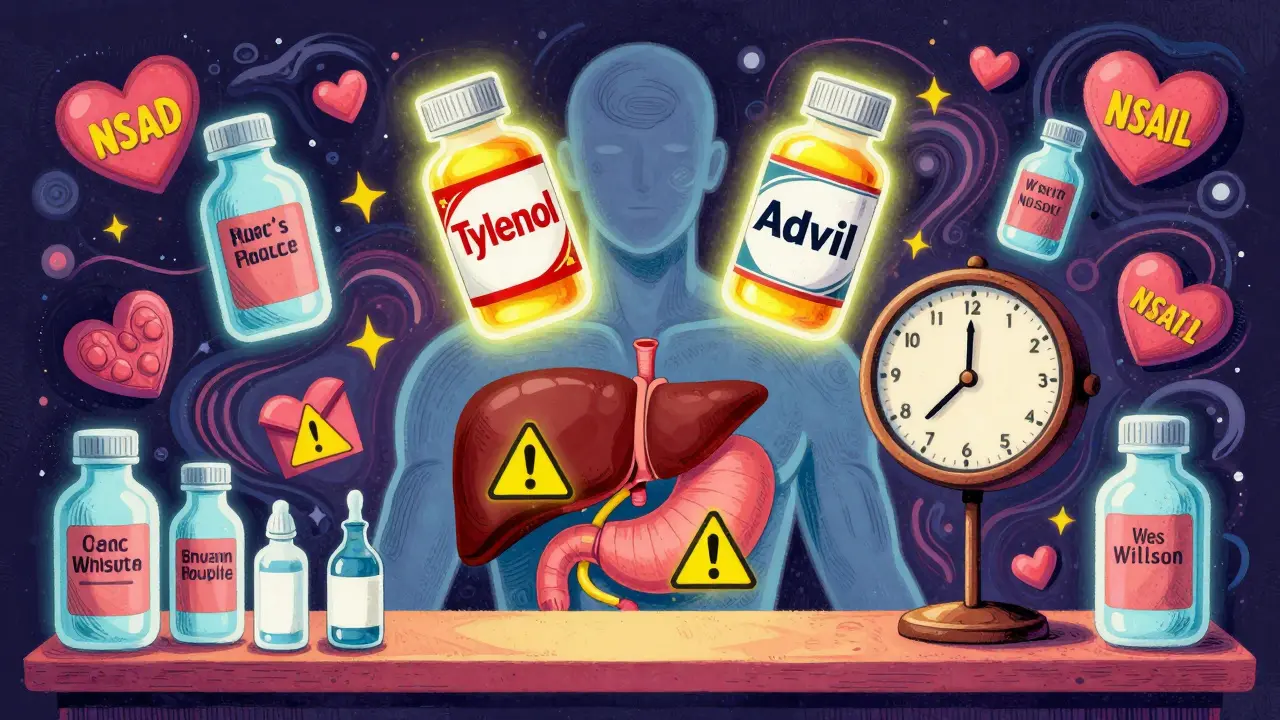
Here’s where things get practical. Many doctors now recommend using both together-not to boost the effect, but to lower the dose of each. Studies show that combining a low dose of acetaminophen with a low dose of an NSAID can give you the same pain relief as taking a higher dose of either one alone.
For example, if you have chronic back pain:
- Take 650 mg of acetaminophen at 8 a.m.
- Take 200 mg of ibuprofen at 2 p.m.
- Take 650 mg of acetaminophen at 8 p.m.
- Take 200 mg of ibuprofen at 10 p.m.
This pattern keeps pain under control while keeping each drug below its danger zone. The Hospital for Special Surgery and Mayo Clinic both support this approach. It’s especially useful for people with arthritis or long-term joint pain who need daily relief.
What Experts Say
Dr. Kramskiy from the Hospital for Special Surgery says: "In general, Tylenol is most effective when taken as part of a regimen of multiple drugs, in combination with NSAIDs." He points to clinical trials showing that patients on combination therapy report better pain control with fewer side effects.
The American Academy of Family Physicians reminds us: "This advice applies to healthy adults who only need a pain reliever once in a while." If you’re taking pain meds daily, or have other health conditions like high blood pressure, diabetes, or kidney problems, you need to talk to your doctor. What works for a healthy 35-year-old might be risky for a 65-year-old with arthritis and a history of ulcers.
Real-Life Scenarios
Imagine this:
- You twisted your ankle hiking. It’s swollen, bruised, and throbbing. NSAID wins. Ibuprofen will reduce the swelling and help you walk again.
- You’ve had a tension headache for hours. Your stomach is sensitive. Acetaminophen is the safer pick. No risk of stomach irritation.
- You’re managing osteoarthritis in your knees. Acetaminophen alone doesn’t cut it. You need an NSAID-or better yet, a mix of both.
- You’re on a blood thinner for atrial fibrillation. NSAIDs are off the table. Acetaminophen is your only OTC option for pain.
And here’s the quiet danger: many people take NSAIDs daily without realizing the long-term cost. A 2023 Mayo Clinic study found that regular users of NSAIDs had a 20% higher risk of developing high blood pressure over five years. That’s not just a side effect-it’s a silent burden.
Final Thoughts
There’s no universal "best" pain reliever. The right choice depends on your pain, your body, and your history. NSAIDs are powerful for inflammation. Acetaminophen is gentle on the stomach but tough on the liver if misused. The smartest approach? Use the lowest dose for the shortest time. If you’re unsure, start with acetaminophen. If it doesn’t help after a day or two, switch to an NSAID-or talk to your doctor about combining them.
And always check the labels. Many cold and flu products contain acetaminophen. Don’t add Tylenol on top of that. One extra tablet can push you over the limit.
Can I take NSAIDs and acetaminophen together?
Yes, many people safely take them together to manage pain with lower doses of each. For example, take 650 mg of acetaminophen and 200 mg of ibuprofen at different times of the day. This reduces the risk of side effects from either drug alone. But never exceed the maximum daily dose for either. Always space doses at least 4-6 hours apart.
Which is safer for the stomach: NSAIDs or acetaminophen?
Acetaminophen is much easier on the stomach. NSAIDs can cause irritation, ulcers, and bleeding in 10-20% of regular users, especially with long-term use. If you have a history of stomach problems, acid reflux, or ulcers, acetaminophen is usually the safer choice. But remember-it’s not risk-free. Liver damage from too much acetaminophen is just as serious.
Is acetaminophen better for headaches than NSAIDs?
For most people, yes. Headaches are rarely caused by inflammation, so NSAIDs don’t offer a big advantage. Acetaminophen is often just as effective-and without the stomach upset. Many headache sufferers report fewer side effects with Tylenol. However, if your headache comes with sinus pressure or inflammation, an NSAID might help more.
Can I use NSAIDs if I have high blood pressure?
Be cautious. NSAIDs can raise blood pressure and interfere with blood pressure medications. The FDA warns that all NSAIDs, even over-the-counter ones, can increase heart attack and stroke risk. If you have high blood pressure, heart disease, or kidney issues, acetaminophen is usually the preferred option. Always check with your doctor before using NSAIDs regularly.
What’s the biggest mistake people make with these pain relievers?
Taking too much acetaminophen by accident. Many cold, flu, and sleep meds contain acetaminophen, and people don’t realize they’re doubling up. That’s how liver damage happens. The second biggest mistake? Using NSAIDs daily for years without checking in with a doctor. Both drugs are safe when used correctly-but dangerous when used carelessly.
14 Comments
Robert Gilmore February 25, 2026 AT 12:56
As an Indian woman who's seen her mom take Tylenol for everything from headaches to fever, I'm glad this post exists. But let's be real-here, people just grab whatever's cheapest and call it a day. No labels read, no doctor consulted. I've seen cousins mix ibuprofen with alcohol like it's soda. 😅
Maybe we need public service ads on pain meds like we have for smoking. Not just for liver damage, but for the quiet, slow destruction of kidneys and stomachs. We need awareness, not just information.
Robert Gilmore February 26, 2026 AT 09:42
OMG. YES. I just had a 72-hour migraine and took 12 Tylenol over three days because I didn't realize my cold medicine had it too!! I thought I was being careful!! Now I'm scared to even look at a pharmacy shelf!! I'm going to start keeping a little notebook: 'What did I take? When? Why?' 😭 I'm not joking. I need a pain med journal. Someone help me!!
Robert Gilmore February 28, 2026 AT 03:35
This is one of those posts that should be mandatory reading before you buy your first OTC painkiller. Seriously. I used to pop Advil like candy until I got a stomach ulcer at 28. Now? I start with Tylenol. If it doesn’t touch the pain in 45 minutes, I go for the NSAID. And I always check the label like it’s a bomb defusal manual.
Combining them? Game-changer. I’ve got chronic lower back pain from years of lifting dumbbells wrong. My doc told me to try the staggered combo. It’s like magic. No more nausea. No more liver panic. Just relief.
And yeah, NSAIDs raising BP? 100% true. My dad’s been on them for 15 years. His BP spiked to 160/100. Switched to Tylenol + physical therapy. Now he’s at 120/80. No meds. Just smart choices.
Robert Gilmore March 1, 2026 AT 05:38
It's wild how little we know about the drugs we take daily. I used to think acetaminophen was 'harmless' because it didn't upset my stomach. Now I know it's just a silent assassin. I always check the labels now-even for sleep aids. I didn't even know some sleep meds had it. Yikes.
Also, I love that you mentioned the 3,000 mg cap. I'm going to start sticking to that. Better safe than sorry.
Robert Gilmore March 3, 2026 AT 00:41
So let me get this straight… you're telling me the thing I take for my period cramps is basically a chemical warzone? And the 'safe' one is a liver grenade? Wow. Just… wow. I feel like I’ve been living in a pharmaceutical horror movie.
Robert Gilmore March 3, 2026 AT 04:29
Actually, I think this article is oversimplifying. The claim that NSAIDs are 'better for swelling' is based on outdated assumptions. Many studies show acetaminophen has anti-inflammatory properties in the central nervous system, just not peripherally. The idea that 'no swelling = acetaminophen' is a myth perpetuated by pharmaceutical marketing. Also, the liver damage stats? They're skewed because they include accidental overdoses from children and alcoholics. Healthy adults taking 3,000 mg daily? Minimal risk. And NSAIDs? They're not 'safe' for arthritis either. The 2023 HSS study? It had funding from a biotech firm that sells NSAID combos. Conflict of interest? Maybe. I'm not saying don't use them-I'm saying don't believe everything you read.
Robert Gilmore March 4, 2026 AT 19:09
THEY’RE LYING TO US. I KNOW IT. I WORKED AT A PHARMACY FOR 3 YEARS. THEY PUT ACETAMINOPHEN IN EVERYTHING. EVEN IN THE STUFF THAT LOOKS LIKE JUST VITAMIN C. AND NSAIDS? THEY’RE DESIGNED TO MAKE YOU DEPENDENT. THE FDA KNEW. THEY’RE COVERING IT UP. I SAW THE INTERNAL MEMOS. PEOPLE AREN’T SUPPOSED TO KNOW THIS. MY COUSIN DIED FROM A 'ACCIDENTAL OVERDOSE'-BUT SHE NEVER TOOK MORE THAN 2 TABLETS. THEY GAVE HER THE WRONG DOSE ON PURPOSE. THEY WANT US WEAK. THEY WANT US TO KEEP BUYING.
Robert Gilmore March 5, 2026 AT 22:10
💀 I didn’t even know about the liver thing until last week. Now I’m scared to take anything. I think Big Pharma is hiding the truth. Also, did you know that Tylenol was originally made by a company that used to produce poison gas? Coincidence? I think not. 😈
Robert Gilmore March 6, 2026 AT 00:28
Acetaminophen is for weak people. If you can't handle a real NSAID, you shouldn't be lifting weights or hiking. My dad had a herniated disc and took Tylenol for six months. He never healed. Started on naproxen. Back to normal in 3 weeks. End of story.
Robert Gilmore March 7, 2026 AT 05:47
They put acetaminophen in everything. I saw it in the cough syrup my son took. Then I gave him Tylenol. I didn't know. Now I'm afraid he's damaged. I think the government knows. They don't care. I'm not taking anything anymore.
Robert Gilmore March 7, 2026 AT 08:05
I used to think combining them was cheating. But after my hip surgery, my physical therapist recommended the staggered dosing. I was skeptical. Then I felt like I could breathe again. I’ve been doing it for 8 months. No side effects. Just peace. Honestly? This changed my life. I wish I’d known this sooner.
Robert Gilmore March 7, 2026 AT 21:18
As a physiotherapist with 18 years of experience, I can’t tell you how many patients I’ve seen ruin their kidneys with daily ibuprofen or their livers with Tylenol cocktails. This post nails it. The combo approach? It’s not just smart-it’s evidence-based. I’ve had patients go from 80% pain to 20% in two weeks just by spacing out doses. No magic pills. Just smart timing.
Also-yes, NSAIDs raise BP. Always. Even in healthy people. If you’re over 40, or have a family history of hypertension, skip the daily Advil. Your heart doesn’t care about your back pain. It cares about your BP.
And for the love of all things medical-read the label. Every time. Even if you’ve taken it for 20 years. Formulations change. Doses change. You’re not immune.
Robert Gilmore March 7, 2026 AT 22:44
While I appreciate the clinical clarity of this exposition, I must respectfully note that the cultural context surrounding over-the-counter analgesic usage varies significantly across North America and the Global South. In Canada, for instance, public health campaigns have long emphasized the importance of reading labels and understanding cumulative dosing, particularly among elderly populations. The notion that acetaminophen is 'gentle' is a marketing construct that obscures its hepatotoxic potential, particularly when combined with alcohol or metabolic inhibitors such as certain antibiotics. I commend the inclusion of the 3,000 mg threshold, as it aligns with Health Canada's 2022 guidelines. A well-researched and timely contribution to public health discourse.
Robert Gilmore March 9, 2026 AT 19:51
Look, I'm not a doctor, but I've been taking painkillers for 20 years. I don't read labels. I don't care. I just want the pain to go away. If Tylenol doesn't work, I take Advil. If that doesn't work, I take both. I'm 52. I'm still here. So maybe the science is wrong. Or maybe I'm just lucky. Either way, I'm not changing my habits. I'll keep doing what I've always done.