Penicillin Allergy Assessment Tool
This tool helps you determine if your past reaction to penicillin was likely a true allergy or a side effect. Based on your responses, we'll provide guidance on whether you might safely take penicillin again.
Many people believe they’re allergic to penicillin. In fact, about 1 in 10 Americans say they are. But here’s the surprising truth: less than 1% of those people actually have a true allergy. Most of them experienced a side effect - something completely different - and got mislabeled years ago. This mistake isn’t just confusing. It’s dangerous. It can lead to worse infections, longer hospital stays, and even death.
What’s the Difference Between an Allergy and a Side Effect?
An allergy is your immune system overreacting. It sees penicillin as a threat and launches a full-scale response. This can be life-threatening. A side effect, on the other hand, is a direct chemical reaction between the drug and your body. It’s not your immune system. It’s just the medicine doing something it wasn’t meant to do - like upsetting your stomach.
Think of it like this: if you eat too much spicy food and get heartburn, that’s a side effect. If you eat peanuts and your throat swells shut, that’s an allergy. One is a reaction. The other is a medical emergency.
True Penicillin Allergy: The Immune System’s Mistake
True penicillin allergies are IgE-mediated. That means your body has made antibodies specifically to fight penicillin. When you take it again, those antibodies trigger mast cells to release histamine and other chemicals. This causes symptoms within minutes to an hour.
Common signs of a true allergy include:
- Hives (raised, itchy red welts on the skin)
- Swelling of the lips, tongue, or throat (angioedema)
- Wheezing or trouble breathing
- Dropping blood pressure (hypotension)
- Anaphylaxis - a full-body reaction that can shut down your airway and circulation
These reactions are rare. Only about 0.01% to 0.05% of people who take penicillin experience anaphylaxis. But when they happen, they’re serious. Penicillin G (given by injection) carries the highest risk. Oral forms like amoxicillin are less likely to cause a true reaction.
Side Effects: Common, Not Dangerous
Far more common than true allergies are side effects. These happen to a lot of people - and they’re not signs of an immune problem.
Here’s what you might actually be experiencing:
- Mild nausea (happens in 5-10% of users)
- Diarrhea (1-2% of users)
- Vaginal yeast infection (due to disruption of normal bacteria)
- Headache or dizziness
- A mild rash that doesn’t itch or spread
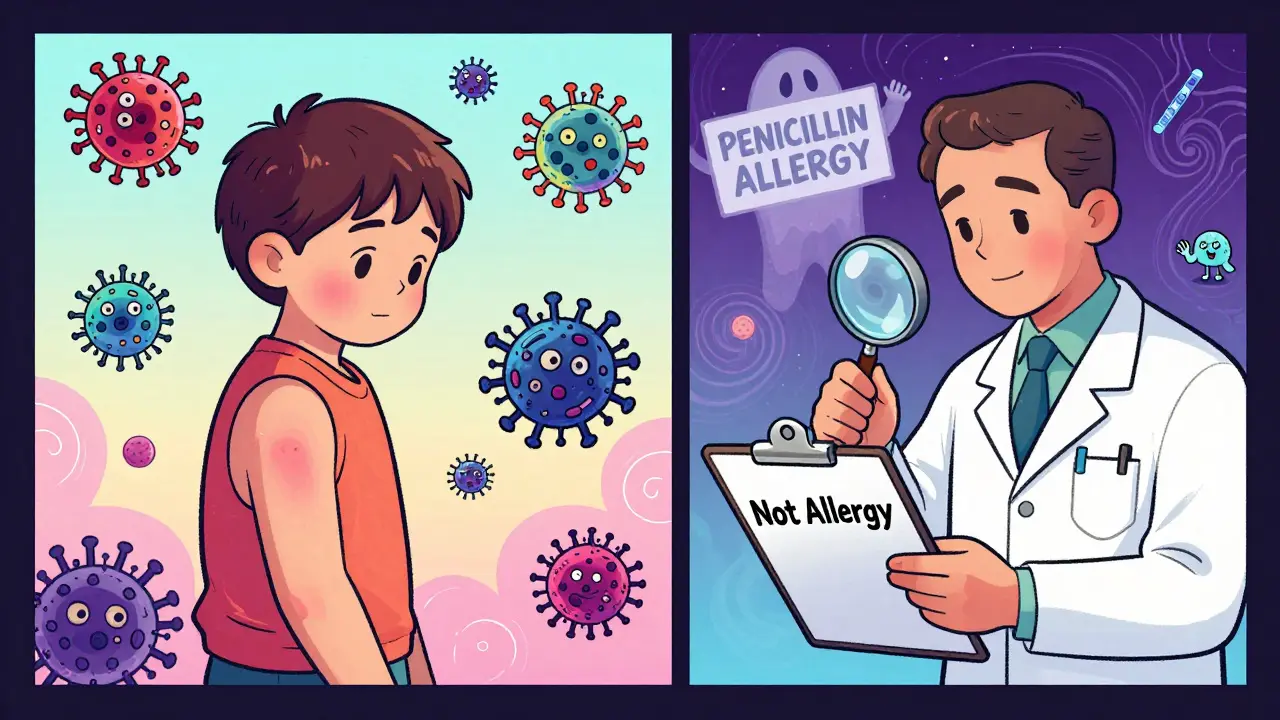
Many people get a rash while on penicillin - especially kids. But if it’s not itchy, doesn’t blister, and isn’t accompanied by fever or swelling, it’s likely not an allergy. Often, it’s caused by a virus you already had. A 2021 study found that 85% of children with a rash after amoxicillin had a viral infection like mononucleosis or roseola - not an allergy.
Why Mislabeling Matters More Than You Think
If your chart says “Penicillin Allergy,” doctors avoid it. They don’t ask questions. They just pick something else. And that’s where things go wrong.
Instead of penicillin, you might get:
- Clindamycin
- Vancomycin
- Fluoroquinolones (like ciprofloxacin)
These drugs are broader-spectrum. They kill more types of bacteria - good and bad. That increases your risk of:
- C. diff infection - a severe, sometimes deadly diarrhea caused by gut bacteria overgrowth
- MRSA colonization - a dangerous antibiotic-resistant staph infection
- Longer hospital stays - on average, half a day longer
- Higher costs - about $1,000 more per admission
And here’s the kicker: people labeled as allergic to penicillin are 6 times more likely to die within a year of hospitalization than those who aren’t labeled - not because penicillin is dangerous, but because they’re forced onto riskier alternatives.
Most People Can Safely Take Penicillin Again
Here’s the good news: if you were told you were allergic as a child - or even 10 years ago - you’re probably not allergic anymore.
Studies show that 80% of people who had a true IgE-mediated reaction lose their sensitivity after 10 years. That means if you were told you were allergic in 2014, there’s a very good chance you can take penicillin safely today.
But you won’t know unless you get tested.

How to Find Out If You’re Really Allergic
There’s a simple, safe, three-step process doctors use to confirm or rule out a penicillin allergy:
- History check - Your doctor asks detailed questions: What happened? When? Did you have hives? Trouble breathing? Was it treated with epinephrine? The PEN-FAST tool (a simple 5-question checklist) helps decide if you’re low-risk.
- Skin test - A tiny amount of penicillin is placed under your skin. If you’re allergic, a red bump appears within 15-20 minutes. This test is over 95% accurate.
- Oral challenge - If the skin test is negative, you swallow a small dose of amoxicillin under observation. You’re watched for an hour. If nothing happens, you’re cleared.
At the Mayo Clinic, they tested over 52,000 people between 2015 and 2022. Only 2.3% still tested positive. And not one had a serious reaction during the challenge.
What’s Holding People Back?
Many people avoid testing because they’re scared. A 2021 survey found that 32% of patients refused testing out of fear. But the truth? The risk of a reaction during testing is extremely low - less than 1%.
Others can’t find a specialist. Allergists aren’t always easy to access. Insurance doesn’t always cover it. And many primary care doctors still don’t know how to refer patients properly.
But things are changing. Hospitals are now using pharmacist-led programs to test patients before discharge. The CDC and University of Pennsylvania created a smartphone app called PAAT that helps doctors decide who needs testing. And by 2025, Medicare will start paying hospitals based on how well they reduce unnecessary antibiotic use - which includes fixing mislabeled allergies.
What You Should Do Now
If you’ve been told you’re allergic to penicillin:
- Don’t assume it’s true. Especially if it happened decades ago.
- Check your medical records. What exactly happened? Was it a rash? Diarrhea? Trouble breathing?
- Ask your doctor: “Can I be tested?”
- If you’ve never had a serious reaction (like swelling or trouble breathing), you’re likely a good candidate.
Getting tested isn’t about being “cured.” It’s about getting the right treatment. Penicillin is still one of the safest, most effective, and cheapest antibiotics we have. Avoiding it without reason doesn’t protect you - it puts you at greater risk.
Can you outgrow a penicillin allergy?
Yes. About 80% of people who had a true IgE-mediated reaction lose their allergy after 10 years. Even if you had a severe reaction as a child, you likely don’t still have it. Testing is the only way to know for sure.
Is a rash always a sign of penicillin allergy?
No. Most rashes from penicillin are not allergic. They’re often caused by viruses, especially in children. A non-itchy, flat, pink rash that appears 5-10 days after starting the drug is usually not IgE-mediated. True allergic rashes are raised, itchy, and appear within hours.
Can you be tested for penicillin allergy if you’re not currently sick?
Yes. In fact, testing is best done when you’re healthy. Skin testing and oral challenges require you to be stable. If you’re currently having an infection or reaction, wait until you’re well. Most allergists recommend testing during a routine visit.
What happens if I have a reaction during testing?
Reactions during testing are rare and almost always mild. If you develop a small bump during skin testing, it’s stopped immediately. If you react during the oral challenge, you’re given antihistamines or epinephrine - the same treatment used in any emergency. Medical teams are fully prepared. The risk is far lower than the danger of avoiding penicillin long-term.
Are there alternatives to skin testing?
For low-risk patients, an oral challenge alone can be enough. If your history suggests a low chance of true allergy (like a rash that occurred years ago with no breathing problems), some doctors skip skin testing and go straight to a supervised dose of amoxicillin. This is safe and effective in 95% of cases.
11 Comments
Robert Gilmore February 28, 2026 AT 21:16
I had a rash when I was 7 on amoxicillin. Was told I'm allergic. Fast forward 25 years - I got pneumonia and my doctor almost gave me something way worse. I pushed back. Got tested. Turned out I'm fine. Changed my life. Seriously, if you think you're allergic, get checked. It's not scary. It's just smart.
Robert Gilmore March 2, 2026 AT 19:31
This is just another example of how medicine is a total mess. People get misdiagnosed all the time, and then they're stuck with these labels like they're tattoos. And don't even get me started on the 'pharmaceutical-industrial complex'-they don't care if you're allergic or not, they just want you on their expensive, broad-spectrum drugs. It's all profit. Always.
Robert Gilmore March 3, 2026 AT 17:53
In India we see this a lot. Parents panic when kid gets rash. Doctor says 'allergy' without testing. Later, patient gets C. diff because they were given clindamycin. Simple skin test takes 20 minutes. Why isn't it standard? Cost? Lack of training? Or just inertia? We need to fix this at system level.
Robert Gilmore March 3, 2026 AT 23:55
I'm so glad this is getting more attention. I work in a hospital and see the fallout every day. Someone gets a non-allergic rash labeled as allergy, then ends up on vancomycin for a simple UTI. They end up with a C. diff infection. It's preventable. We need more awareness. More testing. More courage to question old labels.
Robert Gilmore March 5, 2026 AT 15:59
My mom was told she was allergic in the 80s. Never tested. Last year she got a severe sinus infection. Doctor wanted to give her azithromycin. I asked if she'd been tested. She hadn't. We got her in for a challenge. She passed. Now she's on penicillin. Cheaper. Faster. Better. Why didn't anyone tell us this sooner?
Robert Gilmore March 6, 2026 AT 03:01
This whole thing is a scam. The CDC, the Mayo Clinic, the 'experts' - they all get funding from big pharma. They want you to think you're not allergic so you'll keep taking penicillin. But what about the real cases? What about the people who actually die? They're just brushing it off like it's a minor inconvenience. I'm not falling for it. They're hiding the truth.
Robert Gilmore March 7, 2026 AT 19:21
I work in a clinic and we started doing penicillin challenges last year. We've tested over 200 people. Only 5 were truly allergic. Most were kids with rashes from viruses. It's been life-changing for them. One woman cried because she could finally take the antibiotic her mom used for her ear infections. We need to normalize this. It's not a big deal. It's just healthcare.
Robert Gilmore March 8, 2026 AT 22:31
If you're going to make a life-altering medical decision based on something from 30 years ago, you deserve what you get. People don't question doctors. They don't research. They just accept labels. That's not ignorance. That's negligence. And now you're putting your entire medical team at risk. Get tested. Or don't. But don't pretend you're being safe.
Robert Gilmore March 10, 2026 AT 08:53
Penicillin is the OG antibiotic. The OG. It's like the Model T of medicine - simple, tough, and gets the job done. The fact that we're sidelining it because of mislabeled rashes is like ditching a hammer because someone once hit their thumb. We need to bring back the OG. Not some fancy, overpriced, broad-spectrum overkill. Penicillin is still the boss.
Robert Gilmore March 10, 2026 AT 14:57
In South Africa, we don't even have access to skin testing in most places. People get labeled and that's it. No follow-up. No re-evaluation. Just stuck with 'allergy' on their chart. We need mobile testing units. Community health workers trained to ask the right questions. This isn't just a US problem. It's a global one.
Robert Gilmore March 10, 2026 AT 19:18
I got so scared when I read this. I had a rash. I thought I was going to die. I cried for hours. I still have nightmares. I don't want to test. What if I react? What if I die? I just want to live. I don't want to be brave. I just want to be safe.