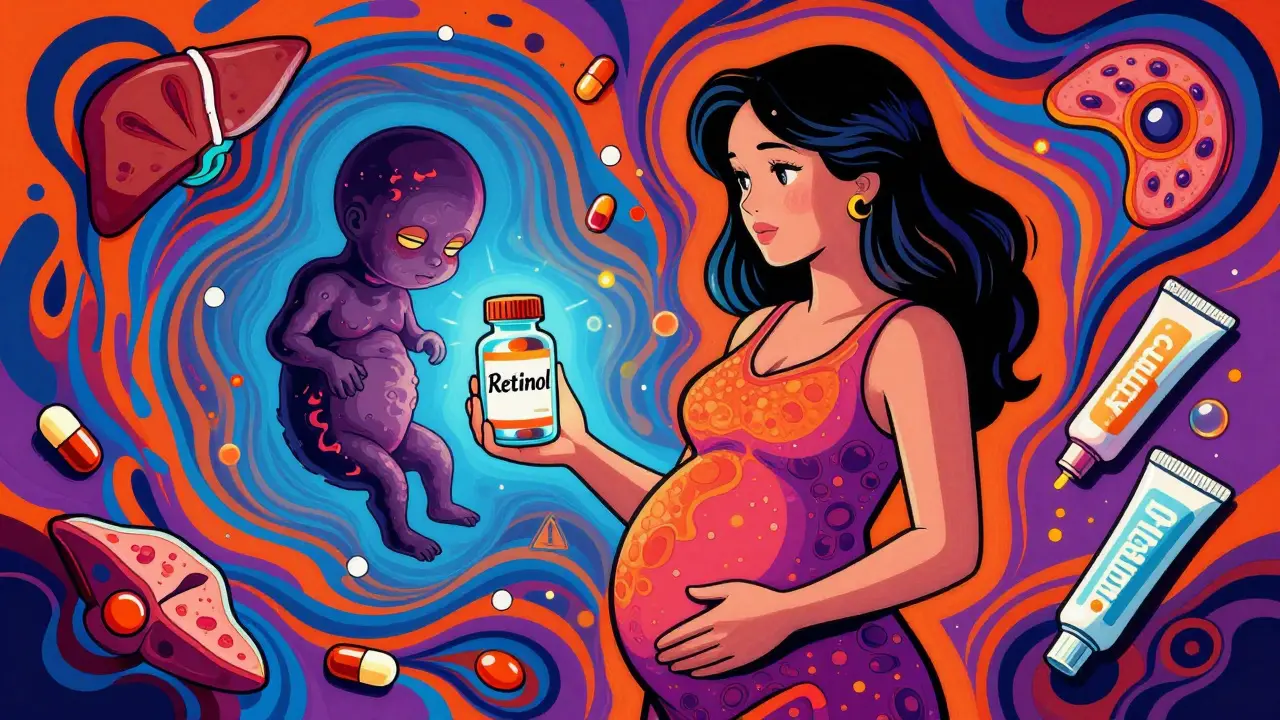
Vitamin A Intake Calculator for Pregnancy
This calculator helps you determine if your vitamin A intake is within safe limits during pregnancy. Remember: Preformed vitamin A (retinol) is risky in high doses, but beta-carotene is safe. The maximum safe limit is 10,000 IU per day.
When you hear vitamin A, you probably think of healthy skin, good vision, or immune support. But what if that same nutrient, taken in the wrong form or amount during pregnancy, could cause serious birth defects? This isn’t hypothetical. It’s a well-documented medical reality. The difference between a safe supplement and a dangerous one comes down to chemistry, dosage, and timing - and most people have no idea how big the risk really is.
What Exactly Are Retinoids and Vitamin A?
Vitamin A isn’t one thing. It’s a group of compounds. The active forms - like retinol, retinal, and retinoic acid - are called retinoids. These are found in animal products: liver, fish oils, dairy, and eggs. Then there’s beta-carotene, a plant-based precursor your body converts into vitamin A as needed. Sounds harmless, right? But here’s the catch: your body can store retinoids for months. Beta-carotene? It doesn’t get stored. Excess just passes through.
Prescription retinoids like isotretinoin (Accutane®) are synthetic versions of retinoic acid. They’re powerful - used for severe acne, psoriasis, and other skin conditions. But they’re also among the most dangerous drugs you can take during pregnancy. The FDA classifies isotretinoin as Pregnancy Category X: absolutely contraindicated. Why? Because even tiny doses can wreck embryonic development.
When Does the Damage Happen?
It’s not about the whole pregnancy. It’s about a narrow window: weeks 3 to 5 after conception. That’s when the embryo’s organs start forming - the heart, brain, eyes, ears, jaws. Retinoids don’t just cause random defects. They disrupt the master switches that tell cells where to go and what to become. Specifically, they interfere with Hoxb-1 and other homeobox genes that control body patterning. Think of it like giving a builder the wrong blueprint during the foundation stage.
Studies from the 1950s, like those by Sidney Q. Cohlan at NYU, showed that rats fed high doses of vitamin A gave birth to offspring with cleft palates, missing eyes, and brains sticking out of their skulls. Human cases mirror this. The most common malformations linked to retinoid exposure include:
- Craniofacial defects: small jaw, cleft lip/palate
- Central nervous system issues: microcephaly, hydrocephalus
- Heart defects: ventricular septal defects, outflow tract abnormalities
- Thymus and ear malformations
And here’s the scary part: you don’t need to be on Accutane® to be at risk. Just eating a 3-ounce serving of beef liver - which contains 27,000 IU of vitamin A - can exceed the safe daily limit for pregnant women.
How Much Is Too Much?
Not all forms of vitamin A carry the same risk. That’s the key point most people miss.
Preformed vitamin A (retinol, retinyl palmitate): Found in supplements, prenatal vitamins, liver, and cod liver oil. This form is directly bioavailable and stored in the liver. The World Health Organization and the American College of Obstetricians and Gynecologists agree: 10,000 IU per day is the upper limit for pregnant women. Exceed that - even for a few weeks - and your risk of birth defects jumps.
Synthetic retinoids (isotretinoin, acitretin, etretinate): These are 10 to 30 times more potent than natural retinol. Isotretinoin increases the risk of major malformations by 25 times compared to the general population. At doses as low as 0.5 mg/kg/day, it’s enough to cause damage. The FDA’s iPLEDGE program, which requires two negative pregnancy tests, monthly counseling, and two forms of contraception, exists for one reason: to prevent this.
Beta-carotene: Found in carrots, sweet potatoes, spinach. Your body only converts it to active vitamin A as needed. No storage. No toxicity. Studies show even 180 mg/day (300,000 IU equivalent) doesn’t cause birth defects. The Institute of Medicine has no upper limit for beta-carotene because it’s safe.

Topical vs. Oral: Don’t Assume Topicals Are Safe
If you’re using retinol cream or tretinoin (Retin-A®) on your face, you might think you’re fine. After all, it’s just a cream. But here’s what the data says:
- Topical tretinoin leads to plasma concentrations under 0.5 ng/mL - too low to be considered teratogenic.
- Still, the FDA and ACOG recommend avoiding it during pregnancy as a precaution.
- There’s no documented case of birth defects from topical retinoids alone.
- But if you’re also taking oral supplements or eating liver? That’s a different story.
The real danger is cumulative exposure. A woman might use a retinoid cream, take a prenatal with 5,000 IU of retinyl palmitate, and snack on liver once a week. No one thinks to add it up. But the body doesn’t care where the retinoid came from.
Who’s at Risk? It’s Not Just Women on Accutane®
Most people assume only women taking isotretinoin are at risk. But data from the National Birth Defects Prevention Network shows 15-20% of vitamin A-related birth defects occurred in women who never took prescription retinoids. They were just taking:
- Prenatal vitamins with retinyl palmitate (78% of them do)
- Cod liver oil supplements (common for “immune support”)
- Fortified foods or multivitamins with high-dose vitamin A
- Traditional liver-based remedies (common in some cultures)
One Reddit user, ‘AcneWarrior2021’, posted: “My dermatologist didn’t properly explain the pregnancy risks with Accutane-I got pregnant 3 weeks after my last dose and had to terminate.” That’s not rare. Isotretinoin’s half-life is only 18-24 hours, but it can still be in your system long enough to cause damage if you conceive too soon after stopping.
And then there’s acitretin - used for psoriasis. It has a half-life of 50 hours, but its metabolites linger for up to two years. Women are told to avoid pregnancy for 3 years after stopping. Many don’t believe it until it’s too late.
What Should You Do? A Clear Action Plan
If you’re planning pregnancy or could become pregnant:
- Check your prenatal vitamin. Look at the label. If it says “retinol,” “retinyl palmitate,” or “vitamin A (as retinol),” it’s risky. Switch to one with beta-carotene instead.
- Avoid liver and cod liver oil. One serving of beef liver = 27,000 IU. That’s 2.7 times the daily limit.
- If you’re on isotretinoin or another oral retinoid: Follow the iPLEDGE program exactly. Two forms of birth control. Monthly pregnancy tests. No exceptions.
- Don’t assume topical retinoids are safe. While risk is low, it’s still not zero. Talk to your doctor.
- Ask about alternatives. For acne, are there non-retinoid options? For skin health, can you get your vitamin A from carrots and sweet potatoes?

The Bigger Picture: Why This Keeps Happening
There’s a gap between science and practice. Dermatologists follow guidelines 92% of the time. General practitioners? Only 58%. Why? Because they’re not trained in teratology. They don’t know that a 5,000 IU vitamin A supplement is risky during pregnancy - they just see “vitamin A” and think it’s healthy.
Supplement makers don’t help. 73% of vitamin A supplements contain preformed vitamin A. 42% exceed 10,000 IU per serving. And labels? Often unclear. “Vitamin A” doesn’t tell you if it’s retinol or beta-carotene.
Global disparities are even worse. In low-resource settings, access to contraception and prenatal care is limited. The Lancet Global Health found teratogenic exposure rates are 8.3 times higher there. No one’s talking about this.
The Future: Safer Options Are Coming
Good news: researchers are working on it. A new retinoid analog, LGD-1550, is in Phase II trials. It works as well as isotretinoin for acne - but in animal studies, it didn’t cause birth defects. If approved, it could replace current drugs.
The Vitamin A Safety Consortium, funded by the NIH, is also creating standardized educational materials. Early results show a 32% improvement in patient understanding after using them. That’s progress.
But until then, the message is simple: vitamin A isn’t always safe. And when you’re pregnant, it can be deadly. You don’t need to avoid all vitamin A. You just need to know which form you’re taking - and how much.
Can I take vitamin A supplements while pregnant?
Only if they contain beta-carotene, not preformed vitamin A. Most prenatal vitamins contain retinyl palmitate or retinol - forms that can cause birth defects. Check the label. If it says "vitamin A (as retinol)" or lists a number over 5,000 IU, switch brands. Beta-carotene is safe even at high doses because your body only converts what it needs.
Is isotretinoin (Accutane®) the only dangerous retinoid?
No. All oral retinoids - including acitretin (Soriatane®) and etretinate (Tigason®) - are teratogenic. Isotretinoin is the most common, but acitretin has a half-life of up to two years, meaning you must avoid pregnancy for 3 years after stopping. Even topical retinoids like tretinoin (Retin-A®) are discouraged during pregnancy, though the risk is very low.
How long should I wait after stopping retinoids before trying to get pregnant?
For isotretinoin, wait at least one month after stopping. For acitretin, wait three years. For etretinate, wait two years. These aren’t guesses - they’re based on how long the drug stays in your system. Many women don’t know this and get pregnant too soon, leading to devastating outcomes.
Can I eat liver during pregnancy?
No. A 3-ounce serving of beef liver contains 27,000 IU of vitamin A - more than two and a half times the safe daily limit. Even one serving can push you over the edge. The same goes for cod liver oil. Stick to plant-based sources like carrots, sweet potatoes, and spinach for your vitamin A needs.
Are there any safe alternatives to retinoids for acne during pregnancy?
Yes. Topical azelaic acid, benzoyl peroxide, and glycolic acid are considered safe. Oral antibiotics like erythromycin may be used under supervision. Always consult your OB-GYN or dermatologist - never self-prescribe. The goal is to manage acne without risking your baby’s development.
Final Takeaway
You don’t need to fear vitamin A. You need to know what kind you’re getting. Beta-carotene? Safe. Preformed retinol? Dangerous at high doses. Prescription retinoids? Absolutely not during pregnancy. The science is clear. The risks are real. And the consequences are lifelong. If you’re planning a pregnancy - or could become pregnant - take five minutes to check your supplements. It could save your child from a preventable birth defect.
13 Comments
Robert Gilmore February 13, 2026 AT 01:03
So let me get this straight - we’re all supposed to panic because someone ate liver and didn’t check the label on their prenatal? This isn’t a pharmaceutical ad, it’s a public health panic dressed up as science. The FDA’s iPLEDGE program exists because Big Pharma wants to sell you more tests, not because the risk is real. You know what’s actually dangerous? Trusting regulatory bodies that approved thalidomide and Vioxx. Vitamin A? Nah. Your body’s been handling it for 2 million years. Now go check your supplement bottle again. You’re welcome.
Robert Gilmore February 13, 2026 AT 19:13
Retinoids are just the tip of the iceberg. Did you know the WHO’s 10,000 IU limit was based on a 1957 rat study where they fed the animals 50x human equivalent? And yet here we are, turning a single data point into a global doctrine. Meanwhile, the same agencies that warn about vitamin A are still pushing fluoride in water and glyphosate in cereal. Coincidence? Or is this just another case of selective toxicity fearmongering? I’ve seen more credible science in a 4chan thread.
Robert Gilmore February 13, 2026 AT 21:10
I love how this post breaks down the science but also acknowledges how messy real life is. People aren't robots. We eat liver because grandma made it. We take prenatal because the label says 'for moms'. We use retinol cream because it clears our skin. The real issue isn't the science - it's the communication gap. Doctors don't explain it. Labels don't clarify it. We need simple visual guides. Like a color-coded system: green for beta-carotene, red for retinol. Maybe even a QR code on bottles. Just saying.
Robert Gilmore February 15, 2026 AT 16:32
The empirical evidence presented in this post is both comprehensive and methodologically sound. The distinction between preformed vitamin A and carotenoid precursors is well-supported by longitudinal cohort studies, including those conducted by the National Birth Defects Prevention Network. The regulatory frameworks, particularly the iPLEDGE program, represent a rational risk mitigation strategy grounded in pharmacokinetic data. It is imperative that clinicians and patients alike prioritize evidence-based counseling over anecdotal assumptions.
Robert Gilmore February 16, 2026 AT 08:52
Imagine your baby’s face being shaped by a molecule you thought was just ‘vitamin A’ - like a sculptor working blindfolded. That’s what this is. But here’s the beautiful part: you can flip the script. Swap that scary supplement for sweet potatoes. Trade liver for spinach. It’s not about fear - it’s about choice. And damn, what a choice. One meal, one label, one switch - and you’re not just protecting a life. You’re giving it a clean slate. That’s power. That’s love. That’s science with soul.
Robert Gilmore February 17, 2026 AT 01:11
i read this whole thing and my brain is like huh? so beta carotene good retinol bad? but what if i eat carrots and take vit a supple? is that bad? or is it like... if i eat one liver and then take a supple its like double trouble? i dont get it. sorry my english bad
Robert Gilmore February 18, 2026 AT 11:14
There’s no evidence that dietary vitamin A causes birth defects. None. The studies they cite are either on synthetic retinoids at 10x human dose or rodent models with forced overfeeding. The real danger? Fear. Fear of supplements. Fear of labels. Fear of doctors who don’t know the difference between retinol and beta-carotene. This post reads like a corporate white paper disguised as public health advice. If you want to be safe, don’t take supplements. Don’t read articles. Just live. Your body knows what to do.
Robert Gilmore February 18, 2026 AT 23:28
Biggest takeaway? Check your prenatal. I didn’t. Mine had 10k IU of retinyl palmitate. I switched to one with beta-carotene - no change in my skin, no change in my energy, but now I sleep better. Also - cod liver oil? Yeah, I was taking that for ‘omega-3s’. Turns out it’s basically pure retinol. Dropped it. No regrets. If you’re trying to conceive or pregnant, spend 3 minutes reading your label. It’s the easiest win in reproductive health. Seriously. Do it.
Robert Gilmore February 18, 2026 AT 23:39
Vitamin A is a molecule. Not a villain. The real tragedy? We turn nutrients into moral tests. You ate liver? You’re a bad mom. You took a supplement? You’re negligent. Meanwhile, the same people who panic about retinol are fine with 300 mg of folic acid - which is 60x the natural intake. We’re not protecting babies. We’re policing women.
Robert Gilmore February 19, 2026 AT 01:38
Okay but what about vegans? If you’re not eating liver or supplements, you’re getting zero preformed vitamin A. Is that a problem? I’ve seen studies where vegan moms had babies with mild vision issues. So is beta-carotene enough? Or are we setting up a new kind of deficiency? Just asking. Not judging. Just… curious.
Robert Gilmore February 20, 2026 AT 06:54
Great point. Beta-carotene conversion varies wildly by genetics - MTHFR mutations, gut health, zinc levels. Some people convert poorly. That’s why some prenatal brands now include a small amount of preformed vitamin A (2,500 IU) alongside beta-carotene. It’s not about avoiding retinol entirely - it’s about smart balance. The goal isn’t zero exposure. It’s controlled, informed exposure. And yes - vegans should talk to a nutritionist. This isn’t fear. It’s precision.
Robert Gilmore February 22, 2026 AT 06:09
In my country, we eat liver every week. Our grandmothers did. Our mothers did. No birth defects. No hospital visits. No panic. You think your Western science is better? You think your labels and programs protect better? We have real food. You have fear. And fear is the real teratogen.
Robert Gilmore February 23, 2026 AT 10:30
You’re not alone. I didn’t know any of this until I got pregnant. My OB said ‘vitamin A is fine’ - until I showed her the label. She was shocked. We switched. Now I eat sweet potatoes like they’re candy. I’m not scared. I’m informed. And if you’re reading this, you’re already ahead. Just check your bottle. One minute. That’s all it takes. You got this.