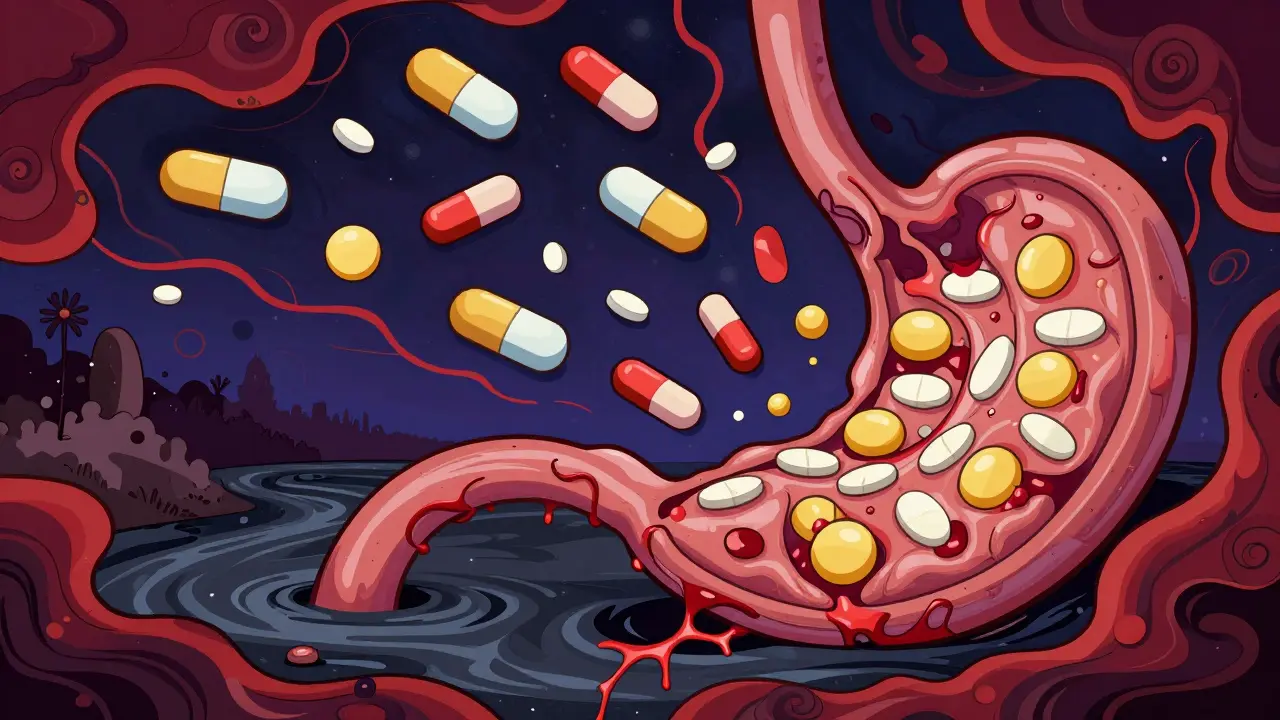
Most people think of NSAIDs as harmless pain relievers you can grab off the shelf. Ibuprofen. Naproxen. Even low-dose aspirin. But when taken too often, too long, or with other meds, these common drugs can silently tear up your gut - and lead to life-threatening bleeding. You might not feel a thing until you’re vomiting blood or passing black, tar-like stools. Or worse - you feel fine, but your hemoglobin drops, your body slowly starves from internal bleeding, and you don’t even know why.
How NSAIDs Damage Your Gut
NSAIDs work by blocking enzymes called COX-1 and COX-2. COX-2 is linked to pain and inflammation - that’s the good part. But COX-1 protects your stomach lining by helping produce mucus and blood flow to keep it healthy. When you take NSAIDs regularly, you shut down COX-1 too. No mucus. Less blood flow. Your stomach lining becomes vulnerable. Even if you’re not taking high doses, long-term use causes damage. Studies show up to 70% of people on chronic NSAIDs have visible stomach or intestinal damage on endoscopy - and most of them have zero symptoms.
This isn’t just about stomach ulcers. NSAIDs hurt your entire digestive tract - from the esophagus down to the colon. They can cause tiny erosions, deep ulcers, and slow, ongoing bleeding you won’t notice until you’re anemic. Iron deficiency isn’t always from diet. Sometimes, it’s from a silent bleed in your small intestine caused by daily ibuprofen.
The Silent Killer: No Symptoms, Just Bleeding
Here’s the scary part: you don’t need to have heartburn, nausea, or pain to be at risk. In fact, only about 10% of people with NSAID-induced ulcers report any warning signs. The rest? They feel fine. Until they collapse from internal bleeding. Clinical trials found that over half of patients on NSAIDs developed anemia - a drop in hemoglobin - without any visible ulcer or bleeding on endoscopy. That means your body is losing blood, but you can’t see it, feel it, or know it’s happening.
That’s why doctors call NSAID-related GI bleeding a "silent" threat. It doesn’t scream. It whispers. And by the time it shouts, it’s often too late.
Who’s Most at Risk?
Not everyone is equally vulnerable. Certain people are walking into danger without realizing it:
- People over 65: Age weakens the stomach lining. The older you are, the higher your risk - and the risk goes up with every extra milligram of aspirin or NSAID.
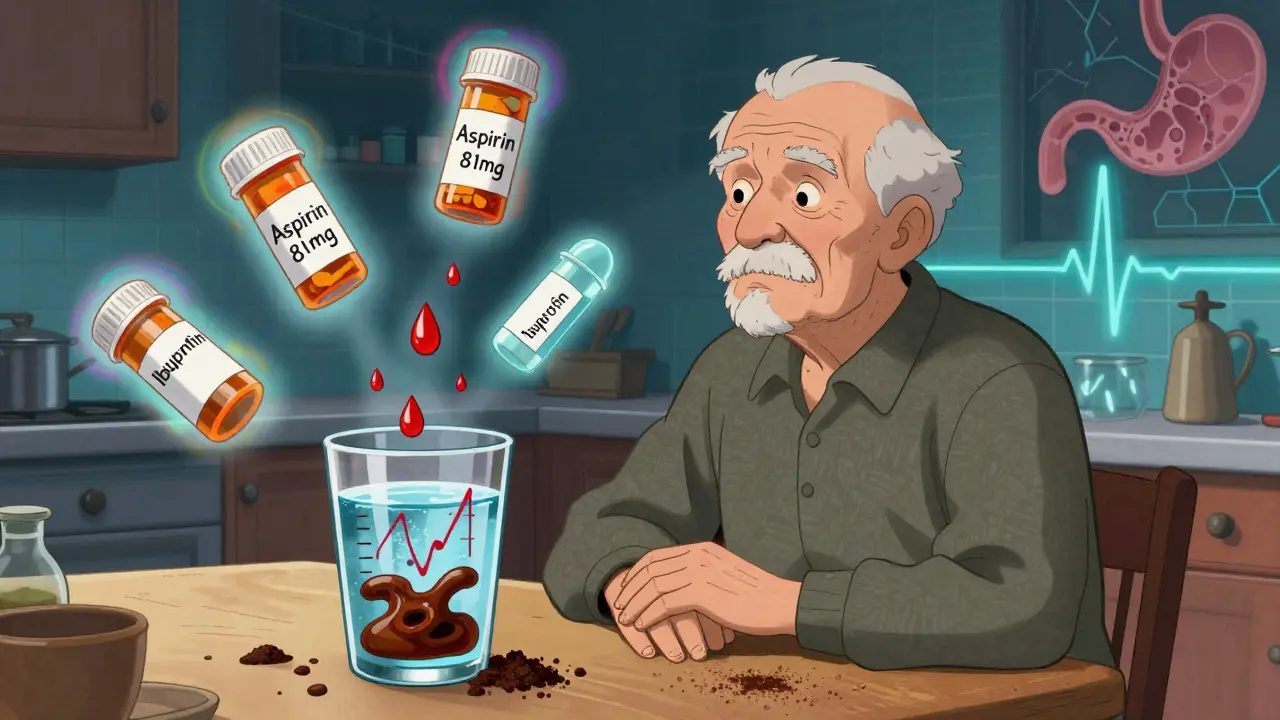
- Those on low-dose aspirin: Even 81 mg daily - the "baby aspirin" many take for heart health - increases GI bleeding risk 2 to 4 times. And if you’re taking it with another NSAID? That risk doubles again.
- People with a past ulcer or GI bleed: If you’ve had one before, your chance of another is five times higher when you take NSAIDs.
- Those on blood thinners or antiplatelets: Mixing NSAIDs with drugs like clopidogrel (Plavix) or warfarin is like pouring gasoline on a fire. The risk of serious bleeding skyrockets.
- People with H. pylori infection: This common stomach bacteria makes NSAID damage worse. It doesn’t cause bleeding alone - but with NSAIDs? It multiplies the risk by 1.2 times.
And here’s something most people don’t know: enteric-coated or buffered aspirin doesn’t help. It still damages your gut. The coating might delay the release, but it doesn’t stop the effect on COX-1.
Aspirin Isn’t Safe Just Because It’s "Low Dose"
Millions take daily low-dose aspirin thinking it’s harmless. But the data says otherwise. In one study, over one-third of people hospitalized for GI bleeding were taking over-the-counter aspirin - often without a doctor’s advice. They thought they were protecting their heart. Instead, they were risking their gut.
And increasing the dose doesn’t help your heart more - it just makes bleeding worse. Daily doses of 75 mg, 150 mg, and 300 mg of aspirin raised bleeding odds to 2.3, 3.2, and 3.9 times respectively. The American College of Cardiology and the American Heart Association agree: stick to 81 mg. Go higher? You’re not getting more protection. You’re just getting more bleeding.
The Deadly Mix: NSAIDs + Aspirin
Combining NSAIDs with low-dose aspirin is one of the most dangerous practices in medicine today. The 2008 expert consensus from the ACCF, ACG, and AHA found that people on both drugs have a 5.6% chance of a serious upper GI event each year - that’s more than 1 in 20 people. And if you’re on a COX-2 inhibitor like celecoxib instead of a traditional NSAID? It doesn’t help. You’re still at 7.5% risk - because aspirin cancels out any protection.
And it’s not just the stomach. This combo also raises your risk of heart attack, stroke, and death by 1.4 times. You’re trading one danger for another.
Doctors need to stop prescribing this mix unless absolutely necessary. And patients need to stop self-medicating with NSAIDs while already on aspirin. If you’re on aspirin for heart protection, talk to your doctor before taking ibuprofen for a headache.
What About PPIs? Do They Help?
Proton pump inhibitors (PPIs) like omeprazole or pantoprazole are often prescribed with NSAIDs to protect the stomach. And yes - they reduce the risk of upper GI ulcers and bleeding. But they don’t fix everything.
PPIs don’t protect your small intestine. That’s where a lot of NSAID damage happens - and where bleeding often goes undetected. You can be on a PPI, feel fine, and still lose blood slowly through your colon or jejunum. That’s why anemia can still develop even with PPIs.
Also, long-term PPI use has its own risks - bone loss, kidney problems, infections. So don’t take them just because you think you "need" them. Only use them if your doctor confirms you’re high-risk and you’re still taking NSAIDs.
What Should You Do?
If you’re taking NSAIDs regularly - even just a few times a week - here’s what to do:
- Ask yourself: Do I really need this? Can you use heat, rest, physical therapy, or acetaminophen instead? NSAIDs aren’t the only option.
- Check your meds list. Are you on aspirin? Blood thinners? Antiplatelets? If yes, NSAIDs are likely unsafe. Talk to your doctor before taking any.
- Don’t assume "over-the-counter" means safe. Just because you can buy it without a prescription doesn’t mean it won’t hurt you.
- Watch for signs. Black stools, dark vomit, unexplained fatigue, dizziness, or shortness of breath could mean internal bleeding. Get checked - even if you think it’s "nothing."
- Get tested if you’re at risk. If you’re over 65, on aspirin, or have a history of ulcers, ask your doctor about a hemoglobin test or stool blood test. It’s simple. It’s cheap. It could save your life.
When to Stop NSAIDs Immediately
Stop taking NSAIDs right away and get medical help if you have:
- Black, tarry stools
- Vomiting blood or material that looks like coffee grounds
- Sudden dizziness, fainting, or rapid heartbeat
- Unexplained weakness or shortness of breath
- Severe abdominal pain
These aren’t "wait and see" symptoms. They’re emergency signs. Delaying care increases your chance of death.
The Bottom Line
NSAIDs aren’t evil. They help millions with pain and inflammation. But they’re not harmless either. The risk of GI bleeding is real, silent, and often preventable. The biggest danger isn’t taking one pill - it’s taking them daily, without thinking, while also taking aspirin or other meds. It’s assuming "it’s just a painkiller" and ignoring your body’s quiet warnings.
If you’re on NSAIDs long-term, especially with aspirin or other heart meds, talk to your doctor. Don’t wait for bleeding to happen. Ask: Is this still necessary? Are there safer options? Do I need a test? Small changes - like switching to acetaminophen, reducing frequency, or stopping NSAIDs entirely - can prevent a hospital stay, a blood transfusion, or worse.
Your gut doesn’t scream. But if you listen - really listen - it’s trying to tell you something.
Can I take ibuprofen if I’m on low-dose aspirin for my heart?
It’s not recommended. Combining ibuprofen or other NSAIDs with low-dose aspirin doubles your risk of gastrointestinal bleeding and increases your chance of heart attack or stroke. If you need pain relief, talk to your doctor about alternatives like acetaminophen (paracetamol). If you must use an NSAID, do so only occasionally and under medical supervision - never daily.
Do I need a stomach test if I take NSAIDs regularly but feel fine?
Yes, if you’re over 65, have a history of ulcers, or are on blood thinners or aspirin. Even if you feel fine, NSAIDs can cause silent bleeding. A simple blood test for hemoglobin or a stool test for hidden blood can detect early signs of internal bleeding before it becomes life-threatening. Don’t wait for symptoms - get checked.
Are COX-2 inhibitors like celecoxib safer for my stomach?
They reduce upper GI ulcer risk compared to traditional NSAIDs - but only if you’re not taking aspirin. If you’re on low-dose aspirin, COX-2 inhibitors offer no extra protection. Your risk of bleeding stays high. Also, they carry their own cardiovascular risks. They’re not a magic fix. Always weigh the full risk profile with your doctor.
Can enteric-coated or buffered aspirin prevent GI bleeding?
No. These formulations may reduce stomach irritation, but they don’t stop aspirin from blocking COX-1 enzymes - the main cause of bleeding. The damage still happens in the gut lining. Studies show no meaningful reduction in bleeding risk with enteric-coated or buffered aspirin. Stick to 81 mg daily and avoid NSAIDs entirely if possible.
What’s the safest painkiller if I’m at risk for GI bleeding?
Acetaminophen (paracetamol) is generally the safest choice for pain relief if you’re at risk for GI bleeding - as long as you don’t exceed the daily limit (usually 3,000-4,000 mg). It doesn’t affect the stomach lining or interfere with blood clotting. But it’s not an anti-inflammatory, so it won’t help with swelling. For inflammation, ask your doctor about non-drug options like physical therapy, ice, or compression.
How long does it take for NSAIDs to cause serious GI damage?
Damage can start within days, especially in high-risk people. But serious bleeding often takes weeks or months to develop - which is why it’s so dangerous. Many people take NSAIDs for months without symptoms, then suddenly have a bleed. There’s no safe "time limit" - it depends on your individual risk factors like age, other meds, and prior history. If you’re taking them regularly, assume you’re at risk.
12 Comments
Robert Gilmore January 18, 2026 AT 16:45
Man, I took ibuprofen every day for my back pain for years. Felt fine. Then one day I just felt exhausted all the time. Turned out my hemoglobin was at 8. No warning. No pain. Just... tired. Got tested after my doc saw I was pale as a ghost. NSAIDs are silent assassins. Don't wait until you're dizzy to check.
Robert Gilmore January 19, 2026 AT 17:25
It’s not just NSAIDs- it’s the entire medical-industrial complex that treats pain like a bug to be eradicated, not a signal to be listened to. We’ve been conditioned to swallow solutions, not ask questions. COX-1 inhibition? Sure. But why do we accept chronic inflammation as normal? Why not address root causes? Why is the default always a pill? We’re not broken-we’re ignored.
Robert Gilmore January 19, 2026 AT 20:09
so like... i was on aspirin for my heart and took advil for my knee like once a week? turns out i was slowly bleeding out? no wonder i was always so tired lmao. my doc was like ‘you’re lucky u didn’t collapse’ and i was like ‘wait… i thought this was safe??’
Robert Gilmore January 20, 2026 AT 04:33
I used to think ‘over-the-counter’ meant ‘harmless.’ Then I watched my mom go from hiking every weekend to needing a blood transfusion because she took naproxen for arthritis. She didn’t even know she was bleeding. That’s the scariest part-your body doesn’t scream. It just fades. And we’re taught to ignore fading. We need to change that narrative.
Robert Gilmore January 21, 2026 AT 05:56
so like everyone’s acting like NSAIDs are the devil but what about the people who actually need them? i have ankylosing spondylitis and if i don’t take celecoxib i can’t get out of bed. yeah i know the risks but i’d rather bleed slowly than live in pain. stop shaming people for surviving
Robert Gilmore January 21, 2026 AT 15:34
Bro I just got off the phone with my doctor and he told me to stop all NSAIDs cold turkey if I'm on aspirin. I was like ‘but I take it for my headaches’ and he said ‘then get a massage or learn to breathe.’ I thought he was joking. He wasn't. I’m switching to Tylenol. No more ‘just one pill’ mentality. This is real.
Robert Gilmore January 22, 2026 AT 12:13
THIS. I’m a nurse. I’ve seen it too many times. Grandpa on aspirin, grandpa on ibuprofen for arthritis, grandpa passes out at the grocery store. No warning. No pain. Just a hemoglobin of 6. We rush him in, give him 4 units of blood, and he asks why he’s so tired. Because your gut’s been leaking for six months and you didn’t notice. We need to screen people like this. It’s not complicated. It’s not expensive. It’s just ignored.
Robert Gilmore January 22, 2026 AT 14:27
It is not merely pharmaceutical negligence-it is a calculated systemic erosion of bodily autonomy. The FDA, the AMA, the pharmaceutical lobby-they profit from chronic illness. They market NSAIDs as benign, while the data screams otherwise. The silent bleeding? It is not an accident. It is a feature of the model. You are not a patient. You are a revenue stream. Wake up.
Robert Gilmore January 23, 2026 AT 06:10
Ugh. Americans. Always popping pills like candy. In Canada, we don’t just swallow whatever’s on the shelf-we talk to a pharmacist. We ask questions. We don’t assume ‘low dose’ means ‘safe.’ We don’t treat our guts like disposable organs. Maybe if you stopped treating your body like a machine that needs a reset button, you wouldn’t be bleeding out from ibuprofen.
Robert Gilmore January 24, 2026 AT 22:46
The pathophysiology of NSAID-induced mucosal injury is mediated through COX-1 suppression, leading to diminished prostaglandin E2 synthesis, which compromises mucosal defense mechanisms. Concurrent low-dose aspirin exacerbates this via irreversible platelet inhibition, synergistically increasing hemorrhagic potential. The absence of symptomatic presentation does not equate to absence of pathology. This is not anecdotal-it is biologically deterministic. Your gut is not a black box. It is a bioelectrochemical interface. Treat it accordingly.
Robert Gilmore January 26, 2026 AT 13:32
I’m 72, on low-dose aspirin since my stent, and I take Tylenol for headaches now. I used to think ibuprofen was fine-I even told my grandkids it was ‘just a painkiller.’ But after reading this, I realized I was being careless with my body. I didn’t want to be the one who ‘didn’t know’ until it was too late. I’m glad I changed. It’s not about fear. It’s about respect. Your body doesn’t owe you pain relief. You owe it care.
Robert Gilmore January 27, 2026 AT 00:30
According to the 2020 ACG guidelines on NSAID-associated gastrointestinal injury, the relative risk of upper GI bleeding in patients on chronic NSAIDs without concomitant PPI is 4.5-fold compared to non-users. The risk escalates to 7.2-fold when combined with low-dose aspirin. Enteric coating confers no significant protective benefit (p > 0.05 in meta-analysis). PPIs reduce upper GI events by approximately 60%, but offer no protection against small bowel injury. Hemoglobin monitoring and fecal occult blood testing are underutilized screening tools with >90% sensitivity in high-risk populations. Clinical decision-making must be risk-stratified, not reflexive.