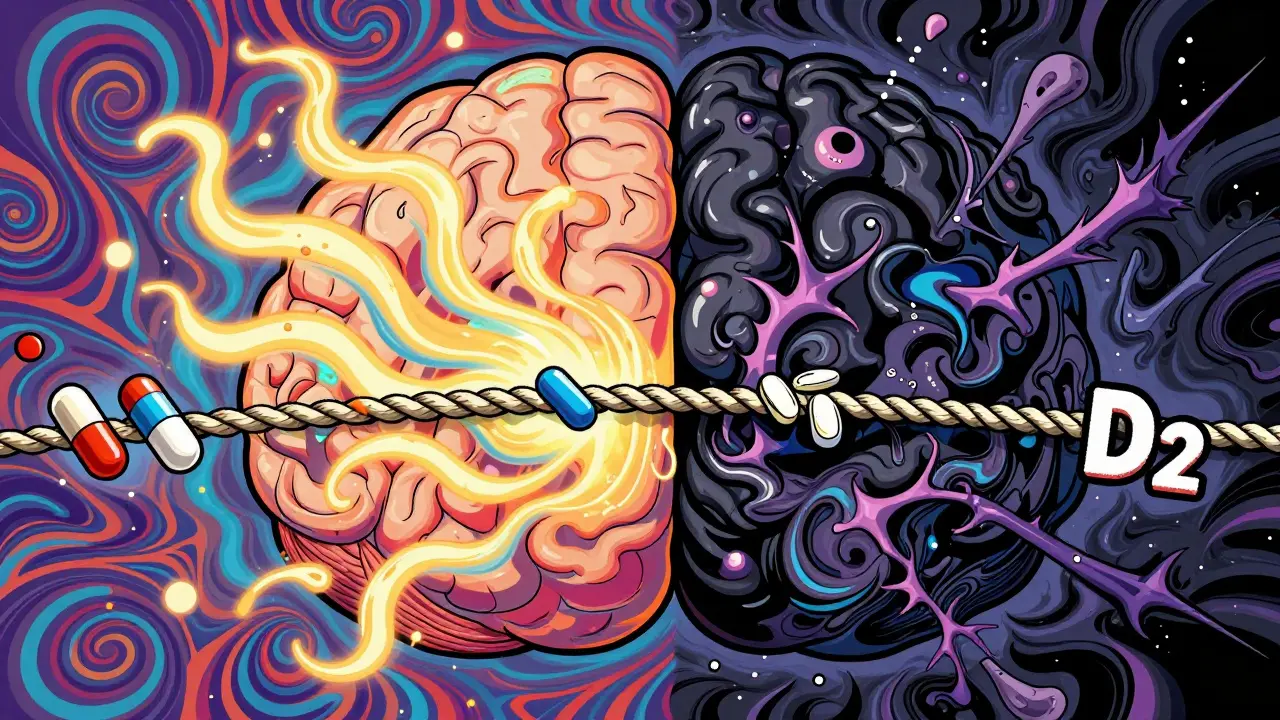
When someone with Parkinson’s disease starts having hallucinations or delusions, doctors face a brutal choice: treat the psychosis and risk making the tremors worse, or leave the psychosis untreated and watch quality of life crumble. This isn’t a simple trade-off-it’s a biological tug-of-war between two types of drugs that work in opposite directions on the same brain chemical: dopamine.
How Levodopa Works (and Why It’s Essential)
Levodopa is the gold standard for treating Parkinson’s disease. It’s not a drug that directly replaces dopamine-it’s a precursor. Your body converts levodopa into dopamine inside the brain, helping to refill the tanks of neurons that have died off due to Parkinson’s. This restores movement, reduces stiffness, and helps people walk again. But here’s the catch: as Parkinson’s gets worse, the brain loses more of its ability to store and regulate dopamine. Early on, leftover dopamine neurons act like smart sponges-they take in levodopa, convert it slowly, and release dopamine in a steady stream. Later, those neurons are gone. What’s left are brain cells that can’t control the flow. So when you take levodopa, dopamine floods the system all at once, then crashes. These wild swings are what cause dyskinesias-the involuntary jerking movements that many long-term users develop. Studies using PET scans show that in advanced Parkinson’s, the same dose of levodopa produces dopamine spikes up to five times larger than in early-stage patients. That’s not a bug-it’s a feature of the disease itself. The brain’s natural braking system is broken.How Antipsychotics Work (and Why They’re Dangerous Here)
Antipsychotic drugs like haloperidol, risperidone, and olanzapine were designed to calm overactive dopamine signaling in schizophrenia. They work by blocking dopamine D2 receptors-the very same receptors that levodopa tries to stimulate. In a healthy brain, this helps reduce hallucinations and paranoia. But in someone with Parkinson’s, those receptors are already starved for dopamine. When you block them with an antipsychotic, you’re essentially turning off the lights in a room that’s already half-dark. The result? Motor symptoms get dramatically worse. Studies show that within days of starting even low doses of antipsychotics, Parkinson’s patients can see a 25-35% increase in rigidity, bradykinesia, and tremor on standardized scales like the UPDRS. Worse still, some antipsychotics trigger a rare but deadly condition called neuroleptic malignant syndrome (NMS). It causes fever, muscle rigidity, confusion, and organ failure. The risk is small-about 1 in 5,000-but it’s 10-20% fatal. And it often happens when levodopa is stopped suddenly, or when antipsychotics are added too quickly. The Cleveland Clinic has documented cases where patients developed NMS within 72 hours of starting risperidone at just 0.5 mg per day.The Therapeutic Paradox
This is where things get truly messy. People with Parkinson’s aren’t the only ones caught in this crossfire. Some patients with schizophrenia develop Parkinson-like symptoms from long-term antipsychotic use. Their doctors may then consider giving them levodopa to relieve the stiffness and slowness. But here’s what happens: in 15-20% of schizophrenia patients, levodopa triggers a return of hallucinations, paranoia, or delusions. One landmark study from 1988 gave 300 mg of levodopa daily to schizophrenia patients and found that 60% had a major worsening of psychotic symptoms. That’s not a side effect-it’s a direct pharmacological trigger. Levodopa isn’t just helping movement; it’s overstimulating the mesolimbic pathway, the same brain circuit that’s overactive in psychosis. So you have two conditions that are, in a sense, mirror images of each other:- Parkinson’s = too little dopamine in motor areas
- Schizophrenia = too much dopamine in thought/emotion areas

What Doctors Actually Do
Most neurologists avoid typical antipsychotics like haloperidol entirely in Parkinson’s patients. Even second-generation drugs like risperidone and olanzapine are risky. A 2022 survey of 150 movement disorder specialists found that 89% avoid typical antipsychotics, and only 42% have ever prescribed pimavanserin-the only FDA-approved drug for Parkinson’s psychosis that doesn’t block dopamine. Pimavanserin (brand name Nuplazid) works differently. Instead of touching dopamine receptors, it blocks serotonin 5-HT2A receptors. This helps reduce hallucinations without worsening movement. It’s expensive-over $40,000 a year-and not always covered by insurance. But for patients who’ve tried everything else, it’s often the only safe option. Quetiapine is sometimes used off-label because it has weaker dopamine-blocking effects. But even at low doses (12.5-25 mg), many patients still report increased stiffness or slower walking. One Reddit user with Parkinson’s wrote: “My tremor went from 2/10 to 8/10 within two days of starting 0.25 mg quetiapine.” That’s not anecdotal-it’s common.When Levodopa Is Given to Schizophrenia Patients
It’s rare, but it happens. Sometimes, a person on long-term antipsychotics develops parkinsonian side effects-shuffling gait, drooling, frozen facial expression. Their psychiatrist might suspect drug-induced Parkinsonism and consider levodopa to reverse it. But in 20-40% of these cases, adding levodopa causes a psychotic relapse. A case series from Zucker Hillside Hospital tracked nine patients with schizophrenia who were given levodopa for movement issues. Within 48 hours, their psychotic symptoms spiked. PANSS scores-the standard measure of schizophrenia severity-jumped from 70 to over 100. One patient had to be hospitalized after hallucinations returned after two years of stability. This isn’t just about dosage. Even 300 mg of levodopa-a dose sometimes used for restless legs-can be enough to trigger psychosis in vulnerable brains. It’s not that levodopa causes schizophrenia. It’s that it can ignite dormant psychosis in people whose brains are already wired for it.
What’s New in Treatment
The pharmaceutical industry is finally catching up. After decades of trying to tweak dopamine, researchers are looking away from it entirely. KarXT (xanomeline-trospium), a new drug tested in a 2023 Phase 3 trial, showed a 25% reduction in psychosis in Parkinson’s patients-with no worsening of movement. It works by activating muscarinic receptors, which are part of a different brain system altogether. It’s not dopamine-based. It doesn’t interfere with levodopa. And it’s already showing promise in schizophrenia trials too. Another approach targets alpha-synuclein, the misfolded protein that clumps in Parkinson’s and may also drive psychosis. If researchers can clear those clumps without touching dopamine, they might solve both problems at once. The FDA now explicitly encourages “dopamine-sparing” approaches in new drug applications. That’s a major shift. It means the old model-block dopamine to treat psychosis, boost dopamine to treat Parkinson’s-is being replaced by smarter, safer strategies.What Patients and Families Should Know
If you or a loved one is on levodopa and starts seeing things that aren’t there:- Don’t stop levodopa on your own. Abrupt withdrawal can cause NMS.
- Don’t start an antipsychotic without a movement disorder specialist’s input.
- Ask about pimavanserin. It’s not perfect, but it’s the only one that doesn’t make Parkinson’s worse.
- Track symptoms. Use a journal to note changes in movement, mood, and hallucinations. A 10-point change on UPDRS or PANSS is clinically significant.
- Don’t assume it’s just aging or Parkinson’s.
- Ask if it’s drug-induced parkinsonism.
- Don’t ask for levodopa unless you’ve ruled out underlying psychosis.
- Work with a psychiatrist and neurologist together. This isn’t a one-doctor problem.
The Bigger Picture
This isn’t just about two drugs clashing. It’s about how deeply we misunderstand brain chemistry. We’ve treated Parkinson’s and schizophrenia as separate diseases with separate treatments. But they’re two sides of the same coin: dopamine imbalance. The future won’t be about choosing between better movement or better mind. It’ll be about fixing the root cause-whether that’s protein buildup, inflammation, or faulty signaling pathways-without touching dopamine at all. For now, the safest path is cautious, collaborative care. And for patients caught in the middle, the best hope lies not in more dopamine, but in smarter, more precise medicine.Can levodopa make psychosis worse in Parkinson’s patients?
Yes. About 15-20% of Parkinson’s patients experience worsening hallucinations or delusions when taking levodopa, especially at higher doses or in advanced disease. This happens because levodopa increases dopamine in brain areas linked to perception and emotion, which can trigger psychotic symptoms in vulnerable individuals.
Why are antipsychotics risky for people with Parkinson’s?
Most antipsychotics block dopamine D2 receptors, which are already under-stimulated in Parkinson’s. This worsens motor symptoms like stiffness, slowness, and tremor by 25-35% on standard scales. Some can even trigger neuroleptic malignant syndrome, a life-threatening condition.
Is there an antipsychotic that doesn’t worsen Parkinson’s symptoms?
Yes-pimavanserin (Nuplazid) is the only FDA-approved antipsychotic for Parkinson’s psychosis that doesn’t block dopamine. Instead, it targets serotonin receptors. While it’s expensive and not always effective, it’s the safest option for patients who need psychosis treatment without worsening movement.
Can you take levodopa if you have schizophrenia?
Generally, no. Levodopa can trigger a return of hallucinations or delusions in 20-40% of schizophrenia patients, even at low doses. It’s only considered in rare cases where drug-induced parkinsonism is severe and other treatments have failed-and even then, it’s done under strict supervision.
What should I do if my Parkinson’s symptoms get worse after starting an antipsychotic?
Contact your neurologist immediately. Do not stop the antipsychotic abruptly-this can cause neuroleptic malignant syndrome. Your doctor may reduce the dose, switch to pimavanserin, or adjust your levodopa regimen. Daily tracking of motor symptoms (UPDRS) is critical during this time.
14 Comments
Robert Gilmore December 23, 2025 AT 00:08
Okay but like... why are we even still using dopamine as the main target?? 🤦♀️ I mean, we’ve been banging our heads against this wall since the 70s. Like, if your brain’s a broken toaster, why keep throwing more bread in? Pimavanserin? Sounds like a drug name from a sci-fi novel. But hey, at least it’s not making people stiff as statues. Also, why is it $40k a year?? Are we paying for the R&D or the CEO’s private island? 🏝️💸
Robert Gilmore December 23, 2025 AT 15:20
One is struck by the profound symmetry inherent in this pharmacological dilemma: a neurochemical axis, once presumed to be a monolithic regulator of behavior, is revealed as a bifurcated river-flowing toward motor liberation in one basin, and toward perceptual dissolution in another. The brain, in its exquisite complexity, does not recognize our categorical boundaries between 'Parkinson’s' and 'schizophrenia.' These are not diseases of the mind or body, but of the topology of neuromodulation. To treat one is to wound the other. Thus, the true therapeutic imperative lies not in manipulation, but in transcendence-beyond dopamine, beyond reductionism, toward systems-level repair.
Robert Gilmore December 25, 2025 AT 03:01
Let’s be clear-this whole 'dopamine-sparing' nonsense is just Big Pharma trying to sell expensive junk because they can’t fix the real problem. In America, we don’t need fancy serotonin blockers. We need better screening, better education, and less of this 'individualized medicine' nonsense. If you can’t handle your meds, don’t take them. Also, why is this article written like a college thesis? Just tell people what to do. Stop overcomplicating things.
Robert Gilmore December 26, 2025 AT 14:49
Look, I get it-dopamine’s the OG neurotransmitter, the godfather of movement and madness. But we’re treating symptoms like they’re the disease. It’s like trying to fix a leaking roof by painting the walls. The real villain? Alpha-synuclein. That’s the real ghost in the machine. We’ve been chasing dopamine like it’s the Holy Grail while the real plague festers in the basement. Pimavanserin’s a Band-Aid. KarXT? Maybe. But until we start cleaning up the protein mess, we’re just rearranging deck chairs on the Titanic.
Robert Gilmore December 28, 2025 AT 13:18
This is a well-structured and clinically accurate overview. The distinction between motor and limbic dopamine pathways is critical. However, access to pimavanserin remains a major barrier in low-resource settings. Global equity in neuropharmacology must be addressed alongside scientific innovation.
Robert Gilmore December 30, 2025 AT 03:18
yo so dopamine is like the brain’s gas pedal and antipsychotics are the brakes… but in parkinson’s the pedal’s already broken and now you’re stomping the brakes? that’s wild. and the fact that giving more gas to a schizo person makes them hallucinate more?? that’s like pouring gasoline on a fire and calling it therapy. i feel bad for people stuck in this mess. we need better tech, not just more drugs. also, i think the brain’s just… glitching. like a corrupted save file. 🤯
Robert Gilmore December 31, 2025 AT 03:18
This is so important!! 🙌 I’ve seen my aunt go through this-tremors worse than ever after trying quetiapine. She cried saying she felt like her body was made of concrete. Pimavanserin? We fought the insurance for 6 months but finally got it. It didn’t fix everything… but it gave her back her smile. 🌈 Thank you for writing this. People need to know there’s hope without sacrificing movement. Keep pushing for better options!! 💪❤️
Robert Gilmore December 31, 2025 AT 22:08
Who funded this study? Big Pharma? I bet they’re hiding something. Dopamine isn’t the problem-it’s the vaccines. They changed the brain chemistry on purpose. That’s why the numbers don’t add up. And why is pimavanserin so expensive? Because they want you dependent. The government knows. The FDA knows. But they won’t tell you. Watch the videos. The truth is buried under jargon. Don’t trust doctors. Trust yourself.
Robert Gilmore January 2, 2026 AT 02:57
Wait, so levodopa can cause psychosis?? But I thought it was just for tremors?? I read this whole thing and now I’m confused. Also, did you mean 'pimavanserin' or 'pimavenserin'? I think you misspelled it. And why is it called Nuplazid? Sounds like a cleaning product. 😅
Robert Gilmore January 2, 2026 AT 09:48
Thank you for this comprehensive breakdown. The clinical nuance here is staggering-and yet so under-discussed in public health discourse. The fact that two neurological conditions are pharmacological mirror images of each other deserves far more attention in medical education. I hope this reaches neurology residents before they’re forced to make these decisions under pressure.
Robert Gilmore January 3, 2026 AT 12:55
So we’re just supposed to accept that dopamine is this magical substance that controls everything and we can’t touch it without breaking something? That’s not science-that’s superstition. Maybe the real issue is that we don’t understand the brain at all. Maybe dopamine is just a red herring. Maybe it’s all about glial cells. Maybe it’s electromagnetic interference from 5G. Or maybe we’re just too lazy to look deeper. But this? This is just pharmaceutical theater.
Robert Gilmore January 4, 2026 AT 02:45
Standardized scales like UPDRS and PANSS are statistically noisy and culturally biased. The 25-35% increase cited is meaningless without effect size confidence intervals. Also, pimavanserin’s efficacy is marginal at best. This article reads like a drug rep’s PowerPoint. The real answer? Better patient selection and early intervention. Not new drugs.
Robert Gilmore January 5, 2026 AT 10:42
Man, this is wild. I’ve got a cousin with Parkinson’s and his doc tried risperidone. He was basically a statue for weeks. We switched to quetiapine and it was still bad. Then we found a doc who knew about pimavanserin-lucky break. It’s pricey, yeah, but he’s walking again and not seeing ghosts. Just wanted to say: if you’re stuck in this mess, keep pushing. There’s a way out. And yeah, the docs don’t always know. Find the specialists. They’re out there.
Robert Gilmore January 5, 2026 AT 18:40
The most haunting thing here isn’t the drug interactions-it’s the fact that we’ve built entire diagnostic categories around a single chemical. We call it 'Parkinson’s psychosis' and 'schizophrenia' as if they’re separate universes. But the brain doesn’t care about our labels. It just reacts. Maybe the future isn’t about finding the perfect drug… but about redefining what we mean by 'disease.' Maybe it’s not a malfunction-it’s a misalignment. And healing might mean restoring balance, not just replacing chemicals.