Why Your Kidneys Need Regular Checkups
Your kidneys work nonstop-filtering about 120 to 150 quarts of blood each day to remove waste and extra fluid. But here’s the problem: you won’t feel anything wrong until they’re already badly damaged. About half your kidney function can be gone before your creatinine levels even start to rise. That’s why simple blood and urine tests are your best early warning system.
Most doctors don’t wait for symptoms. They check kidney health during routine blood work. If you’re over 40, have high blood pressure, diabetes, or a family history of kidney disease, getting these tests yearly isn’t optional-it’s essential. The three key tests? Serum creatinine, eGFR, and urinalysis. Together, they tell you if your kidneys are filtering right-or starting to fail.
What Creatinine Really Tells You
Creatinine is a waste product from your muscles. Every day, your body makes a steady amount. Healthy kidneys filter it out and flush it through urine. When kidney function drops, creatinine builds up in your blood.
But here’s the catch: creatinine alone doesn’t give the full picture. It’s a late signal. You can lose up to 50% of kidney function before your creatinine level climbs above normal. That’s why it’s never used alone. A creatinine level of 1.2 mg/dL might be normal for a muscular man but high for a small woman. Age, sex, and muscle mass all affect it.
For example, a 70-year-old woman with a creatinine of 1.1 mg/dL might have worse kidney function than a 30-year-old man with the same number. That’s why doctors don’t just look at the number-they plug it into a formula to calculate eGFR.
Understanding eGFR: The Real Measure of Kidney Function
eGFR stands for estimated Glomerular Filtration Rate. It’s not measured directly. It’s calculated using your creatinine level, age, sex, and sometimes race. This number tells you how well your kidneys are filtering blood. Think of it as the kidney’s miles per gallon.
The most accurate formula used today is the CKD-EPI equation, adopted by labs worldwide since 2009. It replaced the older MDRD formula because it’s more precise, especially for people with near-normal kidney function.
Here’s what eGFR numbers mean:
- 90 or above: Normal kidney function (even if there’s minor damage)
- 60-89: Mildly reduced function-monitor closely
- 45-59: Moderately reduced-likely early kidney disease
- 30-44: Severely reduced-needs specialist care
- 15-29: Very severe decline-preparation for dialysis may begin
- Below 15: Kidney failure-dialysis or transplant needed
But eGFR isn’t perfect. If you’re very muscular, very overweight, pregnant, or under 18, the calculation can be off. In those cases, doctors may use cystatin C, another blood marker that’s less affected by muscle mass. It’s not routine yet, but it’s becoming more common for tricky cases.
Urinalysis: The Silent Sign of Kidney Trouble
One of the earliest signs of kidney damage? Protein leaking into your urine. Healthy kidneys keep protein in your blood. When the filters break down, albumin-a type of protein-starts slipping through.
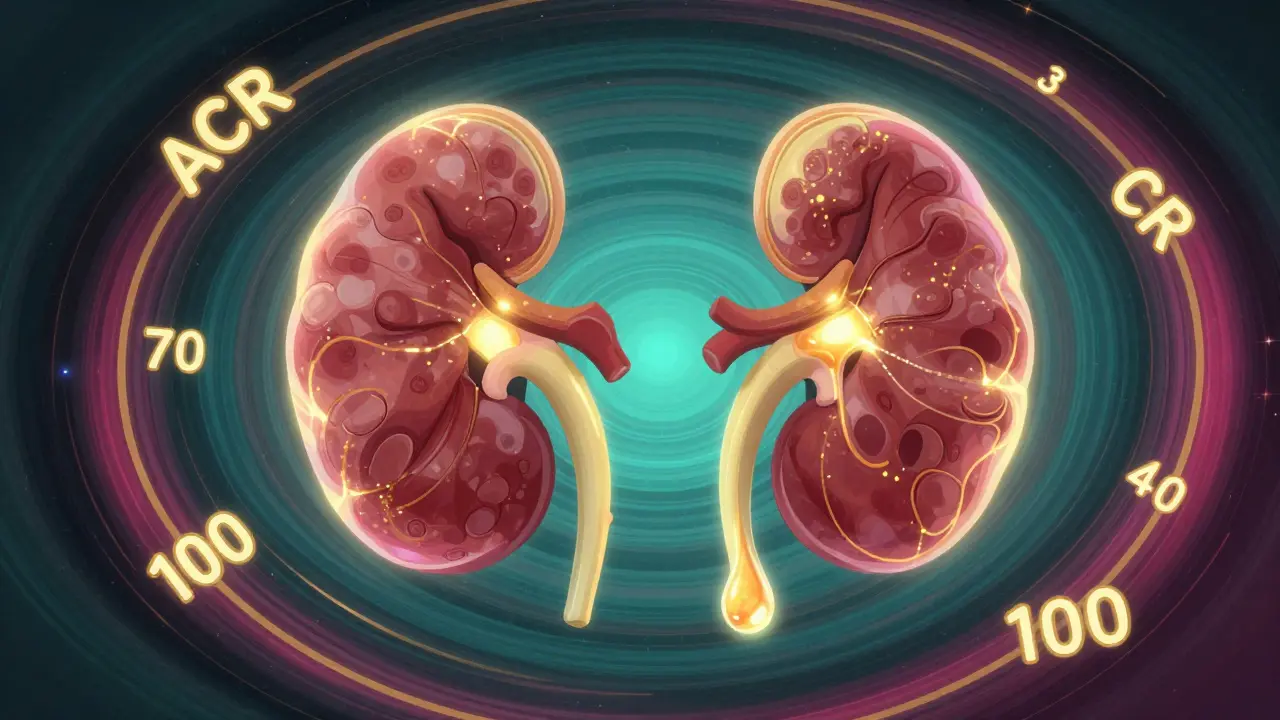
That’s why urinalysis matters more than you think. A simple dipstick test used to be common, but it’s unreliable. Today, the gold standard is the Albumin-to-Creatinine Ratio (ACR). It measures how much albumin is in your urine compared to creatinine, giving a precise number.
Here’s what ACR levels mean:
- Below 3 mg/mmol: Normal
- 3 to 70 mg/mmol: Microalbuminuria-early kidney damage
- Over 70 mg/mmol: Overt proteinuria-significant kidney injury
If your ACR is borderline, your doctor will ask for a second test, usually with your first morning urine. One high result isn’t enough. Kidney damage shows up over time. Two out of three elevated tests over three months confirm the problem.
Even if your eGFR is normal, an abnormal ACR means your kidneys are already stressed. This is why both tests are needed. One checks filtering speed. The other checks filter quality.
When and How Often Should You Get Tested?
You don’t need to wait for symptoms. The CDC and UK Kidney Association both recommend testing for anyone with risk factors:
- Diabetes (type 1 or 2)
- High blood pressure
- Heart disease
- Obesity
- Family history of kidney failure
- Previous acute kidney injury
If you have one or more of these, get an eGFR and ACR test at least once a year. If you’ve already been diagnosed with early kidney disease, your doctor may want tests every 3 to 6 months.
Even if you’re healthy and under 40, consider asking for these tests during your next physical. Many people don’t realize they’re at risk until it’s too late. A 2023 study found that nearly 1 in 3 adults with early kidney damage had no symptoms-and weren’t being monitored.
What About 24-Hour Urine Tests?
You might hear about 24-hour urine collections. These are used in specific cases-not for routine screening. Your doctor might order one if:
- ACR results are unclear
- You’re losing large amounts of protein
- They need to measure other substances like sodium, potassium, or oxalate
The process is simple but annoying: you collect every drop of urine for 24 hours in a special container. You start by emptying your bladder in the morning and saving that sample. Then you collect everything for the next 24 hours, including the first urine the next morning.
It’s not fun, but it gives a complete picture of what’s being flushed out over a full day. Most people only need this if their doctor suspects a rare kidney disorder or needs to track treatment response.
What If My Results Are Abnormal?
Don’t panic. An abnormal result doesn’t mean you have kidney failure. It means your kidneys are sending a warning sign.
Most early kidney damage can be slowed or even reversed. The key is catching it early and treating the cause:
- If you have diabetes, tighter blood sugar control can reduce protein leakage.
- If you have high blood pressure, ACE inhibitors or ARBs (common blood pressure meds) protect your kidneys and reduce protein in urine.
- Reducing salt, quitting smoking, and losing weight all help.
- Some medications, like NSAIDs (ibuprofen, naproxen), can hurt kidneys-especially if you already have damage. Talk to your doctor before taking them regularly.
Your doctor may refer you to a nephrologist (kidney specialist) if your eGFR drops below 45 or if you have persistent proteinuria. Early intervention can delay dialysis by years-or even prevent it.
What You Can Do Today
You don’t need a medical degree to protect your kidneys. Here’s what actually works:
- Ask your doctor for your latest eGFR and ACR numbers-and what they mean for you.
- Keep your blood pressure under 130/80 if you have kidney issues.
- Control your blood sugar if you’re diabetic.
- Drink water regularly, but don’t overdo it-your kidneys handle fluid best with steady intake.
- Avoid long-term use of NSAIDs unless prescribed.
- Don’t ignore swelling in your ankles, foamy urine, or fatigue. These can be signs, even if your tests are normal.
Kidney disease doesn’t come with a siren. It creeps in quietly. But with just two simple tests-eGFR and ACR-you can catch it before it’s too late. Don’t wait until you feel sick. Your kidneys are working right now. Make sure they’re still working well.
Can a normal creatinine level mean my kidneys are fine?
Not necessarily. Creatinine is a late marker. You can lose up to half your kidney function before it rises. That’s why doctors always check eGFR, which uses creatinine along with your age, sex, and weight to give a more accurate picture. A normal creatinine with a low eGFR means your kidneys aren’t filtering well.
Is a dipstick urine test enough to check for kidney disease?
No. Dipstick tests are outdated for screening. They miss early protein loss and give false results. The Albumin-to-Creatinine Ratio (ACR) is the standard. It’s a lab test that measures exactly how much protein is in your urine-and it’s far more accurate.
Why does my doctor want two ACR tests?
One high ACR result could be due to infection, dehydration, or intense exercise. To confirm kidney damage, doctors need two out of three elevated results over three months. This rules out temporary spikes and confirms a real, ongoing problem.
Can I improve my eGFR?
Yes, in early stages. If your eGFR is between 60 and 89, controlling blood pressure, managing diabetes, losing weight, and avoiding kidney-damaging drugs can stabilize or even improve your numbers. The earlier you act, the better your chances.
Should I get a cystatin C test instead of creatinine?
Cystatin C is more accurate if you’re very muscular, very overweight, pregnant, or under 18. But it’s not routine. Most doctors start with creatinine-based eGFR. If results don’t match your symptoms or risk factors, they may order cystatin C to double-check.
Does drinking more water improve kidney function?
Drinking water helps your kidneys flush out waste, but it won’t fix damaged filters. If your kidneys are already impaired, drinking extra water won’t raise your eGFR. But staying hydrated prevents dehydration, which can temporarily worsen kidney function. Aim for steady intake-6 to 8 glasses a day-don’t overdo it.
13 Comments
Robert Gilmore December 24, 2025 AT 15:17
I swear my kidneys are running on fumes and no one tells me until I’m literally drowning in my own pee. I got my eGFR last year and it was 58. My doctor just shrugged like it was a weather report. Meanwhile, I’m Googling ‘can you die from ignoring kidneys’ at 2 a.m. while sipping lukewarm water like it’s holy water.
Robert Gilmore December 25, 2025 AT 17:39
You know what they dont tell you about eGFR it’s all a scam cooked up by Big Pharma and the nephrology lobby to sell more meds and keep you scared. Creatinine is fine if you know how to read it. They just changed the formula so you’d need new tests every year. The real problem? Your liver. Always the liver.
Robert Gilmore December 27, 2025 AT 13:00
In Nigeria we don’t wait for labs. If your ankles swell and your pee looks like foam from a shaken soda, you go to the clinic. No eGFR needed. We call it ‘water on the body’. They give you a pill and tell you to stop eating salt. Works better than all these fancy numbers.
Robert Gilmore December 27, 2025 AT 18:35
I appreciate the clarity here. I had a borderline ACR last year and was terrified. Turned out it was just dehydration from hiking in the desert. Got retested after a week of normal water intake and it was fine. Sometimes the body just needs a reset, not a diagnosis.
Robert Gilmore December 28, 2025 AT 15:49
If you’re over 40 and not checking your kidneys, you’re basically playing Russian roulette with your organs. I got mine tested after my dad went on dialysis. Best decision I ever made. My eGFR was 67. Now I drink water like it’s my job and I don’t touch ibuprofen unless I’m dying. Literally.
Robert Gilmore December 28, 2025 AT 22:39
The CKD-EPI formula? A statistical illusion. Real medicine doesn’t need algorithms. It needs clinical judgment. And yet, here we are, reducing human biology to a spreadsheet cell. Pathetic.
Robert Gilmore December 29, 2025 AT 15:04
I’m a diabetic and I never knew ACR was the real test. My doc just said ‘your creatinine’s normal’ and I thought I was fine. Turns out my ACR was 45. I started cutting sugar, walking daily, and now it’s down to 12. Don’t let the doctor’s words be your only guide. Ask for the numbers. Write them down. Google them. You’re your own best advocate.
Robert Gilmore December 31, 2025 AT 12:15
Did you know the government hides the truth about kidney tests? The real reason they push eGFR and ACR is to track your biological data for the upcoming mandatory health chip implant. They don’t care if you’re healthy-they care if you’re compliant. That’s why they make it sound so scientific. It’s not medicine. It’s surveillance. And they’re watching your urine right now.
Robert Gilmore January 1, 2026 AT 05:17
The assertion that creatinine is a late marker is empirically valid, though its predictive utility remains contingent upon contextual variables including age, sex, and somatic composition. One must exercise caution in overreliance upon calculated indices absent corroborative biomarkers such as cystatin C or urinary protein-to-creatinine ratios.
Robert Gilmore January 2, 2026 AT 14:01
People who take NSAIDs regularly are just asking for their kidneys to give up. It’s not rocket science. If you’re popping ibuprofen like candy, you’re not ‘managing pain’-you’re slowly poisoning yourself. And if you’re not embarrassed by that, you’re not human.
Robert Gilmore January 4, 2026 AT 00:19
My ACR was 68 last year. I stopped processed food. I stopped soda. I started walking. Three months later it was 18. No meds. No drama. Just discipline. If you’re not willing to change your habits, don’t complain about your numbers.
Robert Gilmore January 5, 2026 AT 19:25
They say kidney disease is silent. But I say it’s screaming. And the world is deaf. The pharmaceutical-industrial complex has turned your kidneys into a profit center. They don’t want you healthy. They want you on lifelong meds. That’s why they invented eGFR. That’s why they hide cystatin C. That’s why they make you collect urine for 24 hours-so you’ll feel broken enough to obey. Wake up. Your kidneys are not your enemy. The system is.
Robert Gilmore January 7, 2026 AT 16:35
If you’re getting tested because your doctor told you to, you’re already behind. Real people check their own labs. Real people read the ranges. Real people don’t wait for symptoms. If you need a post like this to understand your body, you’ve already lost.