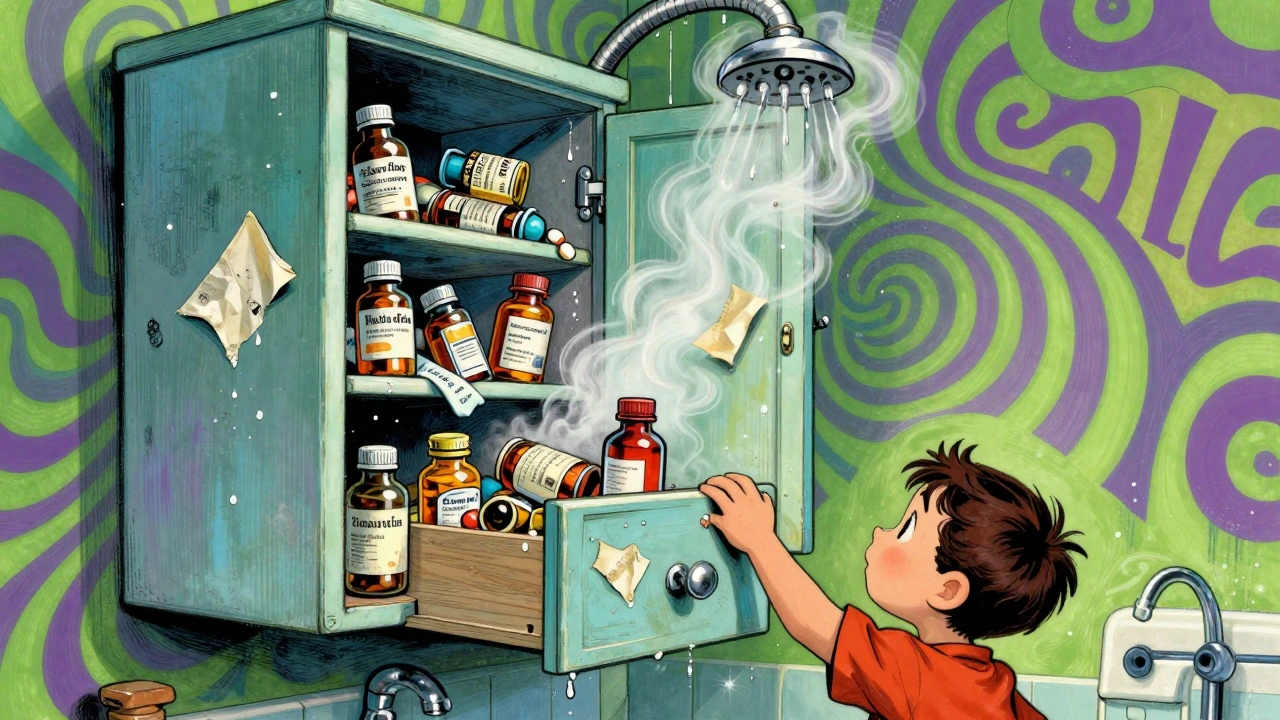
Every family has a medicine cabinet. But how many of them are actually safe? If your cabinet is in the bathroom, full of old pills, and unlocked, you’re not storing medicine-you’re storing risk. Every year, more than 60,000 children under five end up in emergency rooms after accidentally swallowing medications. That’s not a statistic-it’s a real kid, a real panic, a real hospital visit that could have been avoided. And it’s not just kids. Teens are grabbing pills from the cabinet for fun. Visitors steal painkillers during open houses. Even vitamins can turn dangerous if they’re not stored right.
Stop Keeping Medicine in the Bathroom
The bathroom is the worst place for medicine. It’s hot. It’s damp. Every time you shower, steam rises and settles on your pills. That moisture doesn’t just make labels peel off-it ruins the medicine. Melonie Crews-Foye, a pharmacy supervisor at Cone Health, says moisture can make pills crumble or lose their strength. Some medications even become toxic when exposed to humidity. The American College of Emergency Physicians and the American Academy of Pediatrics both agree: never store medicine in the bathroom.Instead, pick a high cabinet in a bedroom or linen closet. Something your kids can’t reach, even if they stand on a chair. The goal isn’t just to hide it-it’s to make it physically impossible for small hands to get to. ADT’s safety guidelines recommend storing medicine at least four feet off the ground. That’s not a suggestion. That’s a minimum.
Lock It, Even If You Think You Don’t Need To
You might think, “My kids are too little to open bottles.” Think again. A 2021 Johns Hopkins study found that 42% of children aged four to five can open standard child-safety caps in under ten minutes. That’s not a fluke. That’s curiosity. That’s determination. And if your child can open a bottle, they can get to the pills.Child-safety caps are not child-proof. They’re child-resistant. That’s a big difference. If your cabinet doesn’t have a lock, install one. Simple, inexpensive childproof locks from hardware stores work fine. Or, use a locked drawer inside the cabinet. Some families even use small combination safes-like the ones you’d use for jewelry. It sounds extreme, but if you’ve ever had to sit in an ER while your child is being pumped full of activated charcoal, you’ll understand why.
Empty the Cabinet. Start Fresh.
Before you reorganize, empty everything. Every pill bottle. Every tube. Every box. Lay it all out on the table. Now sort it into three piles: Keep, Discard, and Questionable.Anything expired? Toss it. The FDA says if it’s more than 12 months past the expiration date, it’s not just useless-it’s risky. Expired antibiotics can cause dangerous reactions. Old liquid cough syrup can grow mold. Even vitamins degrade. Dr. Virani from Memorial Hermann says expired meds can do more harm than good. Don’t keep them “just in case.”
Questionable items? That’s anything you can’t identify. No label? No bottle? No idea what it is? Throw it out. You don’t need mystery pills in your house. And if you’re unsure about a medication, call your pharmacist. They’ll tell you if it’s safe to keep.
Organize by Use, Not by Clutter
Now that you’ve cleared the clutter, organize what’s left. Don’t just shove everything back in. Group items by how they’re used.- Morning meds: Pain relievers, allergy pills, daily vitamins.
- Evening meds: Sleep aids, nighttime cough syrup, muscle rubs.
- First aid: Bandages, antiseptic wipes, hydrocortisone cream, thermometer.
- Emergency: Poison control number, activated charcoal (if recommended by your doctor), epinephrine auto-injector (if prescribed).
Store each group in separate containers or bins. Melonie Crews-Foye recommends separating morning and evening meds-it reduces confusion and helps prevent double-dosing. If you have kids on daily meds, consider using a pill organizer with days of the week. Cone Health even offers free adherence packaging that sorts doses by time of day.
Protect Against Teen Misuse
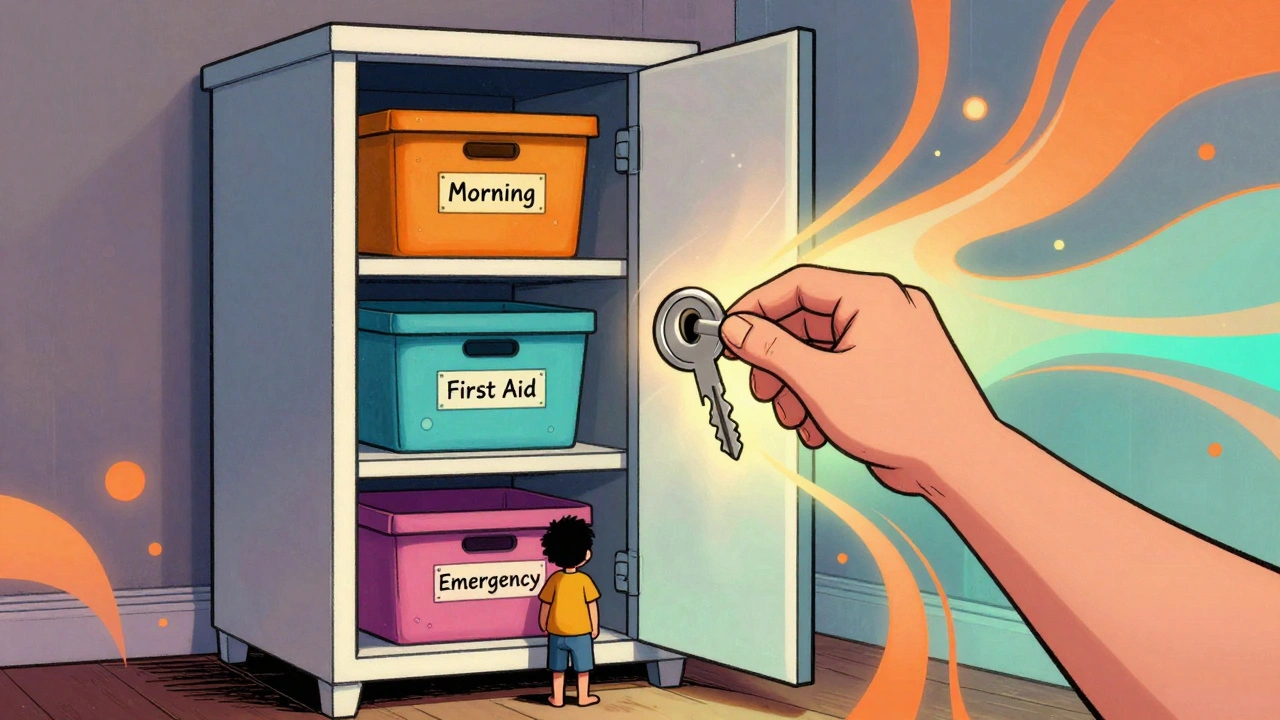
One in seven teens who misuse prescription drugs gets them from their own home. That’s not a myth. It’s from the 2022 National Survey on Drug Use and Health. And the biggest source? The family medicine cabinet.If you have teens, you need a second layer of security. Keep any painkillers, ADHD meds, or anxiety drugs in a locked box inside your locked cabinet. Don’t just rely on the cabinet lock. Use a small lockbox with a key or combination. Only you and one other trusted adult should have access.
Also, talk to your teen. Not in a scary lecture way. Just say: “I keep these locked because they can be dangerous if someone takes them without a doctor’s order.” Make it clear: taking someone else’s medicine isn’t harmless-it can cause seizures, heart problems, or death.
Dispose of Old Medications the Right Way
Don’t flush pills. Don’t throw them in the trash. Don’t pour them down the sink. These methods pollute water and can be dangerous if someone finds them.Use a safe disposal method. CVS and Walgreens have free medication disposal kiosks in their pharmacies. You don’t need a receipt. You don’t need to be a customer. Just drop in the bottle. In 2023, the DEA’s National Prescription Drug Take Back Day collected over a million pounds of unused meds. That’s the power of community.
If you can’t get to a pharmacy, use DisposeRX powder. It’s free. Your pharmacist can give you a packet. Just add it to the bottle with water, shake, and throw it in the trash. The powder turns pills into a gel that can’t be pulled apart or misused. It’s simple. It’s safe. And it’s available at 87% of U.S. pharmacies.
Keep a Medication List
Write down everything you keep in the cabinet. Not just prescriptions. Include vitamins, supplements, herbal remedies, and even eye drops. For each item, write:- Name
- Dose
- Why you take it
- Expiration date
Keep this list in your phone and in your wallet. If your child gets sick and you need to rush to the ER, you won’t have to guess what’s in the cabinet. Paramedics and doctors need to know what’s been taken-fast. This list saves time. And time saves lives.
Check Every Six Months
This isn’t a one-time job. Set a reminder on your phone: every April and October, do a medicine cabinet check. Look at expiration dates. Check for leaks or strange smells. Toss anything old. Update your list.Memorial Hermann recommends checking every six months. That’s not a suggestion-it’s a standard. And if you have a baby or a new prescription, check even more often. Your family’s needs change. Your cabinet should too.
Post the Poison Help Number
Every phone in your house should have 800-222-1222 saved as “Poison Help.” Post it on the fridge. Put it on the cabinet door. Write it on a sticky note by the phone. This number connects you to a poison control specialist 24/7. It’s free. It’s confidential. And if your child swallows something they shouldn’t, calling them is the first thing you should do-not rushing to the ER.Poison control experts can tell you whether you need to go to the hospital, what to watch for, or if it’s safe to wait. In many cases, they can prevent a trip to the ER entirely.
Smart Technology Is Helping-But It’s Not a Replacement
Some families are using smart cabinets that send alerts when opened. ADT and other security companies now offer devices that text you if someone opens the cabinet. Sales of these devices have jumped 300% since 2020. That’s great for high-risk homes-like those with teens or visitors who might steal meds.But technology doesn’t replace good habits. A smart cabinet won’t help if you’re still storing medicine in the bathroom. It won’t help if you’re keeping expired pills. It won’t help if you never check expiration dates. Use tech as a backup, not a fix.
What About Vitamins and Supplements?
Just because something is “natural” doesn’t mean it’s safe. Iron supplements can kill a child if they swallow more than a few pills. High-dose vitamin D can cause kidney damage. Even melatonin can cause drowsiness, confusion, or seizures in kids.Dr. Connie Zajicek, a child psychiatrist, says: “Anything can be dangerous in the wrong hands.” That includes gummy vitamins. They look like candy. Kids love them. And they’re often stored in easy-to-reach places. Treat them like medicine. Lock them up. Keep them off the counter. Check expiration dates. Just like everything else.
Final Rule: When in Doubt, Throw It Out
You’re not saving money by keeping old medicine. You’re risking your family’s safety. Expired painkillers don’t work. Old cough syrup can grow bacteria. Vitamins lose potency. And unused opioids? They’re a target for thieves.If you’re unsure whether to keep something, ask your pharmacist. Or just throw it away. Better safe than sorry. Every bottle you remove from your cabinet is one less chance for an accident.
Building a safe medicine cabinet isn’t about perfection. It’s about progress. Start with one step: move it out of the bathroom. Then lock it. Then check the dates. Then make a list. Do one thing this week. Then another next week. Your family’s safety doesn’t need a big overhaul-it needs consistent, smart choices.
16 Comments
Robert Gilmore December 8, 2025 AT 06:10
Yup. Bathroom cabinet? That’s just a drugstore with a shower.
My kid once swallowed my grandma’s blood pressure pills. Took 3 hours to get to the ER. Don’t be that guy.
Robert Gilmore December 9, 2025 AT 11:47
You think you’re safe because your kid’s too small? Bro. My 3-year-old opened a child-resistant bottle in 47 seconds. Used a butter knife. Found it on YouTube. Kids are little engineers now. Lock it. Or pray.
And stop keeping expired ibuprofen like it’s a family heirloom. That stuff turns into chalk. And sometimes, poison.
Robert Gilmore December 10, 2025 AT 20:02
So I moved my meds to the top shelf of my bedroom closet last week. My toddler just climbed on the dresser and pulled down my Advil. I screamed like a banshee.
Now I have a $12 lockbox. Worth every penny. Also, I threw out 17 bottles I didn’t even remember buying. Feels good.
PS: Gummy vitamins are candy to kids. Treat them like heroin.
Robert Gilmore December 11, 2025 AT 05:30
It is both lamentable and predictable that such a fundamental matter of public health requires a public service announcement in the year 2025. The degradation of parental responsibility is not merely a social trend-it is an epidemic of negligence. The notion that ‘child-resistant’ caps are sufficient is a dangerous fallacy, and the fact that this article even needs to be written speaks volumes about the erosion of basic domestic competence. One must ask: What other aspects of household safety have we collectively abdicated?
Robert Gilmore December 12, 2025 AT 02:17
we live in a world where you need a lockbox for tylenol
and yet people still think vaccines are a plot
we are not okay
also i threw out 3 years of expired gummy vitamins last night
they looked like candy
they tasted like regret
Robert Gilmore December 12, 2025 AT 22:34
OMG I just realized I’ve been keeping my mom’s old antidepressants since 2018 😭
They were in a drawer next to my makeup… like a horror movie 😫
I’m crying rn. I feel so guilty. I’m so sorry to my family. I’m so sorry to humanity. I’m so sorry to the planet. I’m going to throw them out now. I’m going to meditate. I’m going to journal. I’m going to cry again. I’m going to lock my cabinet. I’m going to be better. 🙏💔
Robert Gilmore December 14, 2025 AT 12:28
Let’s be real. The real problem isn’t the cabinet. It’s the fact that we live in a society that pumps out pills like candy and then acts shocked when people take them.
Pharma companies design drugs to be addictive. Doctors prescribe them like they’re giving out lollipops. And now we’re supposed to lock them up like they’re nuclear codes?
Fix the system. Not the cabinet.
Also… did you know the DEA collects millions of pounds of meds every year? That’s not waste. That’s a national failure.
And don’t even get me started on gummy vitamins. They’re literally designed to look like candy. That’s not negligence. That’s malice.
Robert Gilmore December 16, 2025 AT 03:26
The notion that moisture ruins medication is not speculative-it is empirically validated by the United States Pharmacopeia. Humidity above 60% RH degrades active pharmaceutical ingredients through hydrolysis, oxidation, and polymorphic transitions. The bathroom is not merely suboptimal-it is chemically hostile to pharmaceutical integrity. Furthermore, the claim that child-resistant caps are ineffective is corroborated by the Journal of Pediatric Pharmacology and Therapeutics, which reports a 42% failure rate in children aged 4–5 under controlled conditions. To ignore this is not negligence-it is a violation of basic scientific literacy. Your cabinet is not a storage unit. It is a biohazard containment zone. Treat it accordingly.
Robert Gilmore December 16, 2025 AT 18:45
Y’all got too soft. Back in my day we kept pills in the medicine cabinet and if your kid got into them? Tough luck. You didn’t need a lockbox. You needed a parent. Now we’re locking up aspirin like it’s a nuclear launch code. This country’s gone mad.
Also… who the hell puts vitamins in a locked box? You think your kid’s gonna OD on vitamin C? Lol. Next you’ll be locking up the toothpaste.
Robert Gilmore December 18, 2025 AT 16:35
It is with profound sorrow that I observe the commodification of health and the grotesque normalization of pharmaceutical negligence. The very act of storing medications in a humid environment is tantamount to culinary malpractice-imagine serving spoiled meat to your children. The psychological implications of such carelessness are immeasurable. One must ask: If we cannot safeguard the most basic elements of domestic medicine, what does this say about our collective moral architecture? The gummy vitamins? They are not merely dangerous-they are symbolic of our descent into infantilized consumerism. I weep for the future.
Robert Gilmore December 19, 2025 AT 03:59
my mom used to keep all her meds in a shoebox under the bed. one time i found her old blood pressure pills and thought they were candy. i ate three. i was 6.
she didn’t even notice for 3 hours.
we never talked about it.
now i lock everything. even my omega-3s.
it’s not about fear. it’s about love.
Robert Gilmore December 19, 2025 AT 04:30
It is both intellectually and ethically indefensible to equate the storage of pharmaceuticals with the mere act of tidying a shelf. The article, while well-intentioned, fundamentally misrepresents the issue as one of domestic organization rather than systemic pharmacological governance. The proliferation of over-the-counter medications, the lack of federal regulation on expiration dates, and the commercialization of supplements as confectionery products are the true root causes. To place the burden of safety solely upon the individual household is a form of neoliberal obfuscation. One must look upstream-not to the cabinet, but to the FDA, the DEA, and the pharmaceutical lobby.
Robert Gilmore December 19, 2025 AT 20:49
i moved my meds to the top shelf last night
then my cat knocked over the box
so now i have a lockbox
and a new fear
what if someone steals the lockbox?
what if they break in and steal my expired ibuprofen?
am i safe now?
or am i just paranoid with better storage?
Robert Gilmore December 20, 2025 AT 01:46
Dear friends, I commend you for taking this seriously. Safety is not a luxury-it is a discipline. I have implemented all of these steps in my home, and I encourage you to do the same. Begin with one step today: move your medicine from the bathroom. Tomorrow, check expiration dates. The following day, install a lock. Small actions, repeated consistently, create lasting change. You are not alone in this journey. I am here to support you. Remember: every pill removed is a life saved. Keep going. You are doing great.
Robert Gilmore December 20, 2025 AT 05:37
Wait… so you’re telling me the government knows about all this? And they’re still selling gummy vitamins that look like Skittles? And they’re not banning them? And the DEA collects millions of pounds of pills every year… but doesn’t prosecute the companies making them? This isn’t about cabinets. This is a cover-up. The whole system is rigged. They want us addicted. They want us scared. They want us buying more pills. And now they’re selling us lockboxes as the solution? That’s the trap. You’re being played. The real danger isn’t your cabinet-it’s the system that made you need one.
Robert Gilmore December 20, 2025 AT 21:44
And don’t even get me started on the ‘Poison Help’ number. I called it once. The lady asked if my kid ate a rock. I said no, a pill. She said, ‘That’s good. Rocks are worse.’
Then she told me to give my kid a glass of milk. I asked why. She said, ‘It binds the toxins.’
I hung up. Called 911.
Turns out she was right. But still. That’s not a hotline. That’s a game show.