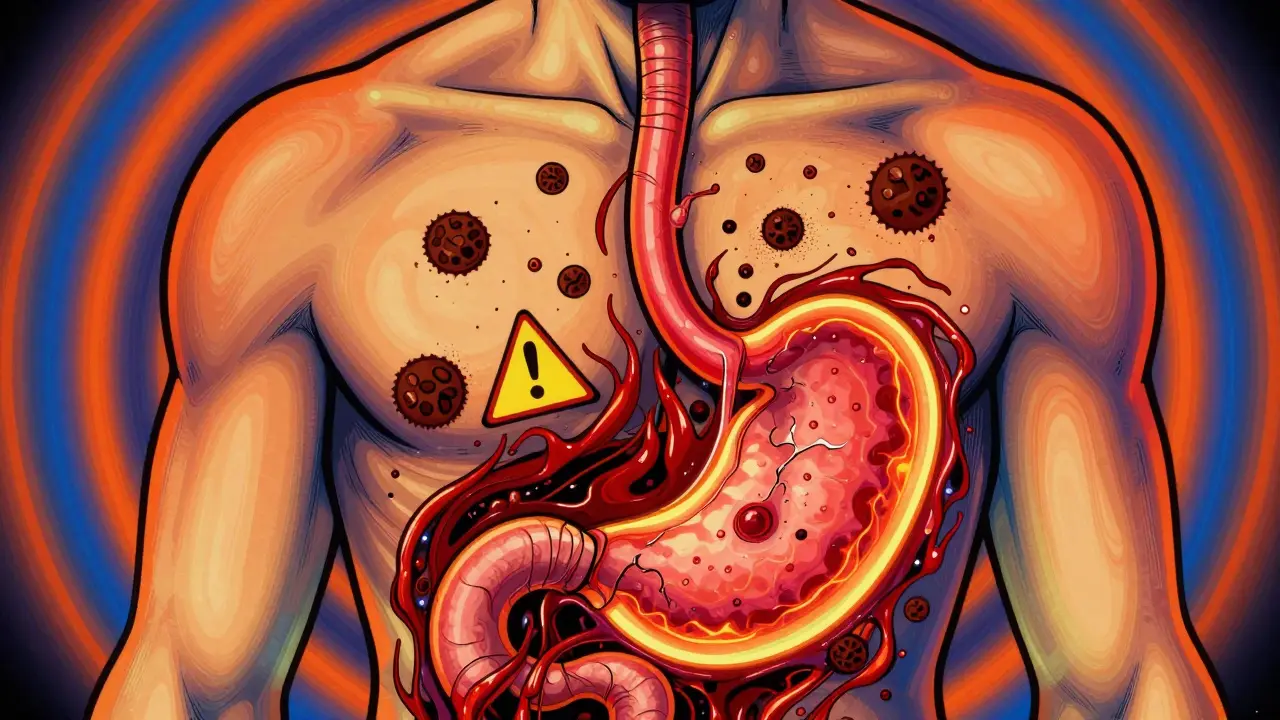
When someone vomits blood or passes black, tarry stools, it’s not just unpleasant-it’s a medical emergency. Upper GI bleeding can happen to anyone, but it’s most common in older adults and those with liver disease or a history of NSAID use. The good news? With fast action and the right care, survival rates have improved dramatically. The bad news? Many people ignore early signs, delaying care until it’s too late.
What Causes Upper GI Bleeding?
Upper GI bleeding means blood is coming from the esophagus, stomach, or the first part of the small intestine (duodenum). The most common cause? Peptic ulcers. These open sores in the stomach or duodenal lining account for 40-50% of all cases. Most are caused by Helicobacter pylori infection or long-term use of NSAIDs like ibuprofen or aspirin. Gastric ulcers make up about 20-30% of ulcer-related bleeds, while duodenal ulcers are more common, at 70-80%. Another major cause is esophageal varices. These are swollen veins in the esophagus, usually due to advanced liver disease and portal hypertension. About 10-20% of upper GI bleeds come from varices, but they’re dangerous-20% of patients die within six weeks without treatment. Unlike ulcers, varices don’t cause pain before they burst. They just… rupture. That’s why people with cirrhosis need regular screening. Other causes include:- Erosive gastritis (15-20%)-inflammation and erosion of the stomach lining
- Esophagitis (5-10%)-often from acid reflux or infection
- Mallory-Weiss tears (5-10%)-tears at the stomach-esophagus junction from violent vomiting
- Malignancies (2-5%)-stomach or esophageal cancer
- Portal hypertensive gastropathy (50-80% in advanced liver disease)
- Hiatal hernias (about 5%)
Even common medications can raise your risk. A 2022 JAMA study tracking half a million people found that those taking SSRIs (like fluoxetine or sertraline) had double the rate of upper GI bleeding compared to non-users. It’s not just NSAIDs anymore.
Recognizing the Signs
You don’t need to be a doctor to spot warning signs. If you or someone else has:- Vomiting bright red blood (hematemesis)
- Vomiting dark, coffee-ground-like material (partially digested blood)
- Black, sticky, foul-smelling stools (melena)
- Maroon or bloody stools (hematochezia, usually with massive bleeding)
- Dizziness, fainting, rapid heartbeat, or low blood pressure
-it’s time to go to the ER. These aren’t symptoms you wait out. Melena means blood has been in the gut long enough to be digested. That’s not normal. And if your heart is racing while you’re lying still, your body is telling you it’s losing blood.
A 2023 Reddit post from user u/GIwarrior99 described waking up at 3 a.m. coughing up coffee-ground material. He went to the ER, got three units of blood, and spent eight days in the hospital. His story isn’t rare. A University of Michigan study found 68% of survivors still felt anxious about another bleed just 30 days after discharge.
How Doctors Diagnose It
The first step isn’t an endoscope-it’s stabilization. If someone is dizzy, pale, or has a heart rate over 100, they need fluids and oxygen before anything else. Then, doctors check:- Hemoglobin-a level below 7 g/dL usually means significant blood loss
- BUN-to-creatinine ratio-a ratio above 30:1 has 68.8% sensitivity for upper GI bleeding
- INR-to check clotting function, especially if liver disease is suspected
But the real game-changer is the Glasgow-Blatchford score. Developed in 2000 and updated in 2019, it uses six simple factors: hemoglobin level, blood pressure, pulse rate, melena, syncope, and history of liver or heart disease. A score of 2 or higher means hospitalization is needed. A score of 0? You might be able to go home safely.
Dr. Robert Logan from Harvard says this score has revolutionized triage-15% of patients can be managed as outpatients now. That’s a huge shift from 20 years ago, when everyone got admitted.
Once stable, the next step is urgent endoscopy. The American College of Gastroenterology recommends getting an esophagogastroduodenoscopy (EGD) within 24 hours. But if you’re high-risk, waiting even 12 hours can cost lives. Studies show endoscopy within 12 hours cuts mortality by 25%.
What Happens During Endoscopy
During the procedure, doctors use the Forrest classification to rate bleeding risk:- Class Ia-spurting blood. 90% chance of rebleeding without treatment.
- Class Ib-oozing. 50% rebleeding risk.
- Class IIa-visible vessel. Also 50% risk.
- Class IIb-adherent clot. 20-30% risk.
- Class III-clean base. Less than 5% risk.
If you have Class I or IIa, they’ll treat it immediately. For ulcers, that usually means injecting epinephrine to constrict blood vessels, then using heat or clips to seal the spot. Success rate? 90-95%.
For varices, they use band ligation-tiny rubber bands slipped around the swollen veins. It’s more effective than older methods like sclerotherapy, cutting rebleeding rates from 60% to 25%.
Treatment: Ulcers vs. Varices
Treatment depends on the cause.For ulcers:
- High-dose IV proton pump inhibitors (PPIs): 80 mg bolus, then 8 mg/hour infusion
- This drops rebleeding from 22.6% to 11.6%, according to the 2022 COBALT trial
- Test for H. pylori and treat if positive
- Stop NSAIDs and SSRIs if possible
For varices:
- Immediate vasoactive drugs: terlipressin or octreotide
- Antibiotics: ceftriaxone 1g daily to prevent infections
- Band ligation within 24 hours
- Long-term beta-blockers to reduce portal pressure
Transfusions are used when hemoglobin drops below 7 g/dL or symptoms of anemia are present. Each unit of packed red blood cells raises hemoglobin by about 1 g/dL. But don’t overdo it-target 7-9 g/dL. Giving too much blood can increase complications.

The Stabilization Bundle
Hospitals that use a standardized “Upper GI Bleed Bundle” have seen big improvements. Massachusetts General Hospital’s version includes five steps:- Assess and stabilize within 30 minutes
- Calculate Glasgow-Blatchford score
- Give PPIs within 1 hour for high-risk patients
- Perform endoscopy within 12 hours
- Follow up with GI specialist within 72 hours
Before this bundle, patients waited an average of 24.5 hours for endoscopy. Now? It’s 9.2 hours. Mortality dropped from 8.7% to 5.3%.
What’s New in 2025
Technology is changing how we treat this. In 2023, the FDA approved Hemospray-a powder that forms a temporary seal over bleeding sites. It’s not a cure, but it buys time for patients who are too unstable for standard endoscopic treatment.Even bigger: AI-assisted endoscopy. The 2023 ENDOSCAPE trial showed AI systems spotted bleeding signs with 94.7% accuracy-far better than human endoscopists at 78.3%. Dr. Thomas Wang predicts all major hospitals will use AI tools within five years.
But there’s a catch. Stanford’s Dr. Susan Chang warns current AI models are less accurate in Black and Hispanic patients because training data lacks diversity. That’s not just a tech problem-it’s a health equity issue.
Meanwhile, the NIH’s UGIB-360 study, launched in January 2024, is tracking 10,000 patients to build personalized risk models using genetics, gut bacteria, and clinical history. Results are expected in late 2025.
What Patients Should Know
If you’ve had an upper GI bleed:- Don’t restart NSAIDs without talking to your doctor
- Limit alcohol-especially if you have liver disease
- Follow up with a gastroenterologist, even if you feel fine
- Ask about H. pylori testing if you haven’t had it
- Consider switching SSRIs if you’re at high risk
One Reddit user, u/StomachSOS, waited two weeks when his doctor dismissed his black stools as “just iron supplements.” He ended up in the ER with a hemoglobin of 5.8-half the normal level. That’s the kind of delay that kills.
And yes, you’ll probably be anxious. That’s normal. But knowing the signs and acting fast can save your life next time.
What should I do if I vomit blood?
Call 911 or go to the nearest emergency room immediately. Vomiting blood-whether bright red or coffee-ground in appearance-is a medical emergency. Do not wait to see if it stops. Delaying care increases the risk of death. While waiting for help, sit upright, avoid eating or drinking, and try to stay calm.
Can upper GI bleeding happen without pain?
Yes. While peptic ulcers often cause burning pain, esophageal varices typically don’t cause symptoms until they rupture. Many people with advanced liver disease bleed from varices with no warning. That’s why regular screening with endoscopy is critical for anyone with cirrhosis.
Is a black stool always a sign of bleeding?
Not always, but it should never be ignored. Black, tarry stools (melena) usually mean digested blood from the upper GI tract. But iron supplements, bismuth (like Pepto-Bismol), or certain foods like black licorice can also darken stools. Still, if you’re unsure, get checked. A simple stool test can confirm blood.
How long does recovery take after an upper GI bleed?
Most people are discharged within 3-7 days if the bleeding stops and no complications occur. But full recovery can take weeks. You’ll need follow-up endoscopy in 6-8 weeks to confirm healing. Avoid NSAIDs, alcohol, and smoking during recovery. Return to normal diet gradually-start with bland, soft foods.
Can upper GI bleeding come back?
Yes. Rebleeding happens in 10-20% of cases, usually within 5 days. High-risk patients (like those with large ulcers or varices) are more likely to bleed again. That’s why long-term treatment matters-PPIs for ulcers, beta-blockers for varices, and avoiding triggers like alcohol and NSAIDs. Regular follow-up with a GI specialist reduces recurrence risk.
Are there any home remedies for upper GI bleeding?
No. There are no safe home remedies for active upper GI bleeding. Attempts to treat it at home with herbal teas, diet changes, or antacids can delay life-saving care. This is a hospital-level emergency. If you suspect bleeding, get to a medical facility immediately.
13 Comments
Robert Gilmore January 11, 2026 AT 18:45
Just read this after my dad had a bleed last year. He’s doing way better now, but man, the scare was real. Glad they’re catching these faster now.
Robert Gilmore January 12, 2026 AT 12:14
The Glasgow-Blatchford score is one of those quiet heroes in emergency medicine. Simple, evidence-based, and saves so much unnecessary hospital time. Why isn’t this taught in every med school orientation?
Robert Gilmore January 12, 2026 AT 12:39
AI in endoscopy? Sure. But who trained it? Big Pharma data. They want you to think it’s about accuracy but it’s about controlling the narrative. Hemospray? That’s just a Band-Aid for a broken system. They’re selling you a fix while keeping you dependent.
Robert Gilmore January 14, 2026 AT 01:05
Y’ALL. I work ER triage and I’ve seen this a hundred times. Someone comes in with black stools, says ‘oh it’s just the iron’-then drops to a 5.8 Hb. I scream internally every time. Please. If your stool looks like tar and you’re not on iron supplements, GO. TO. THE. ER. No excuses. No ‘wait and see.’ Your stomach doesn’t do drama-it does death.
Robert Gilmore January 14, 2026 AT 07:48
My uncle had varices from alcohol-related cirrhosis. He got banding, stayed on beta-blockers, quit drinking, and now he’s been clean for 4 years. It’s not easy, but it’s possible. Don’t give up.
Robert Gilmore January 15, 2026 AT 17:49
It’s scary how many people dismiss melena as ‘just indigestion.’ I wish we had more public awareness campaigns-not just for patients, but for primary care docs too. A quick stool test could save so many lives.
Robert Gilmore January 15, 2026 AT 23:28
Respectfully, the assertion that AI models are less accurate in Black and Hispanic populations is not merely a data diversity issue-it is a systemic failure of clinical trial inclusivity and historical underrepresentation in medical datasets. Until equitable sampling becomes mandatory, not optional, algorithmic bias will persist as a silent killer.
Robert Gilmore January 16, 2026 AT 22:01
Let’s be precise: SSRIs increase bleeding risk by ~100% relative risk, but absolute risk remains low-about 1.5 extra bleeds per 1,000 patient-years. That’s not a reason to panic, but it is a reason to reassess risk-benefit in high-risk patients, especially those on NSAIDs or with H. pylori. Don’t just stop meds-optimize.
Robert Gilmore January 17, 2026 AT 04:59
I can’t believe people still think they can ‘wait it out’ with black stools. My cousin did that and ended up in ICU for three weeks. Now she’s terrified of food. I’m just saying… if you’re reading this and you’ve ignored symptoms? Please, for the love of God, go get checked. You’re not being brave-you’re being reckless.
Robert Gilmore January 18, 2026 AT 20:50
That stabilization bundle at Mass General? That’s the gold standard. Every hospital should adopt it. I’ve seen patients wait 24 hours for endoscopy because of ‘bed shortages.’ That’s not healthcare-it’s Russian roulette.
Robert Gilmore January 20, 2026 AT 17:43
AI spotting bleeds at 94% accuracy? Wild. But honestly? The real win is that we’re finally starting to treat this like the emergency it is-not just another ‘gut issue.’ I used to think ‘coffee ground vomit’ was just a gross phrase-now I know it’s a red flag that could mean the difference between living and dying
Robert Gilmore January 21, 2026 AT 00:14
So we’ve got AI, Hemospray, and fancy scores… but still, the number one cause of death here? People ignoring the signs because they don’t want to ‘bother’ the doctor. We’ve got tech that could save us, but we’re still stuck in 1998 mindset.
Robert Gilmore January 21, 2026 AT 02:21
My mom had a bleed after years of ibuprofen for arthritis. She didn’t even know it was dangerous. Now she takes Tylenol and gets her stomach checked every year. Simple changes, huge difference.