Every time you take a pill, you're making a bet. The drug might help you feel better. Or it might cause something unexpected-dizziness, nausea, even a serious reaction. Medication safety isn’t just about following labels. It’s about understanding the science behind what works, what doesn’t, and what we still don’t know. This isn’t guesswork. It’s a growing field built on data, statistics, and real-life outcomes.
Why Clinical Trials Aren’t Enough
Clinical trials are the gold standard for approving new drugs. But they’re not perfect. Most phase III trials include only 1,500 to 5,000 people, and they last six to 24 months. That’s enough to catch common side effects-like headaches or stomach upset. But what about rare ones? Things that happen in 1 out of 10,000 patients? Those slip through.Take thalidomide. In the 1960s, it was prescribed for morning sickness. Thousands of babies were born with severe limb defects before the link was proven. That tragedy changed everything. It forced regulators to ask: How do we catch dangers that only show up when millions of people use a drug over years?
That’s where pharmacoepidemiology comes in. It’s the science of studying how drugs behave in real populations-not just controlled labs. It looks at who’s taking the drug, when, why, and what happens next. This field didn’t become formal until the 1980s, but today it’s responsible for about 15% of all global drug safety research.
How Real-World Evidence Works
Researchers don’t rely on guesswork. They use massive databases. The FDA’s Sentinel Initiative tracks over 190 million patients. Medicare records cover 57 million. Kaiser Permanente has data on 12.5 million members. These aren’t small samples. They’re full pictures of how drugs are actually used.There are three main ways to study these records:
- Cohort studies: Follow groups of people over time-those who took the drug versus those who didn’t.
- Case-control studies: Look at people who had a bad reaction and compare them to those who didn’t.
- Within-individual designs: Compare a person’s own history-did they have a reaction after taking the drug, but not before?
These methods aren’t perfect. They can’t control for everything. Someone who takes a blood pressure drug might also smoke, eat poorly, or have other health issues. That’s called confounding. Good studies use statistical tricks-like propensity score matching-to balance those differences. Well-run studies can match patients with 85-95% accuracy.
Still, about 15-30% of the links found in these studies might be misleading. That’s why researchers don’t stop at one method. They cross-check findings. If an observational study says a drug increases heart attack risk, they look for confirmation in other databases, or wait for a follow-up trial.
The Role of Randomized Trials vs. Real-World Data
Randomized controlled trials (RCTs) are still the best way to prove cause and effect. But they’re expensive. A single phase III trial costs an average of $26 million and enrolls fewer than 800 people. That’s why they’re used for initial approval-but not for ongoing safety monitoring.Observational studies cost a fraction: $150,000 to $500,000. And they can detect rare events that trials miss. For example, when vaccines were rolled out during the pandemic, self-controlled case series (SCCS) studies helped identify very rare blood clot risks in just weeks. These designs cut bias by 40-60% compared to older methods.
But here’s the catch: 22% of the strong associations found in observational studies were later disproven by RCTs, according to a 2021 JAMA review. That’s why regulators don’t act on one type of data alone. The FDA uses RCTs for approval. They use real-world data for warnings, label changes, and risk management plans.
Between 2015 and 2022, 78% of FDA safety communications relied on observational data. That’s not a backup-it’s the backbone.
Where Medication Safety Fails in Practice
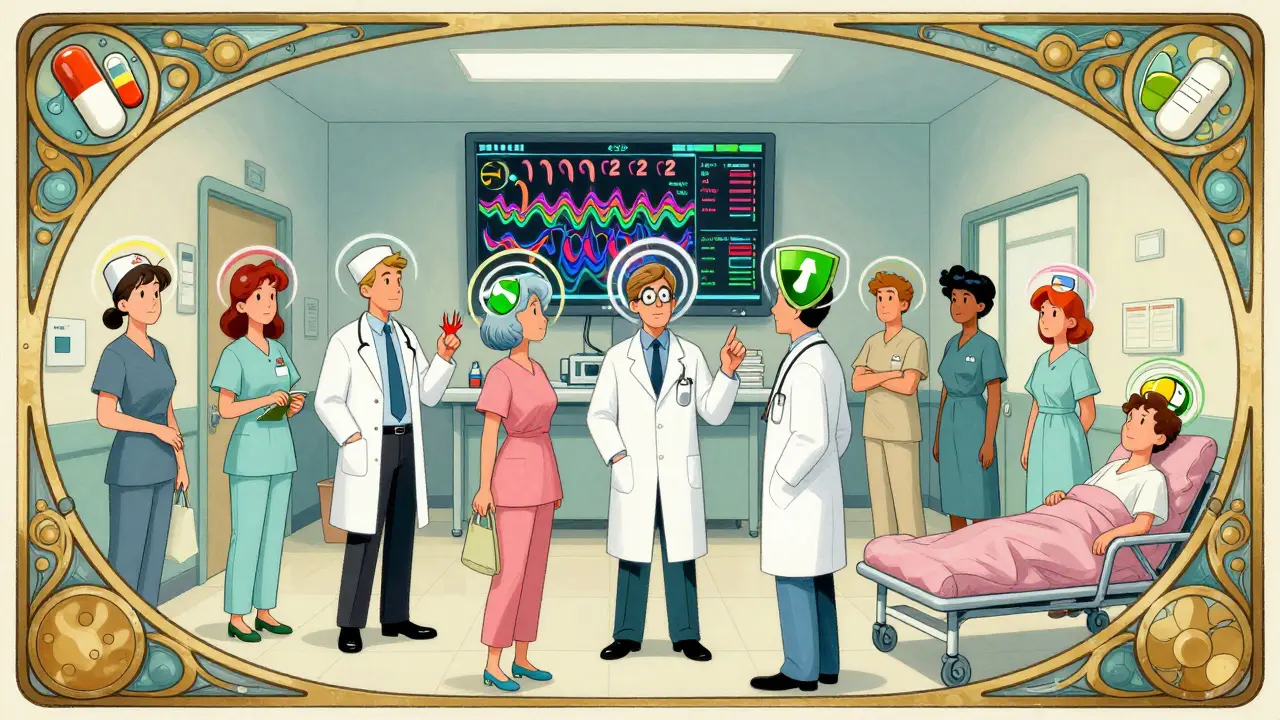
Even with great science, mistakes happen at the bedside. Nurses report near-miss errors weekly. Why? Fragmented electronic health records. Poor communication between doctors, pharmacists, and patients. Alert fatigue is real. In emergency rooms, prescribers override 89% of drug interaction alerts-especially for common medications. Why? Too many warnings. Too many false alarms.Older adults are especially at risk. One in seven Medicare patients has a preventable adverse drug event every year. Opioids alone caused 80,000 deaths in 2022. And 38% of all preventable medication errors happen during nursing administration.
One success story? Kaiser Permanente Washington introduced a standardized protocol for treating alcohol withdrawal with phenobarbital. Before, 15.3% of patients had severe withdrawal symptoms. After? It dropped to 8.9%. That’s a 42% reduction. Simple, evidence-based changes save lives.
What’s Changing Right Now
The field is moving fast. In 2023, the FDA launched Sentinel System 3.0-faster, smarter, with real-time monitoring across 12 major health systems. In 2024, AHRQ started testing AI tools that predict which patients are most likely to have a bad reaction based on their history, medications, and lab results. Early results show 22-35% fewer errors with high-risk drugs like blood thinners and insulin.Future plans include using data from wearables-smartwatches tracking heart rate, sleep, activity-to spot early signs of drug reactions. The International Society of Pharmacoepidemiology is also working to standardize study methods so findings are more consistent across countries.
But risks remain. A 2023 Supreme Court decision weakened HIPAA protections for some health data used in research. And compounded medications-custom mixes made by pharmacies-are barely monitored at all. The GAO flagged this as a major gap in 2024.
What You Can Do
You don’t need to be a scientist to protect yourself. Here’s what works:- Keep a written list of every medication you take-including vitamins, supplements, and over-the-counter drugs.
- Ask your pharmacist: “What are the most common side effects? What should I watch for?”
- If you’re on five or more medications (common for people over 65), ask if any can be stopped.
- Report side effects. Use the FDA’s MedWatch program. One report won’t change anything. But thousands? That’s how warnings get added to labels.
Medication safety isn’t about avoiding drugs. It’s about using them wisely. The science is there. The tools are improving. But the final step? It’s still up to you.
What’s the difference between a clinical trial and real-world evidence?
Clinical trials test drugs under strict conditions with a small group of healthy or carefully selected patients. Real-world evidence looks at how drugs affect millions of people in everyday life-across ages, health conditions, and lifestyles. Trials tell you if a drug works. Real-world data tells you if it’s safe for most people.
Are side effects listed on drug labels always accurate?
Labels list the most common and serious side effects seen in trials. But rare reactions-like one in 10,000-often aren’t discovered until the drug is used by millions. That’s why labels get updated over time. If you experience something unusual, report it. That helps update the label for others.
Why do doctors sometimes ignore drug interaction alerts?
Alert fatigue is a real problem. Electronic systems can flood doctors with hundreds of warnings per day. Many are low-risk or false alarms. When every alert is the same, people start ignoring them-even important ones. Better systems now prioritize alerts based on severity and patient history.
How do researchers know if a drug really caused a side effect?
They don’t assume. They use statistical methods to rule out coincidence. For example, if a patient has a heart attack after starting a new drug, researchers check: Did others have the same reaction? Was the timing consistent? Was the person already at risk? They compare large groups over time to find patterns that can’t be explained by chance.
Is it safe to take multiple medications together?
It depends. Many people, especially seniors, take five or more medications daily. That increases the risk of interactions. But not all combinations are dangerous. The key is regular reviews with your doctor or pharmacist. Ask: “Can any of these be stopped? Are they still needed?” Simple questions like this prevent serious harm.
What’s being done to improve medication safety in hospitals?
Hospitals are adding clinical decision support systems that flag risky prescriptions before they’re given. Some use AI to predict which patients are most likely to have a bad reaction. Others are standardizing protocols-for example, using phenobarbital instead of benzodiazepines for alcohol withdrawal. These changes have cut severe reactions by up to 42% in some places.
What’s Next for Medication Safety
The future is data-driven. By 2027, 78% of pharmaceutical companies expect real-world evidence to support over half of their post-marketing safety decisions. Funding for this research is projected to grow 25% annually through 2030, thanks to aging populations and rising polypharmacy. One in three adults over 65 now takes five or more medications. That number will only climb.The goal isn’t to eliminate all risk. That’s impossible. The goal is to make risks known, measurable, and manageable. Every drug has a balance-benefit versus harm. The science of medication safety helps us find that balance, one patient, one study, one warning at a time.
10 Comments
Robert Gilmore January 6, 2026 AT 12:36
So we're just supposed to trust that some algorithm in a government database knows better than my own body? I've been on 12 different meds in 5 years. Two of them made me feel like my bones were melting. No study told me that. My body did. And now I don't trust anything written by someone who's never had to live with the consequences.
Robert Gilmore January 6, 2026 AT 13:03
You're not alone. I'm so proud of how far we've come in understanding medication safety. Every person who speaks up, every report filed, every pharmacist who asks the right question-that’s how change happens. Keep going. You're helping others just by being aware. 💪❤️
Robert Gilmore January 6, 2026 AT 17:09
AMERICA HAS THE BEST PHARMACEUTICAL SYSTEM IN THE WORLD. 🇺🇸🔥 Those other countries? They're still using stone tablets and snake oil. We have AI, we have data, we have SENTINEL. If you're complaining about side effects, maybe you're just not taking your meds right. Also, stop blaming the system. Take responsibility. 🤷♀️
Robert Gilmore January 8, 2026 AT 00:55
The confounding variables in observational pharmacoepidemiology are non-trivial. Propensity score matching, while statistically elegant, fails to account for unmeasured heterogeneity-especially in polypharmacy cohorts with comorbidities like metabolic syndrome or epigenetic dysregulation. The 15-30% false-positive rate isn't noise-it's systemic bias masquerading as signal.
Robert Gilmore January 9, 2026 AT 15:30
Actually, you're all missing the point. The real issue isn't observational data-it's the lack of pharmacogenomic integration. We're still treating patients as if they're all CYP2D6 extensive metabolizers. But 7% of the population are ultra-rapid metabolizers. That’s why they get toxicity from codeine. We need to sequence before prescribing. Period.
Robert Gilmore January 10, 2026 AT 23:18
Look, I get it-medications are scary, right? I mean, think about it: you swallow a little pill and suddenly your whole body is like, ‘Wait, what’s happening?’ And then you get this weird dizzy feeling, or your skin turns red, or you can’t sleep, and you start Googling at 3 a.m., and then you find out that 1 in 10,000 people get this rare reaction that’s basically like a lightning strike to your liver, and you’re like, ‘Oh my god, am I next?’ But here’s the thing-you’re not alone. Millions of people feel this way. And the reason we even know about these things is because someone, somewhere, had the courage to say, ‘Hey, this isn’t normal.’ And that’s why we have systems now. That’s why we have data. That’s why we’re getting better. So don’t panic. But do speak up. And please, please, please talk to your pharmacist. They’re the real heroes.
Robert Gilmore January 12, 2026 AT 18:35
lol the system is a mess but hey at least we have ai now to fix it. right? 🤖😅 i once got 17 alerts for taking ibuprofen with my 12 other meds. turned out 16 were false. so i just turned them all off. now i just pray.
Robert Gilmore January 13, 2026 AT 09:57
Let me just say this: the FDA doesn’t 'rely' on observational data-it’s forced to because RCTs are too expensive for them to run every time a drug gets a new indication. And let’s not pretend these ‘real-world’ studies are some kind of magic bullet. They’re just the cheapest way to pretend we’re doing science without actually doing science. The fact that 22% of these associations get disproven? That’s not a feature-it’s a bug. And now we’re betting people’s lives on it because it’s ‘faster.’
Robert Gilmore January 13, 2026 AT 14:12
In India, we do not have access to Sentinel or AI tools. We have one pharmacist for every 5,000 patients. We rely on experience, tradition, and prayer. But the principles are the same: know your drugs, ask questions, report what you feel. Science is universal. Access is not.
Robert Gilmore January 14, 2026 AT 16:56
Wow. So much data. So many graphs. So little actual human connection. You talk about algorithms and propensity scores like they’re holy scripture. Meanwhile, my grandma takes six pills a day and doesn’t know what half of them are for. She just trusts the doctor because he smiles. That’s the real problem. Not the stats. The silence.