The Purple Book isn’t a book you buy at a bookstore. It’s a live, searchable database run by the U.S. Food and Drug Administration (FDA) that tells you exactly which biological drugs are approved, which ones are biosimilars, and which ones can be swapped out like generics. If you’re a pharmacist, a doctor, or even a patient trying to understand your treatment options, this tool is critical. It’s the official source for knowing what’s legally substitutable and what’s not.
What Exactly Is the Purple Book?
The Purple Book is the FDA’s official list of all licensed biological products in the U.S. That includes everything from insulin and rheumatoid arthritis drugs to vaccines and cancer treatments. But it doesn’t just list names. It tells you whether a product is the original (called a reference product), a biosimilar, or an interchangeable biosimilar. This distinction matters because not all biosimilars can be automatically swapped at the pharmacy counter. Before 2020, the FDA kept two separate lists-one for drugs under the Center for Drug Evaluation and Research (CDER) and another for those under the Center for Biologics Evaluation and Research (CBER). That made it confusing. Now, it’s one unified database. You can search by brand name, generic name, or manufacturer. The results show you the approval date, whether the product has exclusivity protection, and its regulatory status. Each product card is color-coded. Matching colors mean the products are linked-like a biosimilar tied to its original reference drug.Biosimilars vs. Interchangeable Products: The Key Difference
All interchangeable products are biosimilars. But not all biosimilars are interchangeable. That’s the core confusion. A biosimilar is a biological product that’s highly similar to an already-approved reference product. The FDA requires rigorous testing to prove there are no clinically meaningful differences in safety, purity, or potency. That means it works the same way in the body. But being similar isn’t enough to be swapped automatically. An interchangeable product has to meet an extra standard. It must show that switching back and forth between the biosimilar and the original drug doesn’t increase risk or reduce effectiveness. Think of it like this: if you start on the brand drug, then switch to the biosimilar, then switch back-your body shouldn’t react differently. That’s what interchangeability means. To prove this, companies run switching studies. These aren’t simple trials. They involve patients getting multiple switches between the reference and the biosimilar over time. The data must show no drop in effectiveness and no spike in side effects. The FDA doesn’t say interchangeable products are better-they’re just proven safe to swap.Why Does Interchangeability Matter at the Pharmacy?
Here’s where it gets real for patients and pharmacists. If a doctor prescribes Humira, and there’s an interchangeable biosimilar on the market, your pharmacist can legally substitute it without calling the doctor-if your state allows it. But here’s the catch: federal approval doesn’t override state law. As of 2023, 47 states and Puerto Rico let pharmacists substitute interchangeable biosimilars without prior approval from the prescriber. But some states require the pharmacist to notify the doctor, inform the patient, or keep detailed records. A few states still don’t allow substitution at all. That means the same drug might be swapped in New York but not in California. Pharmacists have to check their state’s rules every time. It’s messy, but it’s the reality. The Purple Book tells you what the FDA says. Your state’s pharmacy board tells you what you can actually do.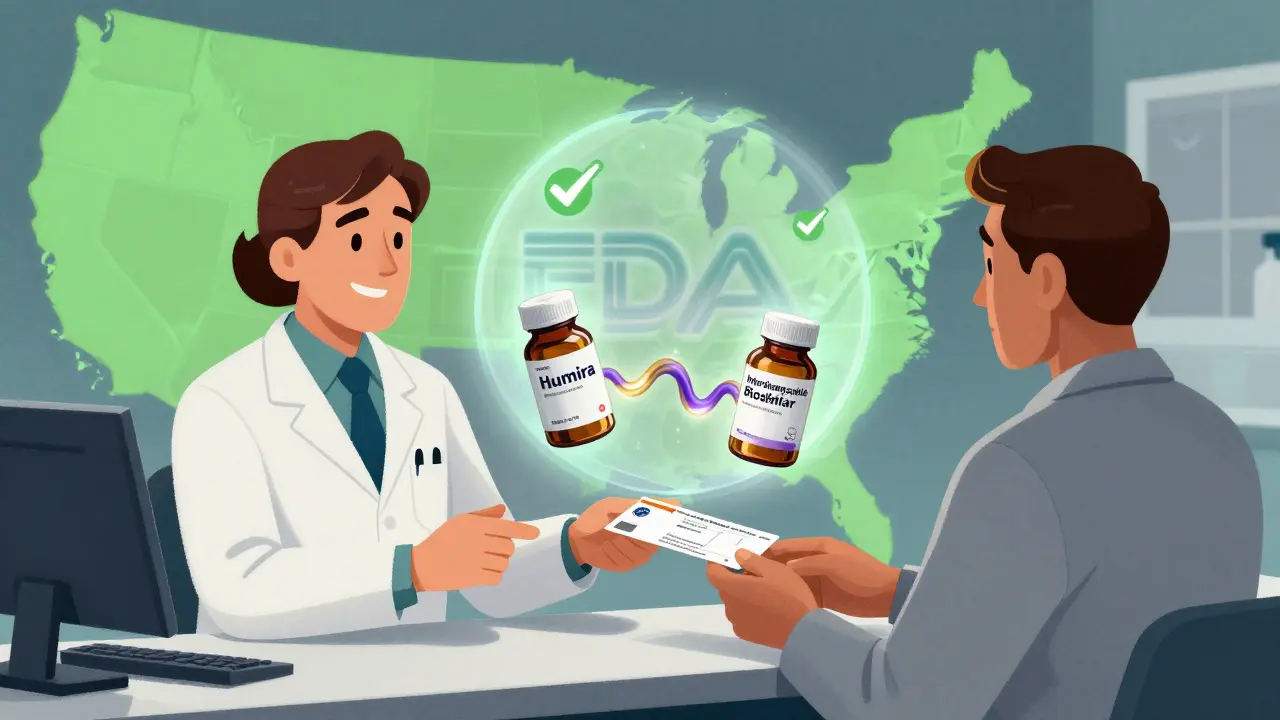
What’s in the Purple Book Right Now?
As of late 2023, only seven biosimilars had received the interchangeable designation. That’s not a lot compared to the dozens of biosimilars approved overall. The majority of biosimilars are still labeled as non-interchangeable. That means even if they’re cheaper, pharmacists can’t swap them unless the prescriber specifically allows it. The interchangeable products include:- Two insulin products (used for diabetes)
- Three drugs for inflammatory conditions like rheumatoid arthritis and Crohn’s disease
- Two treatments for eye conditions like macular degeneration
How to Use the Purple Book
The database is free and easy to use. Go to the FDA’s website and search for any biological drug. The results show you:- The original product (351(a) licensed)
- All biosimilars linked to it (351(k) biosimilar)
- Any that are interchangeable (351(k) interchangeable)
What the Purple Book Doesn’t Tell You
The Purple Book doesn’t list prices. It doesn’t say which biosimilars are covered by insurance. It doesn’t explain how to handle prior authorizations. It also doesn’t mention “unbranded biologics”-a term the FDA uses for products that are equivalent to brand-name drugs but weren’t approved under the biosimilar pathway. These aren’t interchangeable biosimilars, even if they’re chemically the same. And while it’s the most accurate source for regulatory status, it doesn’t replace clinical judgment. A doctor might still prefer the original drug for certain patients, even if a biosimilar is interchangeable. The Purple Book gives you the legal and scientific facts. You still need to apply them to individual cases.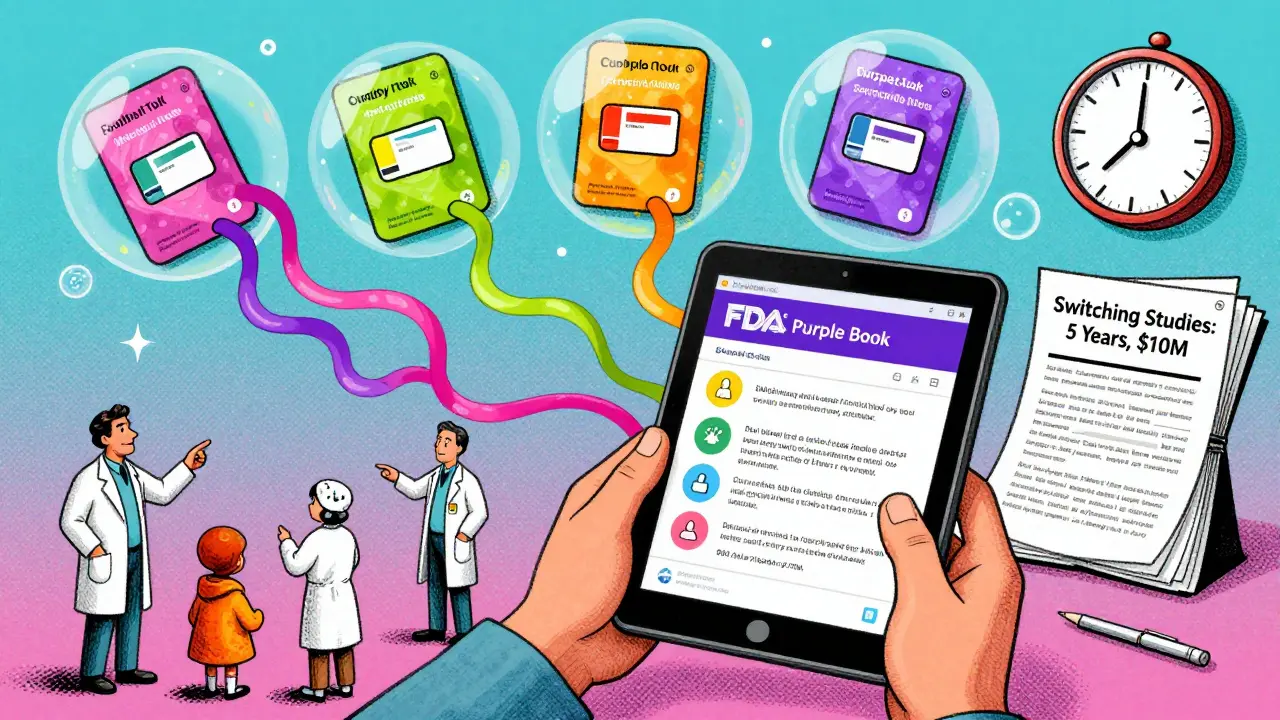
What’s Next for Biosimilars?
More interchangeable products are coming. Insulin biosimilars are leading the charge because they’re widely used and have simpler structures. But complex drugs like monoclonal antibodies are harder to copy exactly. That’s why interchangeability is still rare. The FDA is also updating its guidance on labeling. New rules will make it clearer how interchangeable biosimilars should be named and described on packaging. This is meant to reduce confusion among prescribers and pharmacists. The big picture? Biosimilars are lowering costs. Interchangeable ones could make that happen faster by allowing automatic substitution. But the system is still evolving. Patients need to know their rights. Pharmacists need clear rules. And everyone needs the Purple Book as their starting point.Common Questions About the Purple Book
Is the Purple Book only for U.S. drugs?
Yes. The Purple Book only includes biological products approved by the U.S. Food and Drug Administration. It does not cover drugs approved in other countries, even if they’re the same product. If you’re outside the U.S., you’ll need to check your country’s regulatory agency for similar information.
Can a pharmacist substitute a biosimilar without the doctor’s permission?
Only if the biosimilar is FDA-designated as interchangeable AND your state allows substitution without prescriber approval. In 47 states and Puerto Rico, pharmacists can swap interchangeable biosimilars without calling the doctor. But in a few states, they must notify the prescriber or get consent first. Always check your state’s pharmacy laws.
Are interchangeable biosimilars safer than non-interchangeable ones?
No. The FDA says interchangeable biosimilars are not safer or more effective than non-interchangeable biosimilars. The only difference is that interchangeable ones have been tested for multiple switches between the biosimilar and the original drug. Both types have the same safety and effectiveness profile as the reference product.
Why are there so few interchangeable biosimilars?
Because proving interchangeability requires expensive, complex clinical studies. Companies must show that switching back and forth between the biosimilar and the original drug doesn’t cause any loss of effectiveness or increase in side effects. That takes years and millions of dollars. Many manufacturers focus on getting biosimilar approval first and delay interchangeability applications.
Can I use the Purple Book to find cheaper alternatives to my biologic drug?
Yes. Search your drug’s name in the Purple Book to see all approved biosimilars and interchangeable versions. That tells you what options exist. But the Purple Book doesn’t show prices or insurance coverage. You’ll need to check with your pharmacy or insurer to see which one is covered and how much you’ll pay out of pocket.
8 Comments
Robert Gilmore January 29, 2026 AT 17:46
The Purple Book is a lifesaver but nobody talks about how useless it is if your insurance won't cover the biosimilar anyway
Robert Gilmore January 30, 2026 AT 07:48
so like... the fda says it's interchangeable but your state says no? why do we even have federal rules if states just ignore them? this is why america is a dumpster fire
Robert Gilmore January 31, 2026 AT 10:09
Ohhhhhhh!!!!!! So that's why my pharmacist kept asking me if I wanted the 'other one'?????? I thought they were just being extra nice!!!!!!! The Purple Book is literally the Rosetta Stone of biologics!!!!!!! I printed it out and laminated it!!!!!!! My cat now knows what adalimumab is!!!!!!!
Robert Gilmore February 1, 2026 AT 15:06
Let me break this down like you’re five: Biosimilar = same stuff, different wrapper. Interchangeable = same stuff, same wrapper, and the FDA gave it a gold star for switching back and forth like a pro. The Purple Book is the cheat sheet for the whole damn game. And yeah, it’s a pain that states have their own rules - but at least now you know where to look instead of guessing like a schmuck. This isn’t just paperwork - it’s your right to cheaper meds without your doctor playing gatekeeper.
Robert Gilmore February 2, 2026 AT 22:23
Thank you for making this so clear 😊 I’ve been scared to switch my biologic for years but now I know where to check 🙌 The Purple Book is like a superhero guidebook for patients 🦸♀️💉
Robert Gilmore February 4, 2026 AT 07:59
It’s worth noting that the lack of interchangeable biosimilars isn’t just about cost or bureaucracy - it’s also about scientific rigor. The FDA isn’t cutting corners here. Switching studies require longitudinal data, patient tracking, and statistical power that most companies aren’t willing to invest in unless they’re certain of market dominance. This isn’t laziness; it’s responsible regulation. That said, the system could be more transparent about why certain products are held back - and patients deserve clearer guidance from their providers on when to push for substitution.
Robert Gilmore February 5, 2026 AT 01:34
purple book? more like purple lie. all this is just pharma playing mind games to sell you cheaper versions they made in a lab with a 3d printer. real medicine comes in a white bottle with a logo you recognize. if it ain't branded, it ain't trustable. also biosimilars are just generics for rich people's drugs. why do you think they cost so much? because they're magic.
Robert Gilmore February 6, 2026 AT 11:36
Thank you for the comprehensive overview. I appreciate the clarity on the distinction between biosimilar and interchangeable. As a clinician, I’ve had patients come in confused after their pharmacy substituted a non-interchangeable product. The Purple Book is essential, but its utility is limited without standardized state policies and provider education. A national framework would reduce administrative burden and improve patient trust.