Prescription Transfer Eligibility Checker
Check if your prescription can be transferred to a new pharmacy based on current DEA rules and state regulations.
Switching pharmacies sounds simple-just walk into a new one and ask them to move your prescriptions. But if you’re taking any controlled medications, like painkillers, ADHD meds, or anxiety drugs, it’s not that easy. The rules changed in August 2023, and now there are strict limits on how and when you can transfer prescriptions, especially for controlled substances. If you don’t know what to tell the new pharmacy, your transfer could get stuck, delayed, or denied entirely. This isn’t about bureaucracy-it’s about safety, legal compliance, and making sure you don’t go without your meds.
What You Must Give the New Pharmacy
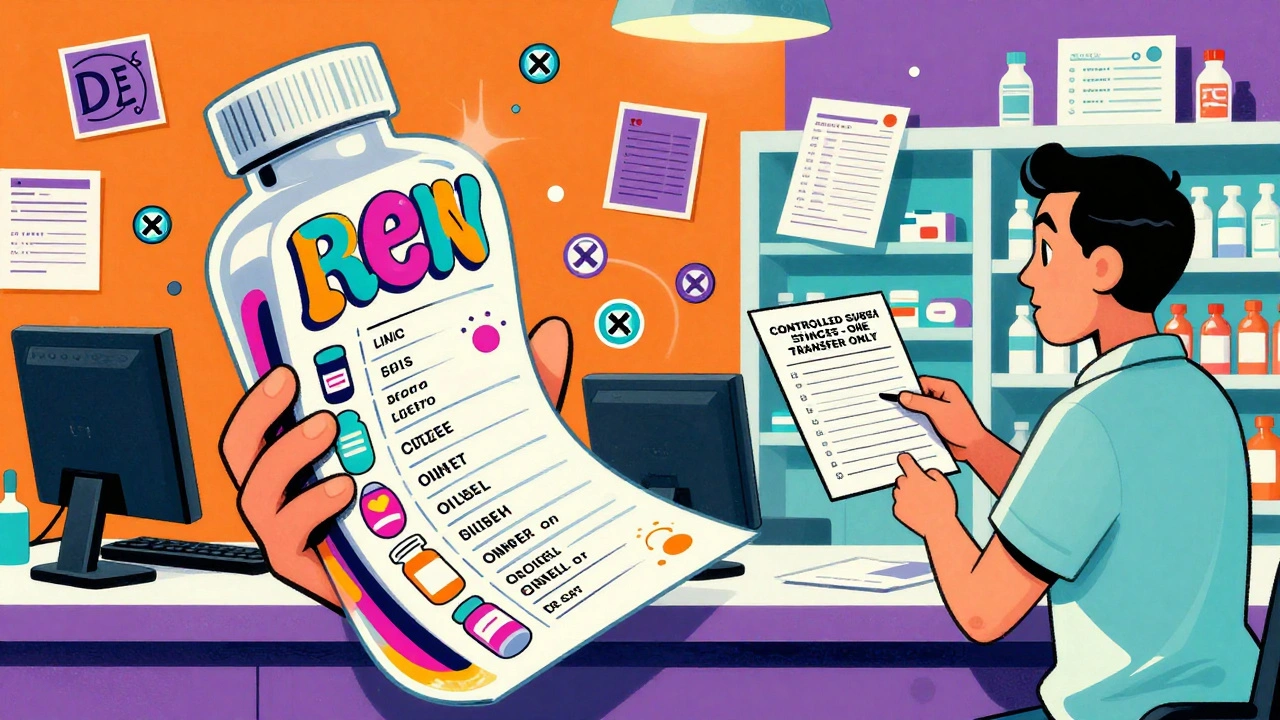
When you walk into a new pharmacy to transfer your prescriptions, you need to give them four key pieces of information: your full legal name, date of birth, current address, and the name of your old pharmacy. That’s the baseline. But if you’re on any controlled substances, you need to go further. You must tell them the exact name of each medication, the dosage, how often you take it, and the name of your prescriber. For controlled substances, they’ll also need the original prescription number and the DEA number of the prescribing doctor.Don’t assume they’ll find it on their own. Many pharmacies still rely on manual searches, and if the information is even slightly off-like a middle initial missing or a typo in the drug name-the transfer won’t go through. Keep a printed list of your medications handy. Include the brand and generic names, dosage strength, and how many refills you have left. That cuts down confusion and saves you time.
Controlled Substances: One-Time Only Transfer
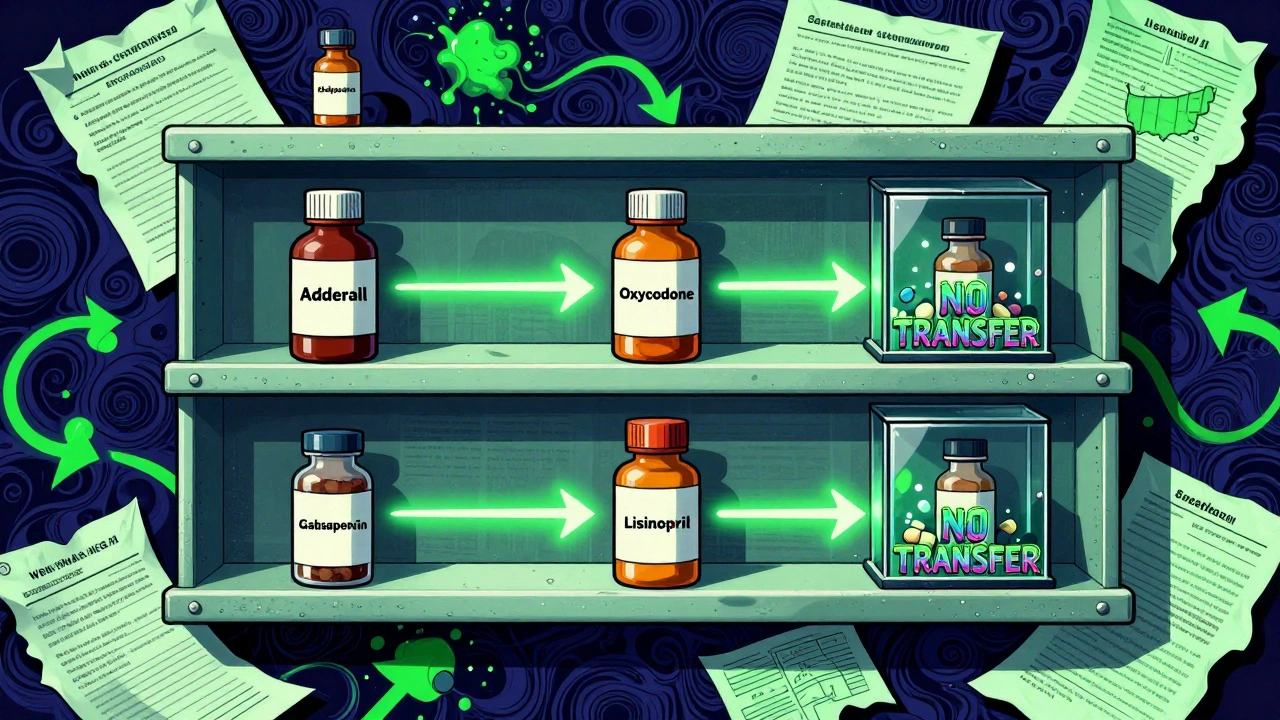
This is where things get tricky. Under the DEA’s 2023 Final Rule, prescriptions for Schedule III, IV, and V controlled substances can be transferred only once between pharmacies. That means if you switch from Pharmacy A to Pharmacy B, you can’t later switch to Pharmacy C and move the same prescription again. Even if both pharmacies are owned by the same company-like CVS to CVS-you still can’t re-transfer the same prescription.And here’s the hard part: Schedule II drugs-like oxycodone, Adderall, or fentanyl patches-can’t be transferred at all. If you need to switch pharmacies and you’re on a Schedule II medication, you must go back to your doctor and get a new prescription. No exceptions. No workarounds. This rule was designed to prevent drug diversion and stacking prescriptions across multiple pharmacies.
Before you switch, check what schedule your meds are on. You can ask your pharmacist or look up the drug on the DEA’s website. If you’re unsure, assume it’s controlled and plan accordingly. If you’re on multiple controlled substances, each one counts as a separate transfer. So you can transfer your Adderall to one pharmacy and your gabapentin to another-just not the same prescription twice.
Non-Controlled Medications: More Flexibility
Good news: if you’re on blood pressure pills, statins, thyroid meds, or antibiotics, you can transfer those as many times as you want, as long as refills remain. There’s no federal limit. But that doesn’t mean it’s automatic. You still need to provide accurate details. Some pharmacies will call your old pharmacy directly. Others will ask you to fill out a form. Some may even require you to bring in the original bottle.Don’t assume your old pharmacy will automatically send everything. They’re not required to. It’s your job to initiate the transfer. Call or visit the new pharmacy first. Give them your info and ask them to contact your old one. Most chain pharmacies (CVS, Walgreens, Rite Aid) have electronic systems that handle this in under 24 hours. Independent pharmacies might take longer, especially if they still use fax or phone to communicate.
What Happens After the Transfer?
Once the transfer is processed, your old pharmacy must mark the original prescription as “VOID” in their system. If it’s a paper prescription, they’ll write “VOID” across it. The new pharmacy must add the word “TRANSFER” to the prescription record and include details like the name of the original pharmacy, the date of transfer, and the name of the pharmacist who handled it. All of this is required by law and must be kept on file for two years.You won’t see this paperwork, but it’s happening behind the scenes. That’s why it’s important to get confirmation. After 24-48 hours, call the new pharmacy and ask: “Has my prescription been transferred?” If they say yes, ask them to confirm the number of refills remaining. Sometimes, refills get lost in translation, especially with older systems.

State Laws Can Make It Harder
Federal rules set the baseline, but states can add more restrictions. For example, some states require pharmacists to verify patient identity with a government ID before accepting a transfer. Others limit transfers to pharmacies within the same state. If you’re moving across state lines, don’t assume your prescription will follow you. Some states have reciprocity agreements with neighboring states; others don’t. New York, California, and Florida have stricter documentation rules than the federal minimum.Before you switch, call the new pharmacy and ask: “Do you accept transfers from [your current state]?” If they hesitate or say they need to check with their compliance officer, that’s a red flag. Don’t waste your time showing up with all your meds if they’re not set up to handle your transfer. You’ll be back to square one.
What to Do If Your Transfer Gets Denied
If the new pharmacy refuses to transfer your prescription, ask for the reason in writing. They’re legally required to give you one. Common reasons include: the prescription has no refills left, it’s a Schedule II drug, the old pharmacy didn’t respond, or the information provided doesn’t match their records.If they say the prescription is “expired,” check the date. Prescriptions for controlled substances expire six months after they’re written. Non-controlled prescriptions expire one year after the date issued. If you’re within that window and still have refills, the pharmacy has no legal right to deny the transfer.
If you’re denied without a clear reason, contact your state’s pharmacy board. They can intervene. You can also ask your doctor to send a new prescription directly to the new pharmacy. It’s faster than fighting a transfer denial.
Pro Tips to Avoid Delays
- Don’t wait until your last refill to switch. Start the process at least 7 days before you run out.
- Call the new pharmacy first. Don’t just show up. Ask if they can handle your transfers and what they need from you.
- For controlled substances, confirm with both pharmacies that they’re using an electronic system. If the old one still uses paper, the transfer won’t work under the new DEA rule.
- Bring your medication bottles with you. They have the exact names, dosages, and refill counts printed on them.
- If you’re transferring multiple prescriptions, do them one at a time. Trying to rush 5 transfers at once increases the chance of errors.
- Keep a copy of your transfer request and the date you submitted it. If something goes wrong, you’ll have proof you followed the process.
What’s Changing Next?
The DEA is required to review this one-time transfer rule by September 2024. Early data suggests that patients are using it as intended-fewer people are going back to doctors just to move prescriptions. But there’s also evidence that some are trying to game the system by switching pharmacies to get extra refills. The DEA will decide whether to allow multiple transfers for controlled substances in the future. For now, stick to the rules. If you need more refills, talk to your doctor. Don’t try to work around the system.Final Thought: Be the Advocate
Pharmacists are busy. They’re not mind readers. If you want your prescription transferred smoothly, you have to give them everything they need-clearly and completely. Don’t assume they’ll know what’s in your medicine cabinet. Write it down. Call ahead. Confirm the details. It takes 10 extra minutes now to save yourself a week of stress later. And if you’re on controlled meds? Treat this like a medical safety check. One wrong step, and you could be left without your treatment.Can I transfer my Adderall prescription to a new pharmacy?
No, you cannot transfer Adderall (a Schedule II controlled substance) between pharmacies under current DEA rules. If you need to switch pharmacies, you must get a new prescription from your doctor. Schedule II drugs like Adderall, oxycodone, and fentanyl are not eligible for transfer under any circumstances.
How long does a prescription transfer take?
For non-controlled medications, transfers usually take 24 to 48 hours if the pharmacies use electronic systems. For controlled substances, it can take up to 72 hours because of extra verification steps. If your old pharmacy is slow to respond or uses fax instead of electronic systems, delays are common.
Can I transfer prescriptions across state lines?
It depends on the state. Some states have reciprocity agreements that allow transfers from out-of-state pharmacies, while others block them entirely. Always call the new pharmacy first and ask if they accept transfers from your current state. If they say no, your only option is to get a new prescription from a doctor in your new state.
What if my prescription has no refills left?
You cannot transfer a prescription with zero refills. The DEA and all state laws require that there be at least one refill remaining for a transfer to occur. If you’re out of refills, you must contact your prescriber for a new prescription, even for non-controlled medications.
Do I need to bring my old prescription bottle to the new pharmacy?
You’re not legally required to, but it’s highly recommended. The bottle has the exact medication name, dosage, prescriber, and refill count printed on it. This prevents mistakes-like mixing up generic and brand names-and speeds up the transfer process. Many pharmacists will ask for it anyway.
8 Comments
Robert Gilmore December 4, 2025 AT 14:23
Been there. Switched from Walgreens to a local indie place last month after moving. Took three calls and a printed list of meds (brand + generic) to get my gabapentin through. They didn’t even ask for the bottle-just matched the name and dose. Took 18 hours. No drama. Just be clear, be patient, and don’t assume they know your history.
Pro tip: Write ‘TRANSFER’ in big letters on the top of your list. Pharmacists appreciate it more than you think.
Robert Gilmore December 6, 2025 AT 09:34
DEA’s 2023 Final Rule is just the tip of the iceberg. This is part of the Controlled Substances Act modernization initiative under Title 21 CFR Part 1306. The one-time transfer restriction for Sched III-V is a direct response to the 2019-2022 diversion spike documented in the NIDA Prescription Drug Monitoring Program. Schedule II non-transferability? Non-negotiable. Any pharmacy that says otherwise is either misinformed or complicit.
Stop treating this like a customer service issue. It’s a federal compliance protocol. If you can’t handle the paperwork, don’t take the meds.
Robert Gilmore December 8, 2025 AT 07:02
They’re lying. They always lie. The DEA doesn’t care about your Adderall. They care about tracking. Every transfer is logged. Every pharmacist is a spy. Your name, your doctor, your refill count-fed into a database that shares with ICE, the FBI, and your insurance. They’re not helping you. They’re watching you. And if you switch pharmacies twice? They’ll flag you as a ‘potential abuser.’
Don’t trust them. Don’t even ask. Just get a new script. Always.
Robert Gilmore December 8, 2025 AT 23:39
Let’s be real-this whole system is a performance art piece. We’re told to be responsible patients, to line up our scripts like obedient soldiers, while the real criminals? Big Pharma CEOs, private equity firms owning 70% of pharmacies, and the damn insurance companies that jack up prices 300% overnight?
We’re the ones getting interrogated like criminals for needing our meds. Meanwhile, the guy who bought 200 oxycodones off a guy in a parking lot? No one asks him for his ID. No one checks his DEA number.
This isn’t about safety. It’s about control. And we’re the ones paying the price in anxiety, lost days, and skipped doses.
Wake up. The system isn’t broken. It’s working exactly as designed.
Robert Gilmore December 10, 2025 AT 15:00
OMG I JUST GOT DENIED FOR TRANSFERRING MY XANAX 😭 I WAS SO SAD I CRIED IN THE PHARMACY 😭
They said ‘no refills’ but I had ONE LEFT?!?! I swear I saw it on the bottle! I think they’re lying to me because I’m brown. I’ve been here 12 years and they still treat me like I’m smuggling drugs. My doctor won’t call in a new one until Monday. I’m going to die without my anxiety meds 😭😭😭
Also I think the government is using this to track our moods. I’m not crazy. Look at the dates. They’re all on full moons. Coincidence? I think NOT.
Robert Gilmore December 12, 2025 AT 14:20
They’re lying about the one-time transfer. I did it twice. Same CVS. Same script. No one noticed. Just say you lost the bottle and need a refill. They’ll do it. They do it all the time. The system’s a joke. They’re not gonna audit your file unless you’re on 10 meds and live in Florida.
Just go. Be chill. Smile. Say ‘I’m a veteran’ if they give you trouble. Works every time.
Robert Gilmore December 13, 2025 AT 15:20
Hey I just switched pharmacies last week and I was so nervous I almost didn’t do it. But I wrote down every med, dosage, refills, and even the prescriber’s phone number. Took me 10 minutes. The pharmacist actually thanked me. Said I made her job easier.
You’re not a burden. You’re just being smart. And if you’re on something like Adderall? Don’t panic. Call your doctor early. They get it. I’ve had mine for 5 years and they’ve always been chill about it.
You got this. And if you need someone to vent to? I’m here. No judgment. Just coffee and empathy.
Robert Gilmore December 14, 2025 AT 18:55
Of course you can’t transfer Schedule II meds. That’s why they’re Schedule II. If you’re too lazy to call your doctor, don’t blame the pharmacy. You think this is about paperwork? No. It’s about preventing junkies from stacking scripts across 5 different towns. You think the DEA gives a damn about your ADHD? No. They care about the 17-year-old in Ohio who’s crushing your Adderall to stay awake for Fortnite.
Get over yourself. Your convenience doesn’t override public safety. And if you’re mad about it? Maybe you shouldn’t be on the drug in the first place.