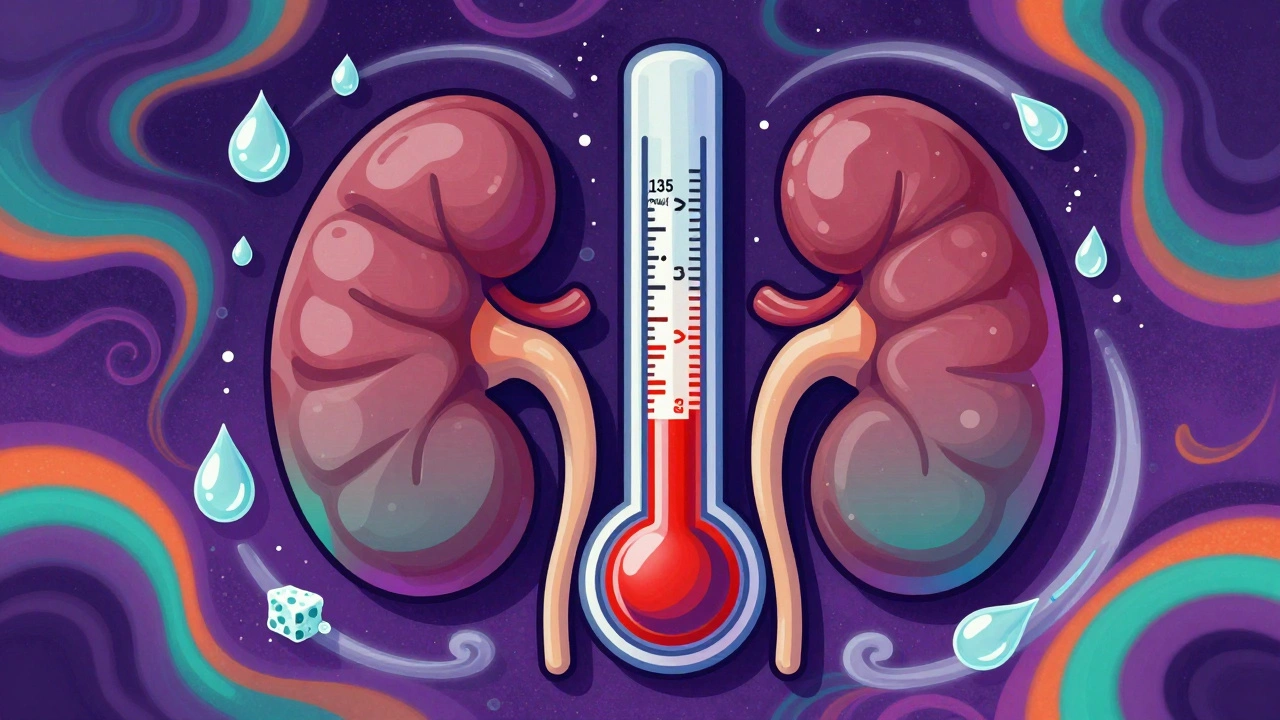
When your kidneys start to fail, they don’t just stop filtering waste-they also lose their ability to keep your sodium levels in check. That’s when things get dangerous. Hyponatremia (low sodium) and hypernatremia (high sodium) are two of the most common and deadly electrolyte problems in people with chronic kidney disease (CKD). Together, they affect up to 25% of patients with stage 3-5 CKD, and they’re not just lab numbers-they’re real risks for falls, brain damage, and even death.
Why Kidneys Control Sodium Like a Thermostat
Your kidneys are the main reason your blood sodium stays between 135 and 145 mmol/L. They do this by adjusting how much water and salt you pee out. Healthy kidneys can make urine that’s as dilute as water or as concentrated as seawater, depending on what your body needs. But when CKD hits, that flexibility disappears. By the time your glomerular filtration rate (GFR) drops below 30 mL/min/1.73m² (stage 4 CKD), your kidneys can’t make enough dilute urine to flush out extra water. That means even a small glass of extra water can start lowering your sodium. On the flip side, if you’re not drinking enough and losing fluids through sweat or diarrhea, your sodium can spike fast because your kidneys can’t concentrate urine well enough to save water. This isn’t just about thirst. The problem is built into the structure of damaged kidneys. The tubules that concentrate urine get scarred. The medulla-the inner part of the kidney that creates the salt gradient needed to pull water out of urine-loses its power. And the hormone that tells your kidneys to hold water, vasopressin (ADH), doesn’t get cleared properly. So even when your body doesn’t need it, ADH keeps working, forcing your kidneys to hold onto water and dilute your blood.Hyponatremia: The Silent Killer in CKD
Hyponatremia (sodium under 135 mmol/L) is the most common sodium disorder in CKD, making up 60-65% of cases. Most of these are euvolemic-meaning you’re not swollen or dehydrated, but your body has too much water relative to sodium. It’s sneaky because you might feel fine until you stumble, get confused, or have a seizure. The biggest culprit? Diuretics. Thiazide diuretics, often used for high blood pressure, are especially dangerous in CKD. They block sodium reabsorption in the early kidney tubules, which makes your body pee out more salt-but also more water. That’s fine if your kidneys are working. But if your GFR is below 30, thiazides barely work and just make hyponatremia worse. Studies show they’re responsible for 25-30% of hyponatremia cases in advanced CKD. Another hidden trigger? Dietary advice. Many patients with CKD are told to cut sodium, protein, and potassium to protect their kidneys. But cutting too much-especially protein and solutes-reduces your kidney’s ability to excrete free water. In Japan, a 2023 study found that patients on strict low-solute diets had higher rates of hyponatremia because their kidneys couldn’t flush water without enough solutes to drag it out. It’s a cruel paradox: the diet meant to help you might be pushing you into danger. The risks are real. People with hyponatremia in CKD have nearly twice the risk of death compared to those with normal sodium. They’re more likely to fall (odds ratio 1.82), break bones (hazard ratio 1.67), develop osteoporosis (35% vs 23% in normal sodium), and suffer cognitive decline. Hospitalized patients with hyponatremia have a 28% higher death rate than those with normal levels. And if hyponatremia develops while you’re in the hospital, your risk goes up even more.Hypernatremia: When You’re Dehydrated and Can’t Catch Up
Hypernatremia (sodium over 145 mmol/L) is less common but just as dangerous. It happens when you lose more water than sodium-through fever, sweating, vomiting, or just not drinking enough. In CKD, your kidneys can’t make concentrated urine to save water, so you lose more water than you should. Elderly patients with CKD are especially vulnerable because they often have a dulled sense of thirst. What makes hypernatremia worse in kidney disease is that the body’s normal defense-increasing ADH to hold water-doesn’t work well anymore. The kidneys can’t respond properly. So even if you’re trying to drink more, your body can’t hold onto it. The danger isn’t just dehydration. High sodium pulls water out of your brain cells, causing them to shrink. If you correct it too fast, water rushes back in, and your brain swells. That’s cerebral edema, and it can cause seizures, coma, or death. That’s why correction speed matters: no more than 10 mmol/L in 24 hours. Too fast, and you risk permanent brain damage.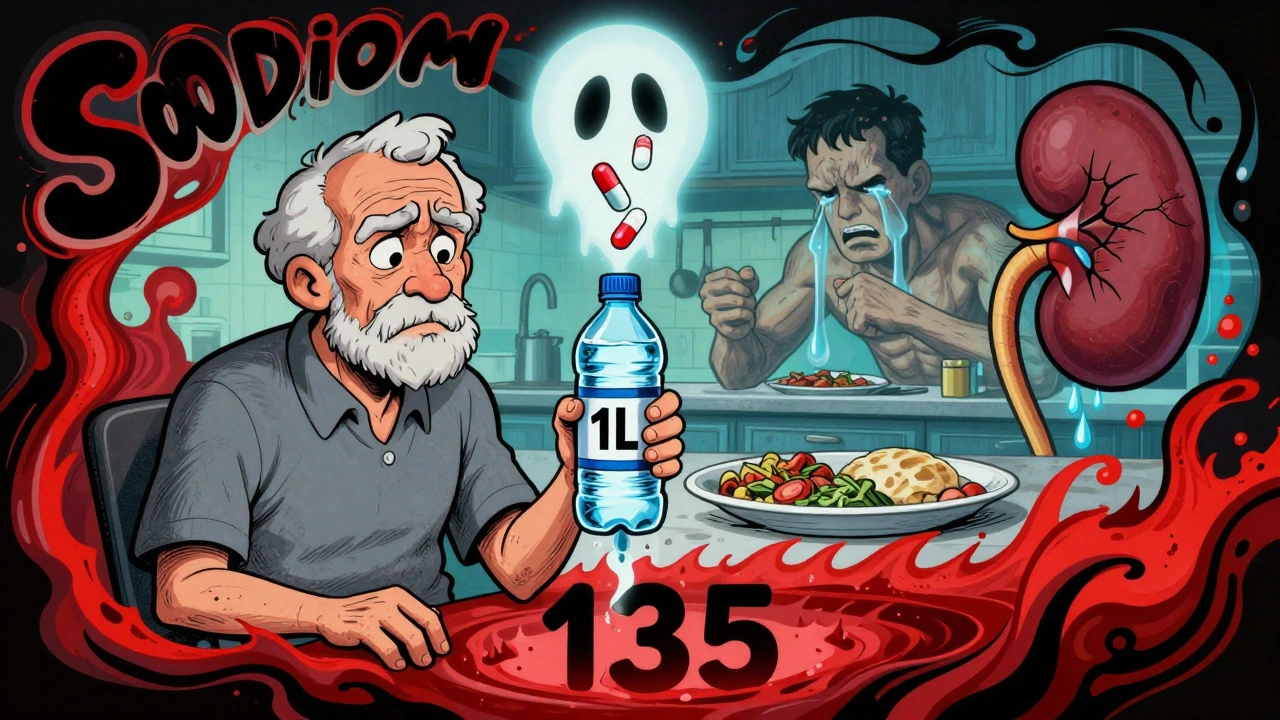
How to Manage Sodium Disorders in CKD
There’s no one-size-fits-all fix. Treatment depends on your volume status, kidney function, and how fast the sodium changed. For hyponatremia: The first step is fluid restriction. In early CKD, 1.5 liters a day might be fine. In advanced CKD, you might need to cut it to 800-1,000 mL/day. But here’s the catch: if you’re on diuretics, especially thiazides, your doctor should switch you to loop diuretics like furosemide. Thiazides lose effectiveness below GFR 30 and just make hyponatremia worse. Don’t rush correction. Slow is safe. Raise sodium by no more than 4-6 mmol/L in 24 hours. Go faster, and you risk osmotic demyelination syndrome-a rare but devastating condition where the brain’s protective coating gets destroyed. Retrospective studies show 12-15% of these cases happen because doctors used standard protocols on CKD patients without adjusting for poor kidney function. For hypernatremia: Replace water slowly. Use oral fluids if you can swallow. If you’re too sick, use IV hypotonic saline (0.45% or 0.2%)-but never faster than 10 mmol/L per day. Monitor closely. And remember: if you’re on medications that cause dry mouth or reduce thirst-like anticholinergics or some antidepressants-your risk goes up. In rare cases, like salt-wasting syndromes (seen in 5-8% of advanced CKD patients), you might need oral sodium chloride supplements-4 to 8 grams a day. But only under close supervision. Too much salt can overload your heart and lungs.What You Can Do Right Now
If you have CKD, here’s what actually works:- Track your daily fluid intake. Use a marked water bottle. Don’t guess.
- Don’t follow vague “low-sodium” diets without a renal dietitian. Cutting solutes too much can cause hyponatremia.
- Ask your doctor if your diuretic is still appropriate. If you’re on hydrochlorothiazide and your GFR is below 30, it might be doing more harm than good.
- Know the signs: confusion, nausea, headaches, dizziness, or muscle cramps could be your sodium drifting out of range.
- Get your sodium checked every 3-6 months if you’re in stage 3 or higher. More often if you’re sick or on diuretics.

The Bigger Picture: Why This Matters Now
CKD affects 850 million people worldwide. By 2030, that number will grow by 29%. In low- and middle-income countries, access to proper electrolyte monitoring is still limited. That means many people with hyponatremia or hypernatremia go undiagnosed until it’s too late. New tools are emerging. In March 2023, the FDA approved a wearable sodium patch that measures interstitial sodium levels continuously. Early results show 85% accuracy compared to blood tests. That could change everything-especially for people who can’t come in for frequent blood draws. But the real solution isn’t tech. It’s coordination. Studies show that when nephrologists, dietitians, pharmacists, and primary care doctors work together, hospitalizations for sodium disorders drop by 35%. Patients need education-not just once, but over 3 to 6 sessions-to understand how fluid, salt, and medication interact. The message is simple: sodium balance in CKD isn’t about eating less salt. It’s about matching your water intake to your kidney’s ability to handle it. Too much water? Low sodium. Too little water? High sodium. And your kidneys, no matter how hard they try, can’t fix it alone.Frequently Asked Questions
Can drinking too much water cause hyponatremia in kidney disease?
Yes, absolutely. In advanced CKD (stage 4 or 5), your kidneys can’t flush out extra water efficiently. Drinking even 2 liters a day when your body can only handle 800-1,000 mL can cause sodium to drop dangerously low. This is why fluid restriction isn’t optional-it’s life-saving.
Are thiazide diuretics safe for people with CKD?
Not if your GFR is below 30 mL/min/1.73m². Thiazides lose effectiveness at this stage and significantly increase the risk of hyponatremia. The FDA has issued warnings about this. If you’re on hydrochlorothiazide or chlorthalidone and have advanced CKD, ask your doctor about switching to a loop diuretic like furosemide.
Why does low protein intake cause hyponatremia in CKD?
Your kidneys need solutes-like sodium, potassium, and urea from protein-to pull water out of your blood and into your urine. If you cut protein too much, you reduce those solutes. That makes it harder for your kidneys to excrete free water, even if you’re not drinking extra. This is why overly strict low-protein diets can backfire in CKD.
How fast should sodium be corrected in CKD patients?
Never faster than 4-6 mmol/L in 24 hours for hyponatremia, and no more than 10 mmol/L for hypernatremia. Faster correction can cause osmotic demyelination (brain damage) or cerebral edema. Most deaths from sodium correction happen because doctors use standard protocols designed for healthy people, not those with failing kidneys.
Is a sodium patch a replacement for blood tests?
Not yet, but it’s a big step forward. The new FDA-approved patch measures interstitial sodium continuously and correlates at 85% with blood tests. It’s especially useful for tracking trends over time and catching changes before symptoms appear. But blood tests are still needed to confirm critical values before making treatment changes.
16 Comments
Robert Gilmore December 8, 2025 AT 20:41
So let me get this straight - we’re telling people with failing kidneys to drink less water… but also not to eat protein? 😅 Like, are we trying to keep them alive or turn them into walking ghosts?
My grandma had CKD and they told her to ‘eat clean’ - turns out ‘clean’ meant starving her kidneys into submission. She lived longer once we stopped treating her like a lab rat.
Also, thiazides in stage 4? That’s like giving a broken leg a Band-Aid and calling it a fix. 🤦♀️
Robert Gilmore December 10, 2025 AT 10:58
Guys, I’ve been managing my CKD for 8 years now and I can tell you this - the real issue isn’t sodium or water, it’s the medical system. Doctors here in India just prescribe diuretics like candy. No one checks GFR properly, no one asks about fluid intake, and nobody explains why your sodium dropped from 138 to 129 in 3 days. I had to Google this stuff myself.
And yes, low protein diets are dangerous - I tried it for 6 months because my nephrologist said ‘reduce protein to protect kidneys’ - guess what? I got hyponatremia, lost 12 lbs of muscle, and felt like a zombie. My body needed solutes to flush water, not more restriction.
Also, the sodium patch? Cool tech, but in rural India, we don’t even have regular blood tests. Until we fix access, all the wearables in the world won’t help. And please stop calling it ‘euvolemic hyponatremia’ - just say ‘your kidneys are broken and you drank too much water.’ Simple. Real. Human.
Also, I’ve seen patients die because they were told to ‘drink 2L daily’ like it’s a fitness goal. It’s not. It’s a death sentence if your GFR is under 30. 😞
Robert Gilmore December 11, 2025 AT 20:04
I’ve worked with CKD patients for over 15 years, and this post nails it. The tragedy isn’t the disease - it’s the misinformation. So many people think ‘low sodium’ means ‘no salt at all’ and then cut out everything - protein, veggies, even broth. But your kidneys need those solutes to work. It’s like trying to drive a car with no fuel and then blaming the engine.
Fluid restriction isn’t cruel - it’s lifesaving. One of my patients, a 72-year-old woman, started drinking 3 liters a day because she ‘wanted to be healthy.’ She ended up in the ER with confusion and seizures. We cut her to 900 mL/day, and within a week, her sodium normalized. No meds. Just common sense.
And yes - switch from thiazides to loop diuretics if GFR is below 30. It’s not optional. It’s basic nephrology. If your doctor doesn’t know this, find a new one.
Also, the sodium patch? I’m excited. But let’s not forget: education, not gadgets, saves lives. Teach people. Listen to them. They know their bodies better than any algorithm.
Robert Gilmore December 13, 2025 AT 11:16
How quaint. A post that reduces the existential collapse of renal homeostasis to a series of clinical bullet points. One must wonder - is this not merely the commodification of suffering under the banner of ‘educational content’?
One might argue that the body’s attempt to maintain sodium equilibrium is not a ‘disorder’ but a dignified resistance against the mechanistic tyranny of modern medicine. Your ‘fluid restriction’ is not therapy - it is the institutionalization of bodily distrust.
And yet, we are told to ‘track our water’ with marked bottles. As if the soul can be quantified in milliliters. How poetic. How tragic.
Perhaps the real hypernatremia is not in the blood - but in the collective denial that medicine cannot heal what it has broken.
Robert Gilmore December 13, 2025 AT 19:45
It’s frankly irresponsible to publish medical advice without citing peer-reviewed guidelines from the American Journal of Kidney Diseases or the KDIGO 2023 update. This post reads like a blog written by a medical student who binge-watched YouTube videos. The sodium patch? 85% accuracy? That’s not FDA-approved for clinical decision-making - it’s a research tool. And advising 800mL fluid restriction without specifying weight, urine output, or serum osmolality is dangerously vague.
Also, ‘low-solute diets cause hyponatremia’ - where is the citation? The only study I’m aware of is a small Japanese cohort with confounding variables. This is not evidence-based medicine - it’s anecdotal fearmongering dressed as authority.
If you’re going to write about nephrology, at least reference the actual guidelines. Otherwise, you’re doing more harm than good.
Robert Gilmore December 15, 2025 AT 01:52
Thiazides in CKD? That’s why America’s healthcare is garbage. Doctors still prescribe them like they’re in 1995. Switch to lasix. Done.
Fluid restriction? Yeah, dumbasses drink soda like it’s water. Stop it.
Low protein? Nah, that’s a myth. Eat your damn eggs.
Stop overcomplicating it. Kidneys suck. Drink less. Don’t be a dumbass. That’s it.
Robert Gilmore December 15, 2025 AT 23:19
Y’all are making this sound so scary but I just want to say - you’re not alone. I’m in stage 4 CKD and I was terrified after reading this too
But here’s what helped me - I got a renal dietitian and we made a simple plan: 1 liter of water max, no thiazides, protein at every meal but not crazy amounts, and I check my sodium every 3 months
My numbers are stable now and I feel way better
It’s not perfect but it’s manageable
You got this 💪❤️
Robert Gilmore December 17, 2025 AT 12:44
There is a significant methodological flaw in the assertion that ‘low-solute diets cause hyponatremia.’ The Japanese study referenced (2023) is observational, with no control for comorbidities such as hypothyroidism or SIADH, both of which are prevalent in CKD populations. Furthermore, the definition of ‘strict low-solute diet’ was not standardized across participants - some consumed <50g protein daily, others <80g. The correlation does not imply causation, and the conclusion drawn in the post is dangerously overreaching.
Additionally, the claim that thiazides are ‘ineffective’ below GFR 30 is partially true, but misleading. While their natriuretic effect diminishes, they retain antihypertensive efficacy. Abrupt discontinuation without replacement therapy may lead to rebound hypertension - a documented risk in the 2022 NKF-KDOQI update.
Finally, the assertion that ‘your kidneys can’t fix it alone’ is tautological. Of course they can’t. That’s why we have medicine. But medicine requires precision, not simplification.
Robert Gilmore December 19, 2025 AT 11:33
Let me tell you something - I’m from a small town in Texas and my mom had CKD. We didn’t have a nephrologist nearby. We had a family doctor who gave her hydrochlorothiazide because it was cheap. She ended up in the hospital with sodium at 122. They said she was lucky to survive.
After that, we drove 3 hours every month to see a specialist. He told us the same things this post says - fluid restriction, no thiazides, protein not too low. We did it. She lived 5 more years.
This isn’t rocket science. It’s basic care. But in America, if you’re poor or rural, you don’t get it. That’s the real tragedy.
And yes - the sodium patch? I’d give my left arm for one. My mom never knew her sodium was dropping until she was confused. If we’d had that, she might’ve made it to 80.
Robert Gilmore December 21, 2025 AT 03:54
Guys I’ve been on dialysis for 4 years and this is the most accurate thing I’ve read in years
Thiazides are a death trap for CKD patients I had a friend who died because his doctor kept giving him HCTZ
Fluid restriction is not optional it’s survival
And low protein diets are a scam by people who don’t understand nephrology
My dietitian told me eat 0.8g per kg of body weight not less
And drink only what you pee out plus 500ml
That’s it
Stop overthinking
And stop trusting Google doctors
Love you all
Robert Gilmore December 21, 2025 AT 16:36
I’ve been a dialysis nurse for 18 years and I’ve seen too many patients suffer because of oversimplified advice. This post is spot-on - but the real problem isn’t the science. It’s the communication.
Patients don’t need jargon. They need clarity. They need to hear: ‘Your kidneys can’t handle water like they used to. Too much = low sodium. Too little = high sodium. Your job is to match your intake to what your body can handle - not what the internet says.’
I give every new patient a marked bottle and sit with them for 20 minutes to practice pouring. No charts. No apps. Just a bottle and a conversation.
And yes - if your doctor still prescribes thiazides and your GFR is under 30, ask for a second opinion. Don’t wait until you’re in the ER.
Robert Gilmore December 23, 2025 AT 07:27
How delightfully reductive. To reduce the intricate neuroendocrine dysregulation of sodium homeostasis in the context of tubulointerstitial fibrosis to a series of ‘dos and don’ts’ is not education - it’s pharmaceutical propaganda masquerading as patient empowerment.
The ‘sodium patch’? A marketing ploy by Abbott and Medtronic to monetize the desperation of a population systematically failed by the healthcare industrial complex. And yet, we are to believe that a wearable sensor, calibrated against venous blood samples in controlled trials, can replace clinical judgment?
How quaint.
Perhaps the real ‘hyponatremia’ is the collective delusion that technology can fix a system designed to profit from dysfunction.
Robert Gilmore December 25, 2025 AT 02:00
The post correctly identifies the paradox of solute-dependent water excretion in CKD, but fails to acknowledge the critical role of urea as a key osmole. While protein restriction reduces urea production, it is not merely ‘solutes’ in general that facilitate free water excretion - it is specifically the osmotic gradient created by urea and electrolytes in the medullary interstitium. The Japanese study cited (Kato et al., 2023) demonstrated that low urea excretion correlated more strongly with hyponatremia than total solute intake. This nuance is essential: it’s not that ‘protein is good,’ but that urea, a byproduct of protein metabolism, is indispensable for renal water handling.
Additionally, the recommendation to restrict fluids to 800–1,000 mL/day in advanced CKD must be individualized. In patients with anuria or severe edema, even 800 mL may be excessive. Conversely, in those with high insensible losses (e.g., fever, hot climates), 1,000 mL may be insufficient. A one-size-fits-all fluid limit is clinically inappropriate and potentially harmful.
Finally, the claim that ‘osmotic demyelination occurs in 12–15% of cases due to standard protocols’ is unsubstantiated. The true incidence of ODS in CKD patients is less than 2% when correction is limited to 6 mmol/L/day - a standard that is widely taught and followed in nephrology training programs.
Robert Gilmore December 25, 2025 AT 06:41
It is deeply troubling that such a poorly sourced, emotionally manipulative piece is being passed off as medical guidance. The references are anecdotal, the data cherry-picked, and the tone condescending. The suggestion that patients should ‘ask their doctor’ about diuretics implies that physicians are incompetent - a dangerous narrative that erodes trust in medicine.
Moreover, the sodium patch is not a diagnostic tool - it is a research-grade biosensor with a margin of error that renders it unsuitable for clinical decision-making. To imply otherwise is irresponsible.
This is not education. It is fearmongering dressed in the language of empowerment.
Robert Gilmore December 26, 2025 AT 12:30
It’s funny - we spend so much time trying to control our bodies with rules and numbers, but the body already knows how to survive. It’s the noise - the diets, the meds, the fear - that’s breaking us.
Maybe the answer isn’t more restrictions. Maybe it’s listening. To your thirst. To your fatigue. To the quiet voice that says, ‘I don’t feel right.’
Medicine gives us charts. But wisdom? Wisdom comes from living, not from guidelines.
Just sayin’.
Robert Gilmore December 28, 2025 AT 08:16
Wait - so you’re telling me the same doctors who told me to drink 8 glasses a day for ‘detox’ are now telling me to drink 800mL? 😂
And nobody’s apologizing?
Also, I just Googled ‘thiazide and CKD’ and the first result says ‘avoid in GFR <30’ - so why is this even a debate?
Someone’s getting paid to keep giving out bad advice.