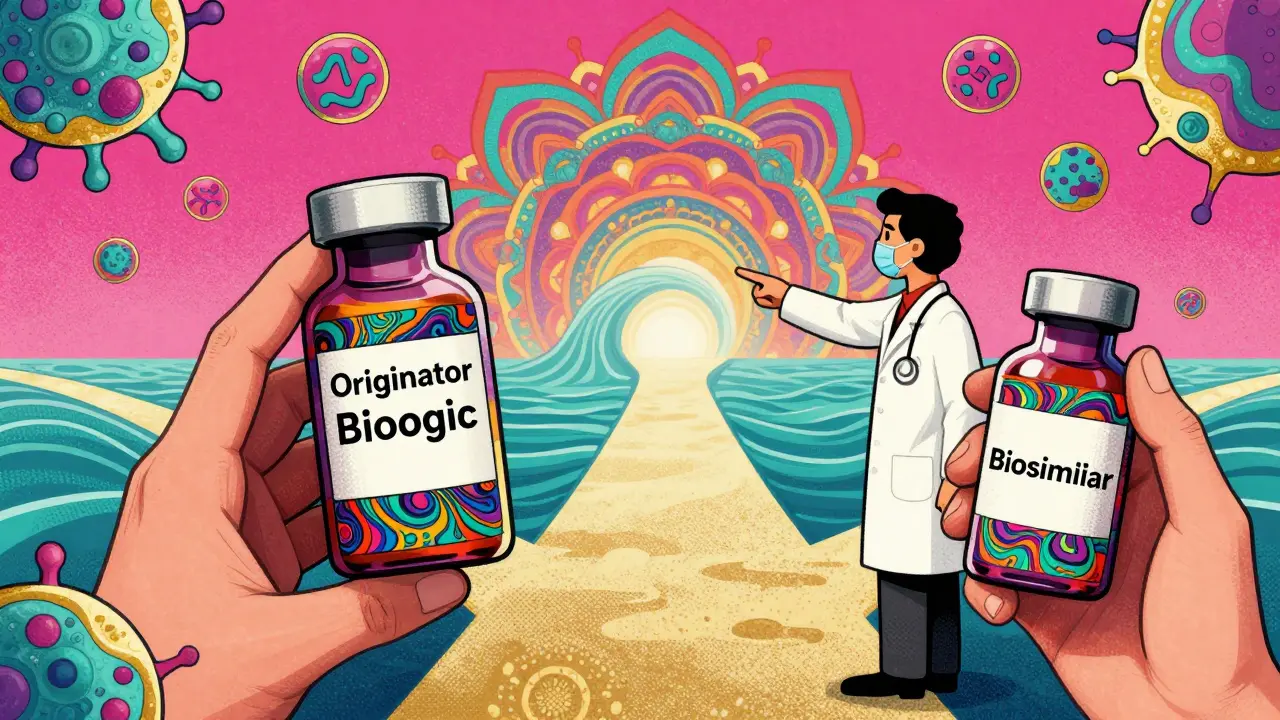
When you’ve been taking a biologic drug for years-maybe for rheumatoid arthritis, Crohn’s disease, or psoriasis-you get used to it. You know how your body responds. You know the injection schedule. You know the side effects, or lack thereof. Then your doctor says, "We’re switching you to a biosimilar." And suddenly, you’re not sure if you should be relieved, worried, or just confused.
What even is a biosimilar?
A biosimilar isn’t a generic. That’s the first thing to understand. Generics are exact copies of small-molecule drugs, like aspirin or metformin. Biosimilars are copies of complex biological drugs-proteins made from living cells. Think of it like trying to recreate a handmade quilt. You can match the pattern, the thread, even the stitching. But no two quilts are truly identical. That’s why biosimilars aren’t called "identical"-they’re called "highly similar."
The U.S. Food and Drug Administration (FDA) and the European Medicines Agency (EMA) require biosimilars to show no clinically meaningful differences in safety, purity, or potency compared to the original biologic. That means if your originator drug works, the biosimilar should work the same way. But it doesn’t mean they’re the same molecule. Minor differences in structure or manufacturing are allowed-just not enough to affect how your body responds.
The first biosimilar approved in the U.S. was Zarxio, a copy of filgrastim, in 2015. Since then, 37 biosimilars have been approved, mostly targeting inflammatory diseases. Infliximab and adalimumab-two of the most common biologics-now have multiple biosimilar versions on the market.
What happens when you switch?
Switching means stopping your current biologic and starting a biosimilar. This can happen for two reasons: medical switching, where your doctor recommends it because it’s the right move for your care, or non-medical switching, where your insurance or pharmacy changes your drug to save money.
Here’s what the science says: For most people, switching doesn’t change anything. A major study called NOR-Switch followed 481 patients with inflammatory diseases who switched from originator infliximab to its biosimilar, CT-P13. After one year, more than half were still on the drug. That’s nearly the same as the group who stayed on the original. No spike in flare-ups. No increase in serious side effects.
Other studies confirm this. In psoriasis patients switching from adalimumab to its biosimilar, 79% stayed on treatment after a year-almost identical to the 81% who stayed on the original. In Crohn’s disease, patients who switched from one biosimilar to another (CT-P13 to SB2) kept their remission rates unchanged. Fecal calprotectin levels, a key marker of gut inflammation, stayed flat.
Even when patients switched multiple times-originator to biosimilar to another biosimilar-immunogenicity (the body making antibodies against the drug) didn’t increase. One study tracked 140 patients over several switches. The rate of anti-drug antibodies stayed at just 3 per 100 patient-years. That’s low. And no one had worse side effects after switching.
But I felt different after the switch
You’re not alone. A 2021 study in Frontiers in Psychology found that 32.7% of patients reported new or worsening symptoms after switching-even when lab tests showed no change in disease activity. Many described feeling "off," more tired, or having new joint pain. But when doctors checked their blood work, disease scores, and drug levels, everything looked normal.
This isn’t a drug problem. It’s a mind problem. It’s called the nocebo effect. If you believe switching will make you feel worse, your brain can create those symptoms. It’s the opposite of the placebo effect. And it’s real. In one study of etanercept switches, 12.6% of patients stopped the biosimilar-even though their disease didn’t flare. They just thought it wasn’t working.
Online communities like Reddit’s r/rheumatoidarthritis are full of posts like: "I switched to the biosimilar and my knees started aching again." But when you dig into the data, most of these patients didn’t have objective signs of worsening disease. Their pain was real-but not caused by the drug.
When switching might not be safe
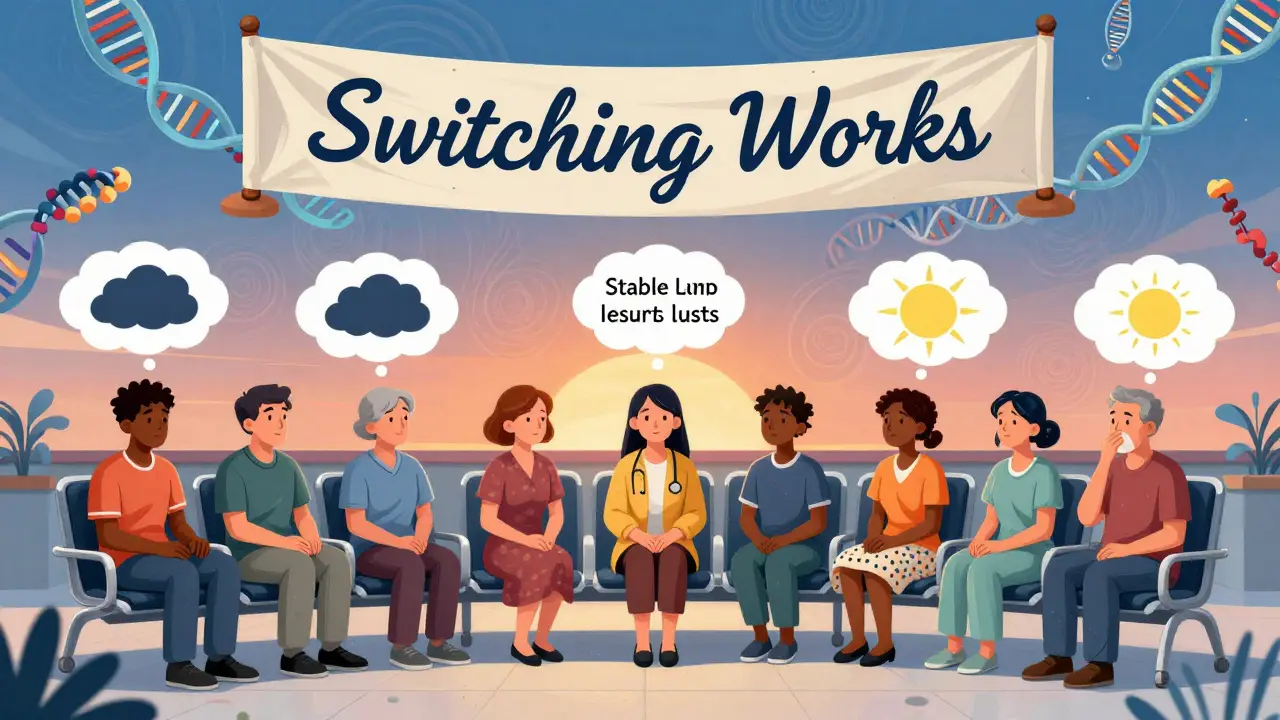
Switching works best when your disease is stable. If you’ve been in remission for months, or your symptoms are well-controlled, switching is low-risk. But if you’re in the middle of a flare, or your disease is unpredictable, switching isn’t the move.
Some studies show slightly higher discontinuation rates when switching between biosimilars. One Spanish study found 15.3% of IBD patients stopped their new biosimilar after switching from another, compared to 8.7% in a control group. But here’s the catch: their drug levels were still fine. The problem? Perceived loss of control. Fear. Uncertainty.
Also, if you’ve had a bad reaction to a biologic before-like a severe infusion reaction or allergic response-your doctor might hold off on switching until they understand why it happened. It’s not the biosimilar’s fault. It’s your immune system’s response to something.
Why do we switch at all?
Cost. Plain and simple.
Originator biologics like Humira can cost over $2,000 per dose. Biosimilars launch at 15% to 35% lower prices. In 2023, Humira biosimilars hit the market at 35% off. That’s billions saved for insurers and patients. By 2023, 85% of U.S. health plans had mandatory switch policies for biologics.
Europe leads the world in biosimilar use. In some countries, over 60% of patients on filgrastim are on a biosimilar. The U.S. is catching up, but slowly. Why? Patent lawsuits, rebates, and pharmacy networks that favor the original drug. But that’s changing. In 2024, the FDA approved the first interchangeable adalimumab biosimilar, Cyltezo. That means pharmacists can swap it in automatically-just like generics.
How to make switching work for you
If you’re being switched, here’s what helps:
- Ask questions. Why are we switching? Is it safe for me? What if I feel worse?
- Get a plan. A good clinic will schedule a pre-switch counseling session-20 minutes minimum. They’ll explain what to expect.
- Track your symptoms. Keep a journal. Note energy levels, joint pain, skin flare-ups, fatigue. Don’t assume everything is the drug’s fault.
- Get monitored. Your doctor should check your drug levels (trough levels) and disease activity (DAS28, PASI, etc.) at 3 months after switching.
- Don’t panic. If you feel different, tell your doctor. But don’t stop the drug on your own. Many symptoms fade after a few weeks.
The PERFUSE study showed that with good communication, discontinuation rates dropped from 18% to just 6.4%. That’s a huge difference. It’s not about the drug. It’s about the conversation.
What experts say
The FDA analyzed 22 switching studies involving over 5,700 patients. Their conclusion? No increased risk of death, serious side effects, or stopping treatment. The EMA says the same: switching doesn’t compromise safety or effectiveness.
Some doctors still hesitate. Dr. Kenneth Fass points out that 20% of IBD patients lose response to infliximab every year-whether they’re on the original or the copy. That makes it hard to know if a flare is from the switch or just natural disease progression.
And yes, biologics are complex. Health Canada notes you can’t make an exact copy of a living molecule. But you don’t need to. You just need to make one that works the same way.
What’s next?
The data keeps getting stronger. The NOR-SWITCH II study, which followed patients for two years with multiple switches, showed 89% were still on treatment. That’s not just safe-it’s sustainable.
More biosimilars are coming. More will be labeled "interchangeable." More pharmacies will swap them automatically. The goal isn’t to replace your drug. It’s to make effective treatment affordable for everyone.
If you’re switching, you’re not taking a risk. You’re joining a growing group of patients who’ve made the change-and kept their health intact. The science says it works. The real question is: Are you ready to trust it?
14 Comments
Robert Gilmore January 31, 2026 AT 07:40
Been on Humira for 8 years. Switched to the biosimilar last year. No difference. Still feel like myself. No new flares, no weird fatigue. Just cheaper.
Robert Gilmore February 2, 2026 AT 06:03
This is such an important topic! So many people fear change without knowing the science. Biosimilars are not second-rate-they’re smart, cost-effective medicine. Trust the data, not the fear.
Robert Gilmore February 3, 2026 AT 19:49
As a rheumatology nurse, I’ve seen patients panic after switching. The nocebo effect is real-but so is the relief when they realize their pain wasn’t the drug’s fault. Education changes everything.
Robert Gilmore February 4, 2026 AT 04:54
My cousin switched from originator to biosimilar for Crohn’s. Thought she’d crash. Ended up feeling better because she wasn’t stressed about the cost anymore. Mental health and meds go hand in hand.
Robert Gilmore February 5, 2026 AT 08:07
lol i switched and my knees hurt for a week but then it went away. turns out i was just stressed about it. also my insurance saved 1500 bucks so i got a new guitar. win win
Robert Gilmore February 6, 2026 AT 20:16
My doctor explained everything before the switch. Gave me a tracker. Checked labs at 3 months. I felt fine. The real issue isn’t the drug-it’s the lack of clear communication. That’s what breaks trust.
Robert Gilmore February 7, 2026 AT 01:35
Let me be clear: the FDA and EMA have reviewed over 5,700 patient-years of switching data. No increased risk. No loss of efficacy. The only variable that matters is patient education. If your provider skips the counseling, demand it. Your health is not a cost center.
Robert Gilmore February 8, 2026 AT 11:04
One must interrogate the epistemological foundations of biosimilar equivalence. The ontological discontinuity between the originator’s glycosylation profile and the biosimilar’s manufacturing cascade-while statistically insignificant in aggregate-may induce microstructural immunogenic perturbations in phenotypically sensitive subpopulations. The clinical trials, while statistically robust, are predicated on a reductionist model of biological identity that fails to account for patient narrative as a co-variative endpoint. The nocebo effect is not merely psychological-it is a phenomenological rupture in the patient’s hermeneutic of bodily integrity.
Robert Gilmore February 10, 2026 AT 00:48
What does ‘equivalent’ even mean when you’re talking about living systems? A biosimilar isn’t a copy-it’s a reinterpretation. Like a jazz cover of a symphony. Same notes, different soul. And maybe the soul matters more than the sheet music. We treat drugs like machines. But they’re not. They’re alive in how they interact with us. Maybe the fear isn’t irrational-it’s intuitive.
Robert Gilmore February 11, 2026 AT 07:00
USA FIRST! Why are we letting big pharma push foreign-made copies? My body deserves the original! 💪🇺🇸 #BiosimilarScam
Robert Gilmore February 12, 2026 AT 07:21
These so-called biosimilars are a regulatory loophole disguised as innovation. The FDA’s standards are laughably lax. If you can’t replicate the exact molecular structure, you haven’t replicated the drug. This is corporate cost-cutting disguised as medical progress. Patients are lab rats.
Robert Gilmore February 13, 2026 AT 03:22
So let me get this straight: you’re telling me the $2,000 drug and the $1,300 drug are functionally identical… but if I feel worse, it’s all in my head? Cool. Thanks for the placebo with a side of gaslighting.
Robert Gilmore February 15, 2026 AT 01:00
They’re hiding something. Biosimilars are just the first step. Next they’ll replace all meds with AI-generated generics. Your body’s data is being sold. Your immune system is a product. Wake up. This isn’t medicine-it’s surveillance capitalism in a syringe.
Robert Gilmore February 15, 2026 AT 21:38
It’s not about the drug. It’s about the story we tell ourselves. I switched twice. Felt weird both times. But my labs never changed. I stopped blaming the medicine and started listening to my anxiety. That’s when I got better. The biosimilar didn’t fail me. My fear did.