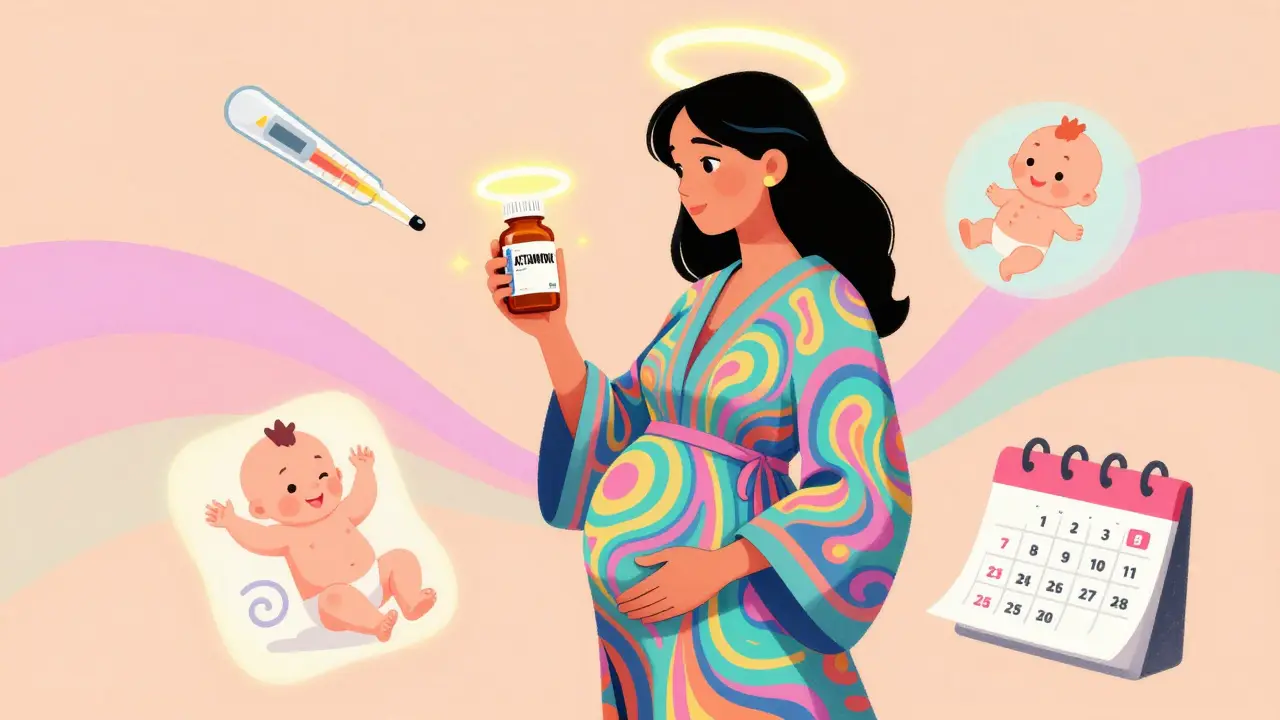
When you're pregnant, even a simple headache or fever can feel like a crisis. You don’t want to risk your baby’s health, but you also can’t ignore how awful you feel. The truth is, not all pain relievers are created equal during pregnancy-and the rules change depending on which trimester you’re in.
Acetaminophen: The Only Over-the-Counter Go-To for All Three Trimesters
Acetaminophen, also known as paracetamol, is the only over-the-counter pain reliever that doctors consistently recommend throughout pregnancy. It’s been used safely for over 70 years, and more than 60% of pregnant women in the U.S. take it at some point. The American College of Obstetricians and Gynecologists (ACOG), the Society for Maternal-Fetal Medicine, and the American Academy of Pediatrics all agree: when used correctly, acetaminophen poses no proven risk to the developing baby.
Standard dosing is 325 to 1,000 mg every 4 to 6 hours, not exceeding 4,000 mg in a single day. Most people find relief with just 500 mg per dose. You don’t need to wait until the pain is unbearable-taking it early for a fever above 100.4°F can actually lower your risk of complications. Studies show untreated maternal fever in the first trimester can double the chance of neural tube defects. Acetaminophen brings that temperature down fast and safely.
Large studies involving nearly 100,000 mother-child pairs found no link between acetaminophen use and autism, ADHD, or intellectual disability. The adjusted odds ratios were all near 1.0, meaning no increased risk. Even when researchers looked at long-term use-like taking it for weeks or even months during pregnancy-the data didn’t show harm. That’s why experts say: if you need it, take it.
Still, some fear lingers. A 2021 paper in Nature Reviews Endocrinology raised theoretical concerns about possible hormonal effects. But here’s the catch: no study has proven actual harm in babies. Meanwhile, the real danger? Ignoring a fever or chronic pain. That’s what puts both you and your baby at risk.
NSAIDs: The Red Flag Drugs After 20 Weeks
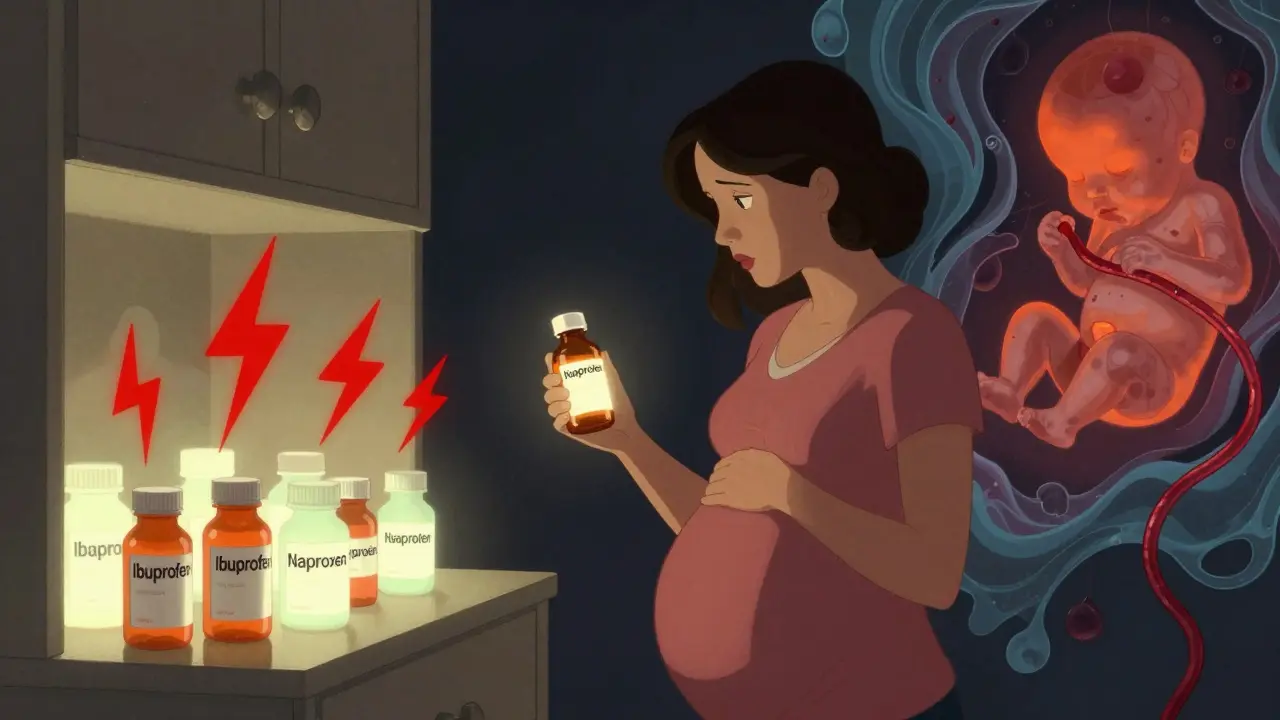
NSAIDs-like ibuprofen (Advil, Motrin), naproxen (Aleve), and diclofenac (Voltaren)-are a different story. They work differently than acetaminophen. They reduce inflammation, which is great for arthritis or sprains. But in pregnancy, that same mechanism can cause serious fetal problems.
Since October 2020, the FDA has required all NSAID labels to warn against use after 20 weeks of pregnancy. Why 20 weeks? Because that’s when the baby’s kidneys start producing amniotic fluid. NSAIDs can shut down a key blood vessel in the fetal kidneys, leading to low amniotic fluid (oligohydramnios). This isn’t rare-it happens in 1 to 2% of cases when NSAIDs are taken after 20 weeks. And once it happens, it can lead to lung underdevelopment, limb contractures, or even stillbirth.
Even worse, after 30 weeks, NSAIDs can cause the fetal ductus arteriosus-a vital blood vessel bypassing the lungs-to close too early. This forces the baby’s heart to work harder and can lead to life-threatening complications. The risk is small (0.5-1%), but the consequences are severe.
And here’s the trap: many cold and flu meds contain NSAIDs. Check the Drug Facts label. If it says “ibuprofen,” “naproxen,” or “NSAID,” put it down. Even topical gels like Voltaren can be absorbed through the skin and reach the baby. If you accidentally took an NSAID after 20 weeks, don’t panic. Stop immediately and call your provider. An ultrasound can check amniotic fluid levels, and in most cases, stopping the drug lets things return to normal.
What About Aspirin?
Low-dose aspirin (81 mg) is an exception. It’s not classified as an NSAID for pregnancy safety purposes when used under medical supervision. Doctors prescribe it daily to prevent preeclampsia in high-risk women. That’s a different use case-targeted, low-dose, and medically necessary. Don’t confuse it with regular aspirin (325 mg or higher), which should be avoided entirely during pregnancy unless your provider says otherwise.
Real-World Confusion: Why So Many Women Are Afraid
Despite clear guidelines, confusion runs deep. A 2023 survey found 68% of pregnant women avoid all pain meds out of fear. Nearly half of them specifically avoid acetaminophen because of social media posts claiming it causes autism. But correlation isn’t causation. Just because some studies noticed a statistical link doesn’t mean acetaminophen caused the outcome. The same studies found no link when controlling for other factors like maternal illness, stress, or genetic risk.
Doctors report patients stopping prescribed acetaminophen because of Reddit threads or Instagram influencers. One mom in Minnesota stopped her daily dose for back pain because she read a blog claiming it “damages the baby’s brain.” She ended up in the ER with uncontrolled pain and high blood pressure. Her provider told her: the pain itself was more dangerous than the medication.
Even the labeling on OTC bottles is messy. A 2023 FDA review found 38% of combination cold meds still don’t clearly warn about the 20-week NSAID restriction. You have to read the fine print. Look for “NSAID” or the drug name. If it’s not listed, assume it’s safe-unless you’re unsure. Then ask.
When to Use What: A Simple Guide
- First trimester (weeks 1-12): Acetaminophen is safe. Avoid NSAIDs unless your provider says otherwise (rare).
- Second trimester (weeks 13-26): Acetaminophen remains the best choice. NSAIDs are not recommended after week 20. If you need them between weeks 20-26, talk to your provider first. Use the lowest dose for the shortest time-no more than 48 hours without an ultrasound check.
- Third trimester (weeks 27-40): No NSAIDs. Period. Acetaminophen is still safe. If you’re having labor pains or back pain, talk to your provider about alternatives like physical therapy, warm compresses, or prescribed medications.
Always use the smallest effective dose for the shortest time. Don’t take acetaminophen daily for weeks without checking in with your provider. And never mix it with alcohol or other medications that contain acetaminophen-like many cold and flu formulas. Overdose can damage your liver, even if you’re pregnant.

What to Do If You’re Already Taking NSAIDs
If you’re past 20 weeks and have been taking ibuprofen or naproxen regularly, stop immediately. Don’t wait for symptoms. Call your OB or midwife. They’ll likely schedule an ultrasound to check amniotic fluid levels. Most of the time, fluid returns to normal within days of stopping the drug.
If you’re in pain and don’t know what to take, reach out. You don’t have to suffer. There are non-medication options too: prenatal yoga, acupuncture, warm baths, or physical therapy can help with back pain, headaches, and swelling. But if you need something stronger, acetaminophen is still your safest bet.
What’s Next? Research Is Still Evolving
The NIH is running a major study called the Acetaminophen Birth Cohort, tracking 10,000 babies born to moms who took acetaminophen during pregnancy. Results won’t be ready until 2027, but so far, no red flags have emerged. Meanwhile, researchers are looking at genetics-some women metabolize acetaminophen differently due to gene variants. That might explain why a few rare cases show unusual outcomes. But for 99% of women, standard dosing is fine.
The bottom line? Acetaminophen isn’t perfect. But it’s the least risky option we have. And in pregnancy, the goal isn’t zero risk-it’s managing risk so you stay healthy and your baby stays safe. Untreated fever, uncontrolled pain, and chronic stress can be far more harmful than a well-dosed pill.
Is acetaminophen safe in the first trimester?
Yes. Acetaminophen is considered safe throughout all three trimesters, including the first. In fact, treating fever early in pregnancy can reduce the risk of birth defects. Use the lowest effective dose-usually 500 mg-and avoid long-term daily use unless directed by your provider.
Can I take ibuprofen while pregnant?
Avoid ibuprofen after 20 weeks of pregnancy. Between weeks 13 and 20, it’s not recommended unless your provider approves it for a specific reason. After 20 weeks, ibuprofen can cause low amniotic fluid and kidney problems in the baby. Even a single dose can trigger issues. Stick to acetaminophen instead.
What if I took an NSAID before I knew I was pregnant?
If you took an NSAID before week 20, there’s no need to panic. The risk is very low before this point. The critical window is after 20 weeks. Tell your provider about the timing and dosage, but most likely, your baby is fine. Moving forward, switch to acetaminophen and avoid NSAIDs entirely.
Does acetaminophen cause autism or ADHD in babies?
No. Large, high-quality studies involving over 97,000 mother-child pairs found no link between acetaminophen use during pregnancy and autism, ADHD, or intellectual disability. Some small studies suggested a possible connection, but they didn’t control for other factors like maternal illness or genetics. The scientific consensus is clear: acetaminophen is safe for brain development when used as directed.
Can I use topical NSAIDs like Voltaren gel while pregnant?
Avoid them after 20 weeks. Even though they’re applied to the skin, some of the drug gets into your bloodstream and reaches the baby. The FDA’s warning applies to all forms of NSAIDs-oral, topical, or injectable. Stick to acetaminophen or non-medication options like heat packs and massage.
What should I do if I have a headache or fever and don’t want to take medicine?
Try rest, hydration, and cool compresses first. For headaches, a dark room and gentle neck massage can help. For fever, a lukewarm bath and plenty of fluids can bring it down. But if your temperature is above 100.4°F or the pain is severe, don’t wait. Acetaminophen is the safest and fastest way to protect both you and your baby. Suffering unnecessarily can raise stress hormones and blood pressure, which are also risky.
13 Comments
Robert Gilmore January 12, 2026 AT 09:46
Just took my first acetaminophen since finding out I was pregnant-was terrified after reading all those Reddit threads. But this post? Total game changer. I’m finally sleeping again. Thank you for the clarity.
Robert Gilmore January 14, 2026 AT 06:41
OMG YES 🙌 I’ve been telling my sister for weeks to stop panicking about ibuprofen. She thought one Advil at 18 weeks was ‘a disaster.’ She cried. I laughed. Then I sent her this. 🤓💊
Robert Gilmore January 15, 2026 AT 12:44
Let’s be real-this is just pharmaceutical propaganda. They’ve been pushing acetaminophen for decades while burying the real data. That 2021 Nature paper? It’s not ‘theoretical.’ It’s ignored because it’s inconvenient. And don’t get me started on how the FDA’s warnings are buried in tiny print. This post is dangerously reassuring.
Robert Gilmore January 17, 2026 AT 11:50
As a British GP, I find the American approach to OTC medication in pregnancy both alarming and overly permissive. In the UK, we treat acetaminophen with far greater caution-especially in the first trimester. The notion that ‘no proven risk’ equals ‘safe’ is a dangerous oversimplification. Evidence absence is not evidence of safety.
Robert Gilmore January 19, 2026 AT 09:07
I’ve been thinking about risk as a spectrum, not a binary. The fear of taking acetaminophen feels like avoiding fire because you’re scared of smoke. But the real danger is the unmanaged fever-burning through neural development, elevating cortisol, triggering inflammation. Sometimes the lesser evil is the only good choice we have.
Robert Gilmore January 20, 2026 AT 15:57
NSAIDs after 20 weeks = bad. Acetaminophen = fine. That’s it. Stop overthinking.
Robert Gilmore January 22, 2026 AT 04:10
I’m a dad. My wife took acetaminophen every day for two weeks with severe migraines. We were terrified. But her doctor said it was safer than the pain. She’s fine. Baby’s fine. I’m just glad we listened to the science, not the internet.
Robert Gilmore January 23, 2026 AT 14:05
My mom told me not to take anything while pregnant. I didn’t. Got a 102°F fever at 10 weeks. Ended up in the ER. The doctor said if I’d taken acetaminophen, I’d have avoided the whole thing. I’m so sorry I listened to her instead of the research.
Robert Gilmore January 23, 2026 AT 15:23
Don’t wait until you’re in pain to act. If you feel a fever coming, take the 500 mg. Sleep better. Stress less. Baby stays calmer too. Simple. Safe. Smart. You’ve got this.
Robert Gilmore January 24, 2026 AT 06:39
PLEASE PLEASE PLEASE read the drug labels!! I took a cold med with naproxen at 19 weeks because it said ‘non-drowsy’ and I didn’t look at the ingredients!! I cried for an hour when I realized… but my OB said to stop and get an ultrasound-and the fluid was fine!! Thank you for this post!!
Robert Gilmore January 24, 2026 AT 23:46
Based on pharmacokinetic modeling and CYP2E1 polymorphism data, the metabolic clearance of acetaminophen varies significantly in South Asian populations. While the current guidelines are adequate for Caucasian cohorts, they may not account for reduced glutathione reserves in certain genetic subgroups. Clinical trials must stratify by ancestry. This post, while well-intentioned, lacks population-specific nuance.
Robert Gilmore January 25, 2026 AT 08:47
If we’re going to say ‘no proven harm,’ then we should also say ‘no proven benefit beyond symptom relief.’ Why are we treating symptoms as if they’re the enemy? Why not explore root causes? Chronic headaches in pregnancy often signal dehydration, magnesium deficiency, or sleep disruption. Are we medicating the symptom while ignoring the signal?
Robert Gilmore January 26, 2026 AT 13:50
This is the most balanced, science-backed piece I’ve read on this topic. I used to avoid acetaminophen like the plague-until I realized my anxiety was worse than the pill. Now I take it without guilt. And honestly? I feel more like myself. And that matters-for me, and for my baby.