When you take medication out of its original bottle and put it into a pillbox or a pharmacy repackaging vial, you’re changing its environment. That change can make the drug less effective-or even unsafe. Most people assume that if the original bottle says "expires in 2027," then the pills in their weekly organizer are still good until then. That’s a dangerous assumption. The truth is, once a medication leaves its original sealed container, its stability clock starts ticking differently. And without proper evaluation, you could be taking degraded pills that don’t work-or worse, cause harm.
Why Original Packaging Matters
Pharmaceutical manufacturers don’t just pick random bottles for their drugs. They design the container-closure system to protect the medicine from light, moisture, oxygen, and temperature shifts. A blister pack might block UV rays. A bottle with a desiccant packet keeps humidity out. HDPE plastic with low moisture vapor transmission rates keeps water from seeping in. These systems are tested under strict conditions to ensure the drug stays potent until its labeled expiration date. But when a pharmacy transfers that same pill into a generic prescription vial or a plastic pill organizer, all those protections are gone. Standard pharmacy vials have moisture transmission rates up to 50% higher than manufacturer bottles. A study in the Journal of Pharmaceutical Sciences found albuterol sulfate tablets degraded 15.7% after 90 days in a pharmacy vial-compared to just 3.2% in the original sealed container. That’s more than four times the degradation.What Happens When Medications Degrade?
Drugs break down in predictable ways. The most common pathways are hydrolysis (water breaking chemical bonds), oxidation (reaction with oxygen), and photodegradation (light exposure). For example:- Amoxicillin absorbs moisture easily. In humid conditions, it can clump and lose potency within 30 days.
- Nifedipine, a blood pressure drug, turns brown when exposed to light. That’s not just cosmetic-it means the active ingredient is breaking down.
- Atenolol is more stable, but even it loses effectiveness over time if stored improperly.
How Long Are Repackaged Medications Actually Good For?
There’s no universal answer. It depends on the drug, the container, and the storage conditions. But here’s what experts agree on:- 30 days for highly hygroscopic drugs like amoxicillin, doxycycline, or levothyroxine.
- 60 days for light-sensitive drugs like nifedipine, nitroglycerin, or riboflavin.
- 90 days for stable drugs like atenolol, metformin, or lisinopril-if stored in amber vials with desiccants.
- Never exceed 6 months under standard pharmacy conditions, even for the most stable drugs.
How to Evaluate Stability-Even Without a Lab
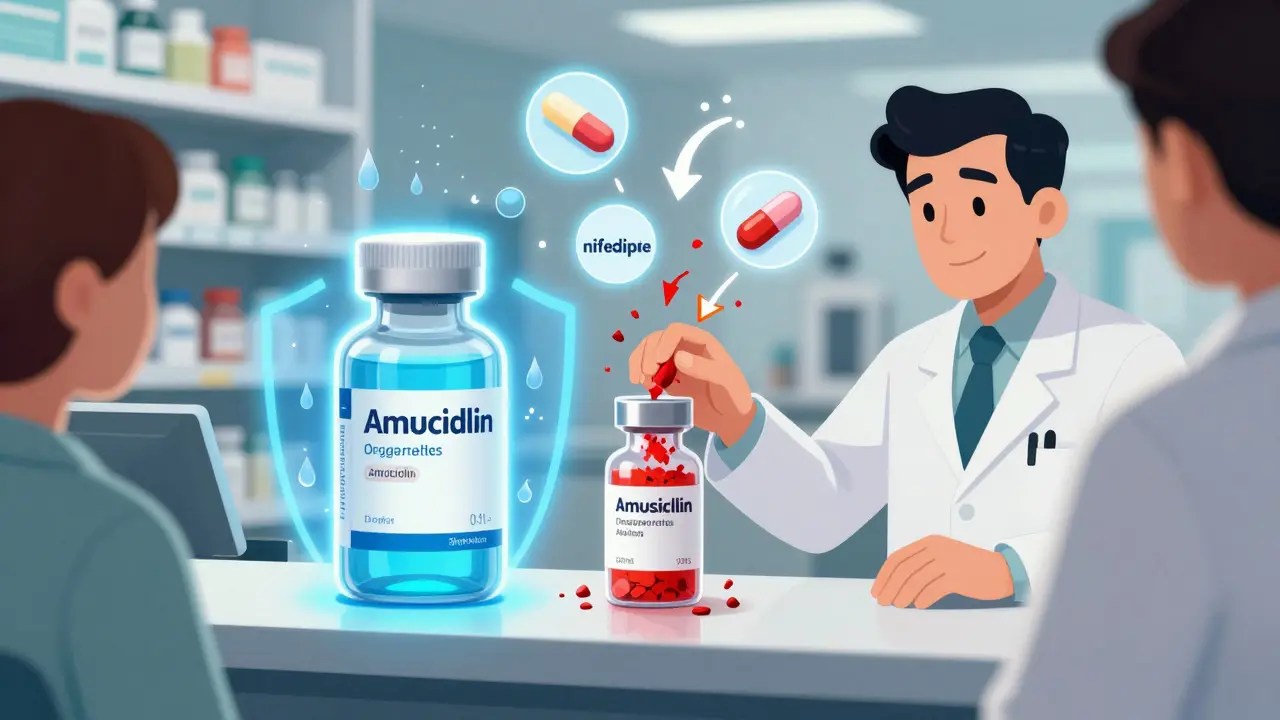
Most community pharmacies don’t have HPLC machines. But that doesn’t mean you can’t assess stability safely. Here’s a practical, evidence-based approach:- Check the drug’s sensitivity. Is it hygroscopic? Light-sensitive? Oxidation-prone? Use resources like the University of Florida’s Web-based Stability Database or the Parenteral Drug Association’s Technical Report No. 73. These list real-world stability data for over 1,800 repackaged medication scenarios.
- Use amber vials and desiccants. A 2023 multicenter trial with over 8,000 repackaged units showed desiccant packs extended stability by 47%. For light-sensitive drugs, amber glass is non-negotiable.
- Store properly. Keep repackaged meds at room temperature (20-25°C), away from sinks, showers, and windows. Humidity and heat are the biggest enemies.
- Inspect visually. Look for discoloration, caking, crumbling, or unusual odors. If a pill looks different than when it was first packed, don’t use it.
- Use bracketing. If you’re repackaging multiple drugs from the same chemical class with similar stability profiles (e.g., several beta-blockers), you can group them under one expiration date based on the most unstable member. But only if you’ve validated the approach.
Pillbox Medications Are a Different Challenge
Pill organizers add another layer of risk. When you put five different drugs into one plastic compartment, you’re not just exposing them to air-you’re risking physical interactions. A 2022 study by the American Pharmacists Association found that 18.7% of combined medications showed physical changes like caking, sticking, or color shifts within just 14 days. Why? Some drugs are hygroscopic and pull moisture from others. Others can chemically react. For example, putting iron supplements next to thyroid medication can cause clumping and reduce absorption. There’s no standard testing for these combinations. So the safest rule is: don’t combine medications in a pillbox unless you’ve confirmed compatibility.
What Pharmacies Should Be Doing
Pharmacies that repack medications need written procedures. The ASHP and PCAB now require formal training for pharmacists overseeing this process. Best practices include:- Testing high-risk drugs (like warfarin, digoxin, or chemotherapy agents) with HPLC before assigning expiration dates.
- Performing stress testing at 40°C and 75% humidity for 14 days to spot vulnerable drugs before full stability runs.
- Documenting every repackaged batch with lot numbers, container type, storage conditions, and assigned expiration date.
- Using container closure integrity testing (helium leak or dye ingress) for sterile or high-risk products.
The Bottom Line: Don’t Guess. Test or Limit.
You can’t rely on the original expiration date once a drug leaves its factory packaging. The science is clear: repackaging changes everything. For patients, this means:- Ask your pharmacist: "What’s the expiration date for these pills in this container?"
- Never use pills that look different-discolored, cracked, or stuck together.
- Use amber containers and desiccants for moisture- or light-sensitive drugs.
- Keep pillboxes cool and dry, and don’t store them for more than 30-90 days.
Can I use the original expiration date on repackaged pills?
No. The original expiration date only applies if the medication stays in its manufacturer’s sealed container with its original packaging. Once you transfer pills to a pillbox or pharmacy vial, the expiration date must be reassessed based on stability data. The FDA explicitly states that repackaged drugs require new expiration dating.
How do I know if a repackaged drug has degraded?
Look for visible signs: discoloration (yellowing, browning), crumbling, caking, unusual odor, or pills sticking together. For example, nifedipine turning brown means it’s degraded. But not all degradation is visible-some drugs lose potency without changing appearance. That’s why following evidence-based expiration timelines is critical.
Are pill organizers safe for all medications?
No. Combining multiple drugs in one organizer can cause physical interactions-like moisture transfer between hygroscopic and non-hygroscopic pills, leading to caking or chemical reactions. A 2022 study found 18.7% of combined medications showed changes within 14 days. Only combine drugs if you’ve confirmed compatibility, and limit storage to 30 days or less.
What’s the safest way to store repackaged medications?
Store them in amber glass vials with desiccant packs, at room temperature (20-25°C), away from humidity and direct light. Avoid bathrooms, kitchens, or windowsills. For high-risk drugs, refrigeration may be needed-but only if the manufacturer’s data supports it. Never freeze repackaged pills unless specifically instructed.
Why do some pharmacies still use 6-month expiration dates for repackaged meds?
It’s often a default policy due to lack of testing resources. But it’s not scientifically sound. The Institute for Safe Medication Practices found 32% of pharmacies lack formal stability protocols. While 6 months is the upper limit for stable drugs under ideal conditions, many drugs-especially hygroscopic or light-sensitive ones-need much shorter dates. Relying on 6 months across the board puts patients at risk.
15 Comments
Robert Gilmore January 3, 2026 AT 11:56
Wow, this is eye-opening. I’ve been using a pillbox for my blood pressure meds for over a year without thinking twice. Now I’m checking the expiration date on the original bottle and realizing I’ve been risking it. Thanks for the clarity-this should be mandatory reading for every senior on meds.
I’m switching to amber vials with desiccants immediately. No more bathroom cabinet storage either. Humidity is the silent killer here.
Robert Gilmore January 3, 2026 AT 23:36
People in my country don’t even have access to proper packaging. We reuse plastic containers because we can’t afford new ones. Your ‘stability science’ sounds rich when you’re choosing between food and medicine. This isn’t a luxury-it’s a privilege.
Robert Gilmore January 5, 2026 AT 03:44
It’s fascinating how we anthropomorphize pills-assigning them ‘expiration dates’ as if they have a soul. But the truth is, molecules don’t care about calendars. They obey thermodynamics. The real tragedy isn’t the degradation-it’s our collective denial that we’ve outsourced our health to corporate packaging systems we don’t understand.
Perhaps the real expiration date is the one on our trust in institutions.
Robert Gilmore January 5, 2026 AT 07:06
OMG I JUST REALIZED I’VE BEEN KEEPING MY LEVOTHYROXINE IN A PLASTIC PILLBOX BY THE SINK FOR 6 MONTHS??!!
MY MOM HAS SEIZURES AND I’M A MONSTER. I’M GOING TO THE PHARMACY RIGHT NOW AND I’M GOING TO SCREAM. I CAN’T BELIEVE NO ONE TOLD ME THIS. I’M SO GUILTY.
Also, does anyone know if Walmart sells amber vials? I need them NOW.
Robert Gilmore January 7, 2026 AT 02:07
While the scientific rigor presented here is commendable, one must also acknowledge the systemic failures that render these guidelines inaccessible to the majority of patients. The burden of compliance-procuring amber vials, desiccants, temperature-controlled storage-is disproportionately borne by the elderly, the underinsured, and the isolated. A well-intentioned protocol is not a solution when it requires resources most patients lack.
Until regulatory bodies mandate affordable, standardized repackaging with stability-assured containers, this remains a moral hazard disguised as patient education.
Robert Gilmore January 8, 2026 AT 05:14
my pharmacist just handed me a pillbox with my whole week and said 'just take 'em'. i didn’t even think to ask. now i’m kinda freaked out. thanks for the heads up. i’m gonna go get those little silica packs from amazon and switch to amber bottles. also-no more pillbox combos. i’m keeping my meds separate now. peace.
Robert Gilmore January 9, 2026 AT 00:02
It is imperative to underscore that the integrity of pharmaceutical formulations is not a matter of convenience, but of bioethical obligation. The U.S. Pharmacopeial Convention, in conjunction with the Food and Drug Administration, has established non-negotiable standards for repackaged medications. Failure to adhere to these standards constitutes a breach of the Hippocratic Oath by proxy.
Pharmacies must implement validated stability protocols. Patients must be informed. There is no middle ground.
Robert Gilmore January 9, 2026 AT 03:59
So let me get this straight. You spent 1,200 words telling people not to put pills in a plastic box… and the FDA shut down a pharmacy for not labeling expiration dates correctly? Wow. I’m so glad we have people like you to protect us from our own dumbassery.
Meanwhile, my grandma takes her pills out of the bottle and drops them into a cereal box because ‘it’s easier to see’. She’s 87. She’s fine. You’re the one who needs to chill.
Robert Gilmore January 10, 2026 AT 02:56
This is one of the most vital pieces of health literacy I’ve read in years. The way you broke down degradation pathways-hydrolysis, oxidation, photodegradation-made it feel like a detective story for molecules. And the visual inspection tips? Gold.
My aunt’s atenolol turned chalky after two months in her pillbox. She thought it was ‘just old’. Now she knows better. Thank you for turning science into something people can actually use.
Robert Gilmore January 11, 2026 AT 20:29
Of course the FDA cares about pill stability. They care more about liability than actual human outcomes. Meanwhile, people in rural areas are getting generic meds repackaged by unlicensed clerks in back rooms. You think amber vials are the solution? Try fixing the system that lets this happen in the first place.
And yes, I’ve seen a 72-year-old woman take a brown nifedipine tablet because ‘it still looks like a pill’. That’s not negligence-it’s systemic abandonment.
Robert Gilmore January 13, 2026 AT 11:20
Let’s be real-this isn’t about science. It’s about control. Who gets to decide when your medicine expires? The FDA? The pharmacy? The guy who stuffed your pills into a plastic tray at 3 a.m.?
I’ve been taking my meds in a pillbox for 12 years. I haven’t died. My neighbor didn’t die. But now I’m supposed to buy silica packets and amber bottles like I’m prepping for the apocalypse?
Maybe the real problem is that we treat medicine like it’s a magic potion instead of a chemical compound. We’re scared of it. We worship it. We fear it.
And that fear? That’s what’s killing us.
Robert Gilmore January 15, 2026 AT 03:33
So… the FDA shuts down a pharmacy for not labeling repackaged meds properly… and then we’re supposed to trust that same FDA to approve the 6-month expiration rule?
It’s like a cop who arrests you for jaywalking and then gives you a speeding ticket for driving 2 mph over the limit.
Also, I’ve been storing my metformin in my purse for six months. It’s fine. I’m fine. My blood sugar’s stable. Maybe the science is right… but the fear is overblown.
Robert Gilmore January 17, 2026 AT 02:21
just wanted to say i love this post 😊
my mom’s on 7 meds and i repackaged them last week. now i’m using amber vials with the little white packets from the original bottles. i feel like a pharmaceutical ninja.
also-no more pillbox combos. i’m keeping them separate. peace out 🙌
Robert Gilmore January 18, 2026 AT 00:20
I’ve been a pharmacy tech for 15 years. I’ve seen the chaos. I’ve seen people take pills from a Ziploc bag because their bottle ran out.
This post is accurate. But here’s the truth: most patients don’t care. They just want to take their pills without thinking. And we, the professionals, have failed to make this simple.
Maybe we need a sticker. One that says: ‘This is not your original bottle. Expiry: 60 days.’
Simple. Clear. No science lecture needed.
Robert Gilmore January 19, 2026 AT 14:44
First world problems. In India, we don’t have amber vials. We don’t have desiccants. We don’t even have refrigerators in 70% of villages. People take pills from plastic bags tied with string. They survive. They live. They don’t die from ‘degradation’-they die from lack of access.
Stop pretending this is about safety. It’s about control. You want people to buy more bottles. More packaging. More ‘certified’ nonsense.
Real stability? It’s not in the container. It’s in the will to live.