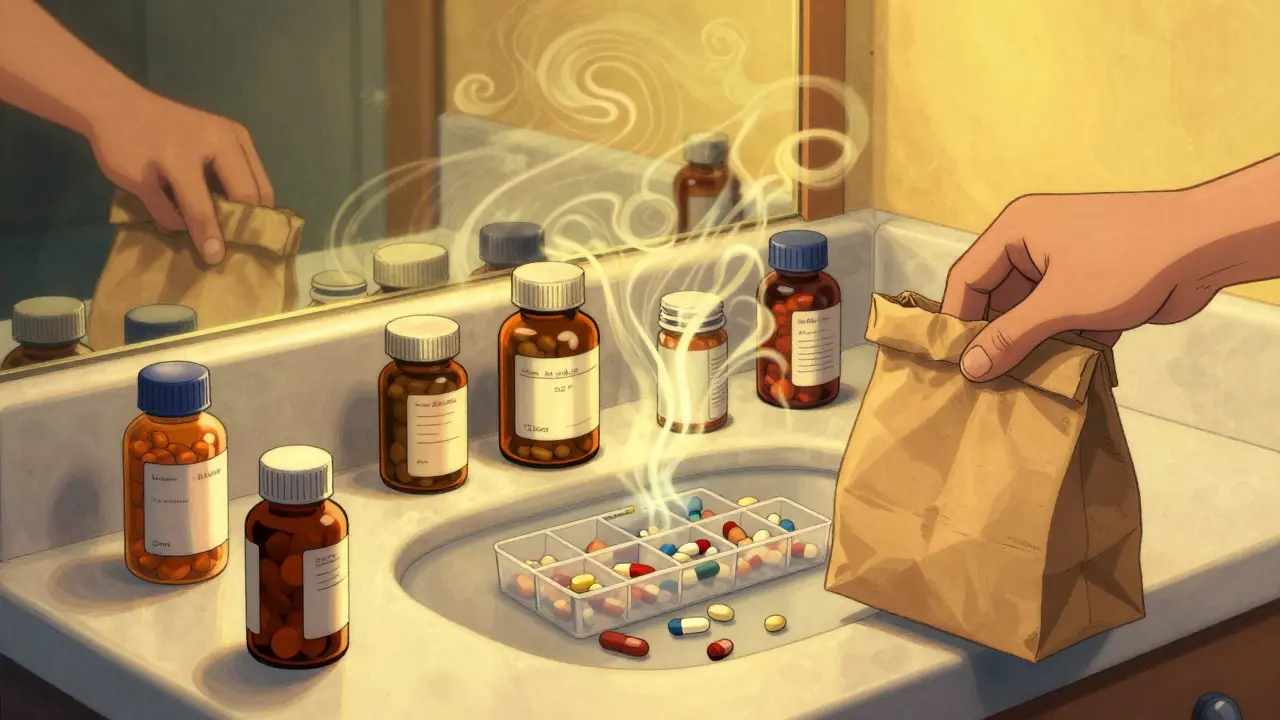
Why Bringing Pill Bottles to Your Doctor Appointment Matters
Most people think they know what medications they’re taking. You’ve been on the same pills for years. You take them every morning. You even set a phone reminder. But when your doctor asks, "What are you taking right now?"-you freeze. You forget one. You mix up the dose. You don’t mention the ibuprofen you take for your knee. Or the fish oil your daughter gave you. Or the leftover antibiotics from last year’s infection.
This isn’t just a memory glitch. It’s a safety risk. According to the American Hospital Association, 80% of medication errors happen during transitions in care-like when you go from the hospital to your doctor’s office, or when you start seeing a new provider. And the biggest reason? Incomplete or inaccurate medication lists.
Bringing your actual pill bottles to your appointment isn’t about being organized. It’s about saving your life. Studies show that when patients bring their real bottles, medication discrepancies drop by 67%. That means fewer dangerous interactions, fewer hospital visits, and fewer side effects you didn’t know you were getting.
What Exactly to Bring
You don’t need to bring just your prescriptions. You need to bring everything.
- All prescription medications-even if you stopped taking them
- All over-the-counter drugs: pain relievers, sleep aids, antacids, cold meds
- Vitamins and supplements: magnesium, vitamin D, gummy multivitamins, turmeric capsules
- Herbal remedies: elderberry syrup, melatonin, St. John’s wort
- Any medications in pill organizers, travel cases, or ziplock bags
Yes, even the empty bottles. Yes, even the ones with expired dates. Yes, even the ones you haven’t touched in six months.
Why? Because your doctor doesn’t just need to know what you’re taking now. They need to know what you’ve taken, what you stopped, and what you might still have lying around. A 2023 study found that 56% of inappropriate medications in older adults were only found when the doctor physically saw the bottle-not when the patient tried to remember.
Why Pill Organizers Don’t Cut It
Many people, especially older adults, transfer their pills into weekly or daily organizers. It’s easier. It looks neat. But it’s dangerous for reconciliation.
A 2023 study in PMC found that 38% of patients use these organizers-and almost none of them keep the original labels. That means your doctor sees a little white pill in a Monday compartment and has no idea if it’s 5 mg of lisinopril, 10 mg of metoprolol, or just a generic aspirin.
Even worse: some people use two organizers-one for morning, one for evening. Others use two-week containers to cut down on refills. None of these tell your doctor what’s actually in the bottle. Only the original prescription label does.
Your job? Bring the organizers, but also bring the original bottles they came from. That way, your doctor can match what’s in the organizer to what was prescribed.
How to Prepare: A Simple 15-Minute Routine
You don’t need to spend hours. Just set aside 15-20 minutes the night before your appointment.
- Go to every drawer, cabinet, and bedside table where you keep meds.
- Gather every bottle, packet, or container-even if it’s half-empty or expired.
- Don’t throw anything away. Don’t recycle the labels. Don’t assume it’s not important.
- Put everything in one clear plastic bag. A brown paper bag works too. This is called the "brown bag review"-and clinics that use it cut reconciliation time by 38%.
- If you use a pill organizer, leave it in its case. Bring it with you.
Pro tip: If you’ve thrown away a bottle already, take a photo of the label before you toss it. Many pharmacists recommend this. Apps like Medisafe can also sync with your pharmacy to generate a digital list-but don’t rely on it alone. The physical bottle still beats the screen.

What Your Doctor Will Do With Your Bottles
When you hand over that bag, your doctor won’t just glance at it. They’ll compare each bottle to your electronic health record.
They’ll check:
- Drug name (is it the same as what’s in the system?)
- Dosage (is it 5 mg or 10 mg?)
- Frequency (once daily? twice? as needed?)
- Route (oral? patch? inhaler?)
- Expiration date (is it still safe?)
- Prescriber (who wrote this? Is it still active?)
They’ll also look at the pill itself. Is it the right color? Shape? Markings? That’s how they spot counterfeit or mislabeled meds.
And here’s the kicker: they’ll ask you what each pill is for. If you can’t answer, they’ll write it down as "unknown." That’s a red flag. A 2024 survey found that 19% of patients don’t know what most of their pills are for. That’s not laziness-it’s a system failure. And your doctor can fix it.
What Happens When You Don’t Bring Them
Let’s say you forget your bottles. You try to list your meds from memory. You get most of them right.
But you forget the blood thinner you took for a month after surgery. You don’t mention the daily aspirin you started for heart health. You leave out the melatonin you take because you can’t sleep.
Your doctor prescribes a new antibiotic. It interacts with the blood thinner you forgot. You end up in the ER with internal bleeding.
This isn’t hypothetical. In 2024, the Agency for Healthcare Research and Quality found that medication errors caused 18% of all primary care visits. And the number one fix? Bringing the bottles.
Even worse: patients who don’t bring bottles often feel ashamed. They worry their doctor will think they’re disorganized. Or noncompliant. But here’s the truth: your doctor has seen it all. They’ve seen pills in shoeboxes, pill organizers with mismatched labels, and bags full of unlabeled capsules. They’re not judging you. They’re trying to keep you safe.
What About Telehealth? Can You Show Bottles on Camera?
Some people try to show their pill bottles during Zoom visits. It’s better than nothing. But it’s not enough.
A 2024 AMA report found that virtual pill checks miss 22% of discrepancies that in-person visits catch. Why? Because cameras can’t show you:
- Which pills are missing from the bottle
- How many are left
- Whether the bottle is empty but still in the drawer
- Whether the pills have changed color or shape (a sign of degradation or substitution)
- Whether you’re taking them as directed-or crushing them, skipping doses, or hoarding them
Plus, lighting, angle, and focus make it hard to read tiny print. And if you’re using a pill organizer? Good luck showing your doctor what’s inside each compartment.
For telehealth, do your best: hold each bottle up to the camera, read the label out loud, and mention any changes. But if you can, still go in person for your annual med review.
What If You Have Too Many Bottles?
Some people, especially those managing chronic conditions, have 15, 20, even 30 bottles. It’s overwhelming. You feel like you’re taking over the clinic.
Here’s the truth: your doctor wants them all. The more you bring, the safer you are.
One Reddit user, u/ElderCareGuru, wrote: "My mother brings 15+ bottles to every appointment. The staff groans." But then they added: "She hasn’t been hospitalized in two years. That’s because they caught a dangerous combo she didn’t know about."
Think of it this way: your doctor has 10 minutes to review your meds. If you bring everything, they can do it fast. If you leave things out, they’ll waste time guessing-and you’ll be at risk.
What Happens After the Appointment?
Your doctor will update your medication list. They’ll remove drugs you’re no longer taking. They’ll add ones you forgot. They’ll fix doses. They’ll flag interactions.
Then they’ll give you a printed copy. Or email it. Or upload it to your patient portal.
Keep that list. Update it every time you start or stop a medication. And next time you have an appointment? Bring the bottles again. Because this isn’t a one-time thing. It’s a habit that saves lives.
Final Thought: The Bottle Is Your Best Ally
Technology is getting better. Apps, AI pill scanners, pharmacy data feeds-they’re all helpful. But none of them replace the physical bottle.
As Dr. Michael A. Steinman wrote in JAMA Internal Medicine: "The physical bottle remains the Rosetta Stone of medication reconciliation-nothing else provides the complete picture of what’s actually in the patient’s home."
You’re not just bringing pills to your doctor. You’re bringing clarity. You’re bringing safety. You’re bringing peace of mind-for yourself, and for the people who care about you.
15 Comments
Robert Gilmore January 27, 2026 AT 17:20
I bring my brown bag to every appointment and my PCP actually keeps a copy in my chart now. Best habit I ever picked up. No more guessing games.
Robert Gilmore January 27, 2026 AT 21:44
I swear the pharmaceutical industry doesn't want you to bring bottles. Why do you think they push those dumb pill apps? They profit off confusion. 🤔
Robert Gilmore January 29, 2026 AT 19:58
People who don't bring their bottles are basically playing Russian roulette with their health. It's not just negligence-it's selfish.
Robert Gilmore January 31, 2026 AT 02:57
I used to think this was overkill until my mom ended up in the ER because her doctor missed a blood thinner interaction. Now I bring everything. No exceptions.
Robert Gilmore January 31, 2026 AT 16:17
You know what's scary? Pharmacies sometimes re-label pills wrong. I once had a bottle that said "Lisinopril 10mg" but the pills were actually metoprolol. The label didn't match. I caught it because I checked the bottle. Don't trust the paper.
Robert Gilmore February 1, 2026 AT 03:14
In the UK we call this the 'brown bag ritual'-and it's bloody brilliant. Americans need to stop treating medicine like a DIY project and start treating it like the science it is.
Robert Gilmore February 2, 2026 AT 00:14
I work in a clinic and I can tell you-patients who bring bottles? We can help them faster. Those who don't? We waste 20 minutes guessing. Bring the damn bottles. It’s not hard.
Robert Gilmore February 3, 2026 AT 16:23
I bring my bottles AND a selfie holding them. My doctor laughs but he says it's the only way he knows I'm not lying. 😎
Robert Gilmore February 3, 2026 AT 20:07
If you're too lazy to bring your bottles, you're not ready to be on medication. Period. End of story.
Robert Gilmore February 3, 2026 AT 23:46
i used to think this was dumb but then i realized my grandpa was taking 3 different blood pressure pills because he forgot one was discontinued. he was fine after we fixed it. just bring the bottles. it's not that hard.
Robert Gilmore February 4, 2026 AT 16:24
This changed my life. I used to forget half my meds. Now I have a little basket by the door. Every appointment, I grab it. I feel so much more in control.
Robert Gilmore February 6, 2026 AT 01:33
The 67% reduction statistic is misleading. It's based on retrospective self-reports from clinics that already have robust reconciliation protocols. The real-world effect is closer to 12-18%. Also, pill organizers aren't inherently dangerous-they're efficient. The issue is poor labeling, not the container.
Robert Gilmore February 7, 2026 AT 16:17
You don't need to be perfect. Just bring what you can. Even one bottle is better than none. Start small. Build the habit.
Robert Gilmore February 7, 2026 AT 19:22
My sister used to hate this. Said it was embarrassing. Then she had a bad reaction to a new med because they didn't know she was taking St. John’s wort. Now she brings everything. And she thanks me every time.
Robert Gilmore February 9, 2026 AT 15:47
The epistemological rupture between pharmacological representation and embodied practice is profoundly under-theorized in contemporary clinical discourse. The pill bottle, as a material semiotic object, disrupts the neoliberal fantasy of the autonomous, self-optimizing patient. It re-territorializes agency back into the corporeal, the tactile, the un-digitizable. The algorithm cannot parse the sediment of expired tetracycline in a drawer. Only the hand that holds it can. This is not compliance-it is ontological resistance.