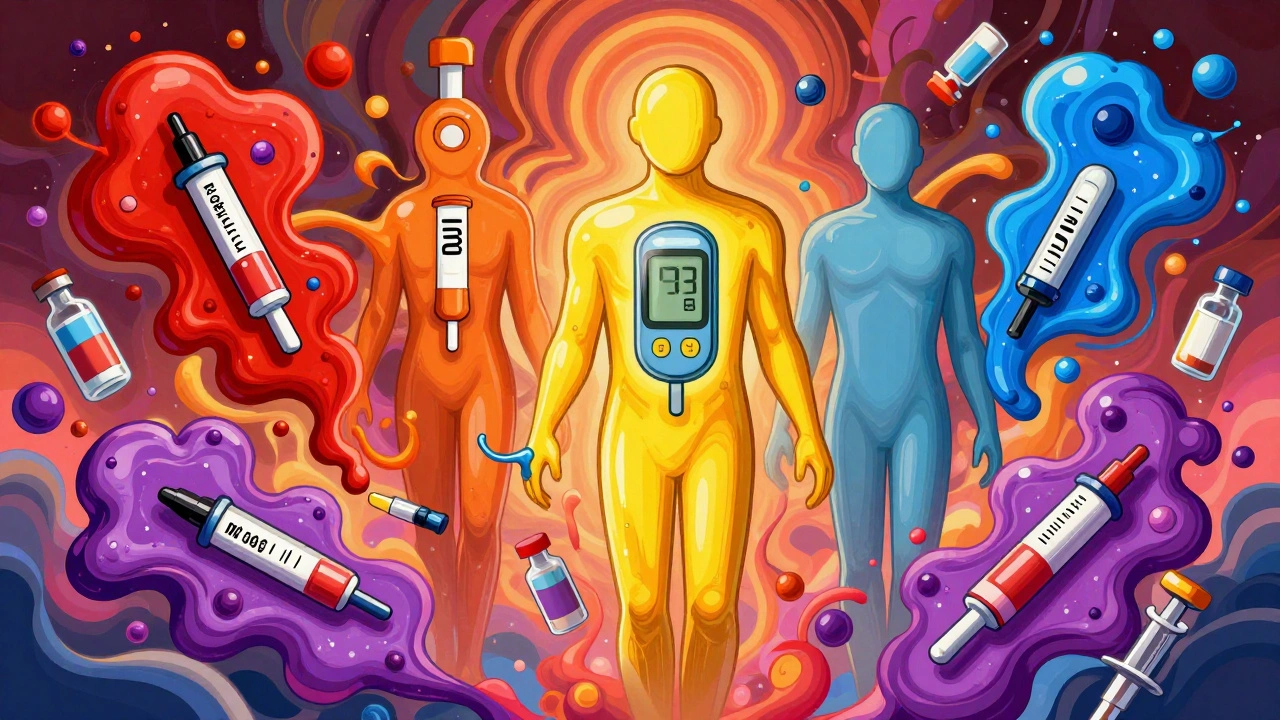
Choosing the right insulin isn’t just about picking a pen or a vial-it’s about matching your life, your body, and your goals to a treatment that works without making you feel like you’re constantly managing a medical emergency. For millions of people with diabetes, insulin isn’t optional. It’s survival. But with so many types, dosing strategies, and new options hitting the market, it’s easy to feel overwhelmed. The good news? You don’t need to be a doctor to understand what works-and what doesn’t.
What Are the Main Types of Insulin?
Insulin comes in five main categories, each designed to do a specific job in your body. Think of them like a team: some act fast to handle meals, others work slowly to keep your blood sugar steady between meals and overnight.
- Rapid-acting insulin starts working in 10-15 minutes, peaks in under 90 minutes, and lasts 3-5 hours. Examples: insulin lispro (Humalog), insulin aspart (NovoLog), and insulin glulisine (Apidra). These are used at mealtime to control blood sugar spikes from food.
- Regular/short-acting insulin takes 30 minutes to start, peaks at 2-3 hours, and lasts 5-8 hours. Brand names include Humulin R and Novolin R. It’s cheaper but less precise than rapid-acting analogs, making it harder to match meals and more likely to cause low blood sugar later.
- Intermediate-acting insulin (NPH) kicks in after 1-2 hours, peaks at 4-12 hours, and lasts 12-18 hours. Brands like Humulin N and Novolin N are often used twice daily. But its peak can cause unpredictable lows, especially at night.
- Long-acting insulin gives steady coverage without a strong peak. insulin glargine (Lantus) lasts 24 hours, insulin detemir (Levemir) lasts 18-24 hours, and insulin glargine U300 (Toujeo) lasts up to 36 hours. These are the backbone of most modern regimens.
- Ultra-long-acting insulin is the newest class. insulin degludec (Tresiba) lasts over 42 hours with no peak. It’s the most stable, reducing nighttime lows by 40% compared to older long-acting insulins.
Inhaled insulin, like Afrezza, is an option for people who hate needles. It works fast-within 12 minutes-but isn’t for smokers or those with lung issues. And it’s expensive.
How Insulin Regimens Work
There’s no one-size-fits-all insulin plan. Your regimen depends on whether you have type 1 or type 2 diabetes, your daily routine, your risk of low blood sugar, and your budget.
- Basal-bolus therapy (also called MDI-multiple daily injections) is the gold standard for type 1 diabetes. You take one long-acting insulin once or twice a day for background coverage, and rapid-acting insulin before each meal. This mimics how a healthy pancreas works. Studies show this approach lowers A1C by 0.5-1% more than older regimens and cuts hypoglycemia risk by 25%.
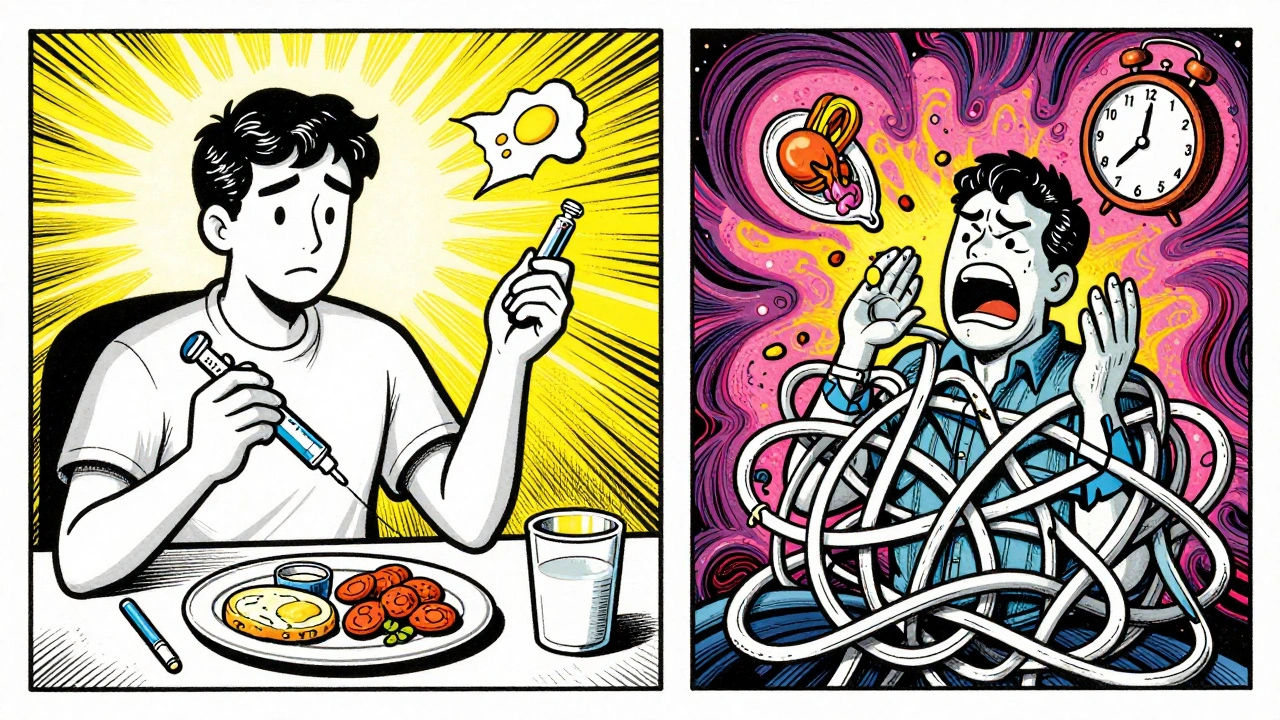
- Premixed insulins combine rapid- and intermediate-acting insulin in one shot (like Humalog Mix 75/25). They’re convenient for people with predictable meals and routines. But they’re rigid-you can’t adjust mealtime doses independently. If you skip a meal, you risk low blood sugar. If you eat more, you’re stuck with too much insulin.
- Basal-only therapy is common in type 2 diabetes when pills aren’t enough. You start with a low dose of long-acting insulin (like 10 units at night) and slowly increase based on fasting blood sugar. It’s simple, but doesn’t control post-meal spikes well. Many people eventually need to add mealtime insulin.
- Insulin pumps deliver rapid-acting insulin continuously through a tiny tube under the skin. They can be programmed to adjust for meals and corrections. People using pumps report higher satisfaction and 0.5-1% lower A1C than those on injections. But they require constant monitoring, and 62% of users deal with site issues like irritation or dislodging.
- Once-weekly insulin (insulin icodec, approved in 2024) is a game-changer. It’s still new, but early data shows it works as well as daily degludec with less frequent dosing. This could be a big win for people who struggle with daily injections.
Human Insulin vs. Analog Insulin: Cost vs. Benefit
The biggest decision isn’t just about how insulin works-it’s about what you can afford.
Human insulins (Humulin R, Novolin N) are the original versions made to match human insulin. They cost $25-$35 per vial at Walmart’s ReliOn brand. But they’re less predictable. They peak harder, cause more lows, and require strict meal timing.
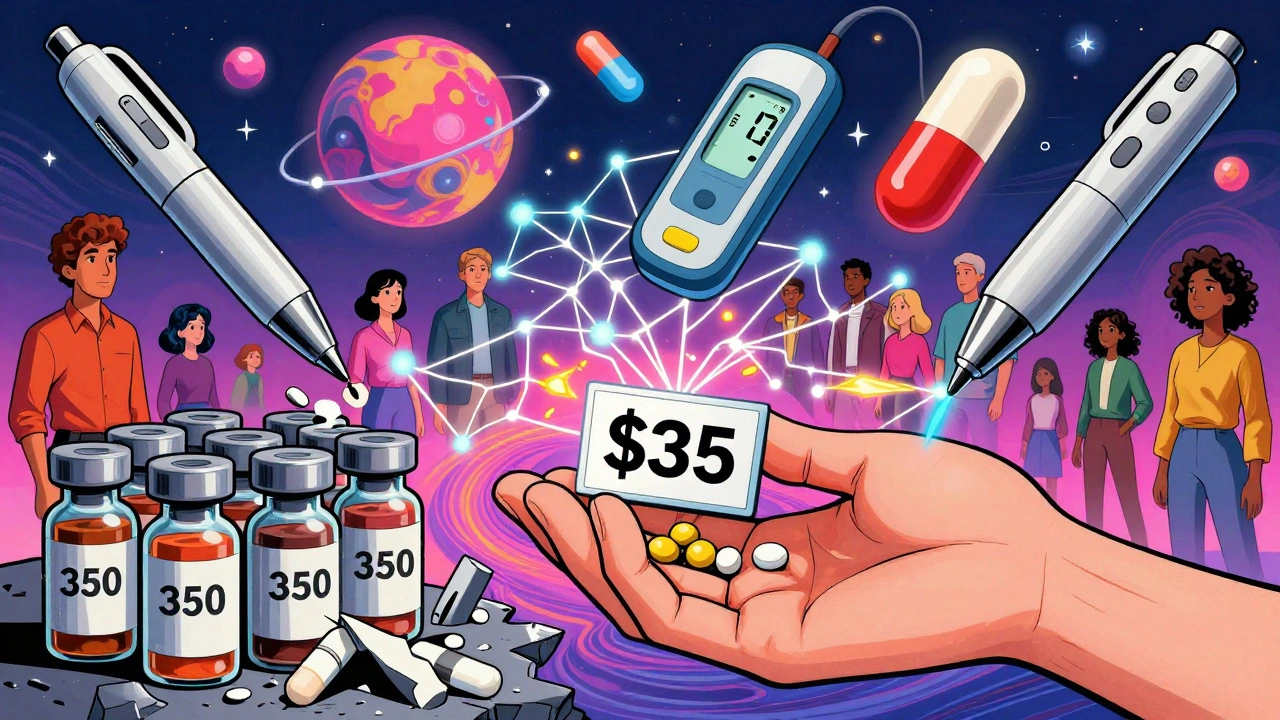
Analog insulins (Lantus, NovoLog, Tresiba) are engineered to work more like your body’s natural insulin. They’re smoother, safer, and more flexible. But they cost $250-$350 per vial without insurance. That’s 10-15 times more.
In 2023, 25% of insulin users admitted to rationing-skipping doses, stretching vials, or going without-because of cost. The Inflation Reduction Act capped insulin at $35/month for Medicare beneficiaries, and by 2025, this cap expanded to many commercial plans. That’s helping, but not everyone is covered yet.
For many, the choice comes down to this: pay more for safety and flexibility, or pay less and risk more lows and less control. The American Diabetes Association says analogs are preferred, but if cost is a barrier, human insulin is still effective-if you’re disciplined.
Who Gets What? Type 1 vs. Type 2
People with type 1 diabetes must use insulin. Their bodies make none. The standard is basal-bolus therapy or an insulin pump. Most experts recommend starting with analog insulins because they reduce hypoglycemia risk and improve quality of life.
For type 2 diabetes, insulin isn’t always the first step. Guidelines now say to start with GLP-1 receptor agonists (like semaglutide) or SGLT2 inhibitors (like empagliflozin) if you have heart or kidney disease. These drugs lower blood sugar, help with weight loss, and protect your heart and kidneys-without causing lows.
Insulin is added when those aren’t enough. Many people with type 2 start with once-daily long-acting insulin at night. Only about 25% of people with type 2 ever need insulin, but it’s often delayed by 8-10 years after diagnosis-even though guidelines say to start earlier. That delay can lead to more complications.
Real-World Challenges and How to Beat Them
Even the best insulin plan fails if you’re not supported.
Nocturnal hypoglycemia (low blood sugar at night) affects 35% of insulin users weekly. It’s dangerous and scary. The fix? Switch from NPH to a long-acting analog like degludec or glargine U300. Reduce your nighttime dose by 10-20%. Check your blood sugar before bed.
Carb counting is essential for mealtime insulin. Most people need 1 unit of insulin for every 10-15 grams of carbs. But it takes time to learn. Structured education programs like DAFNE cut the learning curve by 40%. Ask your doctor for a referral to a certified diabetes care and education specialist (CDCES).
Insulin sensitivity varies. One person might need 1 unit to drop 30 mg/dL, another might need 1 unit for 50 mg/dL. That’s your correction factor. Test your blood sugar, see how much it drops after a dose, and adjust. Don’t guess.
Pump issues are common-site infections, dislodged cannulas, insulin degradation in tubing. Rotate sites weekly. Keep extra supplies. Don’t let fear of problems stop you from using a tool that works better.
What’s Coming Next?
The future of insulin is smarter, simpler, and more accessible.
- Smart pens now track doses, remind you, and sync with apps. Sales grew 72% in 2023.
- Closed-loop systems (artificial pancreases) automatically adjust insulin based on real-time glucose readings. By 2030, nearly half of type 1 patients will use them.
- Oral insulin (like Oramed’s ORMD-0801) is in phase 3 trials. It could replace injections for some people in the next 5-7 years.
- Biosimilars (like Semglee, a copy of Lantus) are already cutting prices. By 2027, analog insulin could drop 30-50% in cost.
But none of this matters if people can’t access it. One in four insulin users still ration. Until that changes, even the best science won’t fix the problem.
How to Start Choosing
Ask yourself:
- Do I have type 1 or type 2 diabetes?
- Am I willing to inject multiple times a day-or prefer one shot?
- Do I eat at consistent times, or do my meals vary?
- Have I had low blood sugar before? How often?
- What’s my insurance coverage? Can I afford analogs?
- Do I want to use technology (pump, CGM, smart pen)?
Talk to your doctor. Bring your logbook. Ask for a referral to a CDCES. Don’t accept a plan that doesn’t fit your life. Insulin isn’t a punishment-it’s a tool. And like any tool, it only works if it’s the right one for the job.
What’s the difference between rapid-acting and regular insulin?
Rapid-acting insulin (like Humalog or NovoLog) starts working in 10-15 minutes and peaks quickly, making it better for matching meals and reducing low blood sugar risk. Regular insulin takes 30 minutes to start and peaks later, so it’s harder to time with meals and more likely to cause lows hours after eating. Most doctors now prefer rapid-acting for mealtime coverage.
Can I use human insulin instead of analogs to save money?
Yes, human insulin (like Humulin R or N) is much cheaper and still effective. But it’s less predictable-it has a stronger peak and longer tail, which increases the risk of low blood sugar, especially overnight. If you can manage strict meal timing and frequent blood sugar checks, it’s a viable option. But if you want flexibility and safety, analogs are better.
Why do some people need insulin for type 2 diabetes and others don’t?
Type 2 diabetes starts with insulin resistance, then the pancreas slowly loses its ability to make enough insulin. Some people can manage with diet, exercise, and pills like metformin or GLP-1 agonists for years. Others, especially those with high A1C levels, weight loss resistance, or complications, need insulin sooner. It’s not about failure-it’s about the disease progressing.
Is insulin dangerous because of low blood sugar?
Low blood sugar is the biggest risk with insulin-but it’s preventable. Using analog insulins, checking blood sugar regularly, learning your correction factor, and carrying fast-acting carbs (like glucose tabs) reduces risk dramatically. People who use continuous glucose monitors (CGMs) have 50% fewer severe lows. Insulin isn’t dangerous if you’re educated and prepared.
How do I know if my insulin dose is right?
Check your blood sugar before meals and 2 hours after. If your fasting sugar is consistently above 130 mg/dL, your basal dose may be too low. If your post-meal sugar is above 180 mg/dL, your bolus dose may need adjusting. Use a correction factor (like 1 unit per 40 mg/dL) to fix highs. Keep a log for 3-5 days and bring it to your doctor. Small, steady changes work better than big jumps.
Can I switch from injections to an insulin pump?
Yes, if you’re motivated and have support. Pumps offer more flexibility, better A1C control, and fewer injections. But they require constant attention-you need to change the site every 2-3 days, monitor for blockages, and learn how to program boluses. Most people who switch report higher satisfaction, but it’s not for everyone. Talk to your diabetes team before deciding.
What to Do Next
Don’t wait until your A1C hits 9% to act. If you’re on insulin, make sure your regimen matches your life. If you’re not on insulin but need it, don’t delay. Talk to your doctor about your options. Ask about biosimilars, patient assistance programs, and whether you qualify for a CGM. Connect with a certified diabetes educator. Your blood sugar numbers aren’t just data-they’re signals. Listen to them. Adjust. Get help. You don’t have to do this alone.
13 Comments
Robert Gilmore December 3, 2025 AT 18:27
Wow, this is one of the most thorough breakdowns of insulin types I’ve ever read 🙌 I’ve been on Lantus + Humalog for 8 years and honestly, switching to Tresiba cut my nighttime lows by like 60%. The ultra-long-acting stuff is a game-changer. Also, if you’re in India and can’t afford analogs, Humulin N works if you’re disciplined-but please, PLEASE check your sugars before bed. I’ve woken up drenched in sweat from a low more times than I care to admit 😅
Robert Gilmore December 5, 2025 AT 14:35
This article is pure pharmaceutical propaganda. Insulin is a profit machine. Big Pharma invented analogs to make people dependent on expensive vials. Human insulin has been around since the 1920s and kept millions alive. Why are you being sold this luxury nonsense? The real problem isn’t insulin-it’s capitalism.
Robert Gilmore December 6, 2025 AT 14:50
There are several grammatical inconsistencies here. For instance, ‘It’s survival’ should be italicized for emphasis, not bolded. Also, ‘insulin glargine U300 (Toujeo) lasts up to 36 hours’-this is misleading. The half-life is ~25 hours; duration of action is pharmacodynamically defined, not pharmacokinetically. Precision matters.
Robert Gilmore December 6, 2025 AT 19:31
Why are we even discussing Western insulin regimens in an Indian context? We have 200 million diabetics here, and most can’t even afford a glucometer. This article reads like a marketing brochure for Novo Nordisk. In India, we use human insulin because it’s accessible, not because we’re lazy. Stop pretending analogs are the only ‘correct’ choice. We survived before your fancy pens arrived.
Robert Gilmore December 6, 2025 AT 23:15
I’m type 2 and started on basal-only insulin last year. Took me 6 months to get my dose right. I was scared of needles, but once I got a smart pen, everything changed. I track my meals, my sugars, even my sleep now. It’s not perfect, but I feel in control for the first time. Also, shoutout to CDCES-my educator helped me figure out my carb ratio. You’re not alone in this.
Robert Gilmore December 7, 2025 AT 11:22
Let me tell you something-insulin isn’t just medicine, it’s freedom. When I switched from premixed to basal-bolus, I went from living in fear of dinner to actually enjoying it. I eat tacos on Tuesdays, sushi on Fridays, and my insulin adapts. Pumps? I tried one. Loved the flexibility, hated the tubing tangles. But damn, my A1C dropped from 8.9 to 6.2. This isn’t about being perfect-it’s about being alive. And if you’re rationing insulin? Stop. Talk to your doctor. There are programs. You’re worth more than a vial.
Robert Gilmore December 8, 2025 AT 17:26
Once-weekly insulin? That’s a marketing gimmick. Degludec already lasts 42 hours. The only reason they’re pushing this is to extend patents. Also, closed-loop systems? They’re expensive, glitchy, and require a PhD to operate. Most people just want to live without constant monitoring. Stop overengineering diabetes.
Robert Gilmore December 10, 2025 AT 06:56
Did you know the FDA approved insulin analogs without long-term cancer studies? Big Pharma funded the trials. They know insulin can stimulate IGF-1 receptors. That’s why some of us avoid analogs entirely. Human insulin = natural. Analog = lab-made. And if you’re using a CGM? You’re being tracked. Your data is sold. Wake up.
Robert Gilmore December 11, 2025 AT 16:53
So… if I’m on NPH and I’m not having lows, why should I switch? Is this just FOMO? I’ve been stable for 12 years. Are we pathologizing normal adaptation now?
Robert Gilmore December 13, 2025 AT 02:41
Oh, you’re one of THOSE people. The ones who think ‘stability’ means ‘ignoring the science.’ NPH peaks unpredictably-that’s why it’s responsible for 30% of nocturnal hypoglycemia in older adults. You’re lucky you haven’t had a seizure yet. You’re not ‘stable,’ you’re just not monitoring. And now you’re endangering others by spreading misinformation. Please, for the love of glucose, get a CGM.
Robert Gilmore December 13, 2025 AT 14:48
I’m from the UK and we’ve had insulin rationing for years too. I’ve seen people cut their doses in half to make vials last. It’s heartbreaking. But here’s what changed: the NHS now provides free analogs to all type 1 patients. It’s not charity-it’s public health. When you prevent amputations and kidney failure, you save money. This isn’t about cost. It’s about dignity.
Robert Gilmore December 14, 2025 AT 17:28
Thank you for this. As a Certified Diabetes Care and Education Specialist, I see patients every day who believe insulin means failure. It doesn’t. It means you’re still fighting. And if you’re struggling with cost-ask for samples, check out NeedyMeds, call your pharmacy. You are not alone. And yes-yes-your life matters more than a vial.
Robert Gilmore December 15, 2025 AT 23:07
Insulin regimens vary by individual. Recommendations are not universal. End.