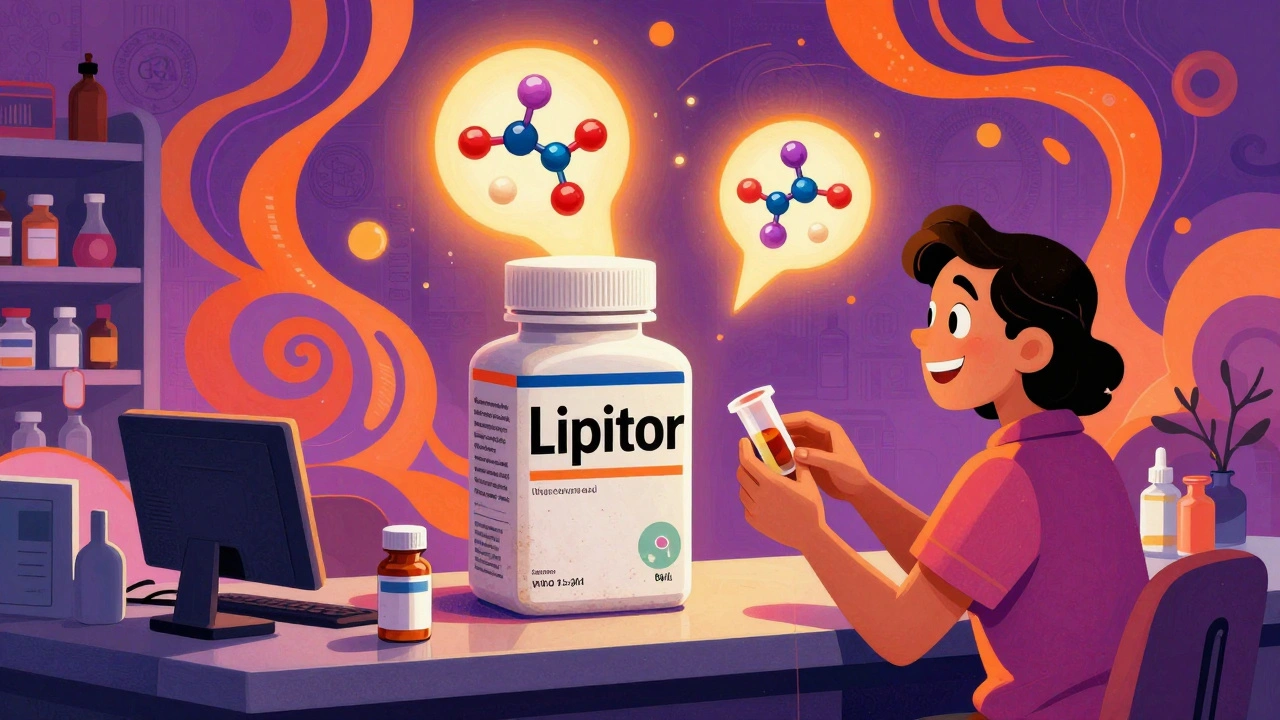
Every year, millions of people in Australia and around the world face the same tough choice: pay hundreds of dollars for a brand-name medicine, or switch to a cheaper generic version and wonder if it’s really the same. The truth is, generic medications aren’t a compromise-they’re a smart, science-backed way to cut costs without risking your health. But not everyone knows how to do it right. Some people avoid generics because they’ve heard rumors. Others switch blindly and end up confused when their pill looks different. This isn’t about fear. It’s about knowing what to look for-and what to ignore.
Generics Are Exactly the Same-Except for the Price
Let’s clear up the biggest myth right away: generic drugs contain the exact same active ingredient as their brand-name counterparts. If your doctor prescribes atorvastatin, whether you get Lipitor or a generic version, your body gets the same molecule. The FDA, Therapeutic Goods Administration (TGA) in Australia, and other global regulators require generics to match brand drugs in strength, dosage, how fast they’re absorbed, and how well they work. The only differences? The color, shape, flavor, or filler ingredients-things that don’t affect how the drug works. These are called excipients, and they’re harmless. You wouldn’t expect two different brands of ibuprofen to taste the same, right? Same logic applies here.
The numbers speak for themselves. In 2023, generic drugs saved U.S. patients $370 billion. In Australia, a 30-day supply of brand-name losartan might cost $80. The generic? Around $6. That’s not a small difference-it’s life-changing for people on fixed incomes or managing multiple chronic conditions. The TGA approves every generic before it hits shelves, just like brand-name drugs. They inspect the same factories, run the same tests, and require the same proof of safety and effectiveness.
When Generics Might Need Extra Care
There’s one group of drugs where switching needs more attention: narrow therapeutic index (NTI) medications. These are drugs where even a tiny change in blood levels can cause big problems. Think warfarin (for blood clots), levothyroxine (for thyroid), phenytoin (for seizures), and lithium (for bipolar disorder). For these, your body is fine-tuned to a very specific dose. A slight variation in absorption-even within the legal 80-125% bioequivalence range-could mean your INR goes off track, your thyroid symptoms return, or you have a seizure.
That doesn’t mean you can’t use generics for these. It means you need consistency. If you’re stable on a brand-name version, switching to a different generic manufacturer every time you refill can cause problems. Studies show that frequent switches in NTI drugs are linked to higher rates of hospital visits and unstable lab results. The fix? Ask your pharmacist: “Is this the same manufacturer as last time?” If not, ask if you can stick with one brand. Most pharmacies can order the same generic maker for you, even if it’s not the cheapest option.
Why Some People Feel Different on Generics
It’s not all in your head. Some people do report side effects or reduced effectiveness after switching. Why? Three reasons:
- Excipient sensitivity. One person might react to a dye or preservative in a generic that they never noticed in the brand version. This is rare, but real. If you get a rash, stomach upset, or dizziness after switching, tell your doctor. It might be the filler, not the drug.
- Placebo effect. If you believe the generic is “inferior,” your brain might make you feel worse-even if the drug works exactly the same. This isn’t weakness. It’s human psychology. Studies show patients who are told they’re switching to a cheaper version report more side effects than those told it’s the same drug.
- Manufacturer inconsistency. If your generic switches makers every refill, your body gets used to one formulation, then suddenly gets another. Even small differences in how the pill breaks down can throw off your rhythm. That’s why sticking with one manufacturer matters, especially for NTI drugs.
Don’t assume every change is the drug’s fault. Keep a simple log: note when you switch, what the pill looks like, and how you feel over the next two weeks. If symptoms fade, it was likely temporary. If they don’t, talk to your pharmacist or doctor about switching back.

How to Make Sure You’re Getting a Safe Generic
Here’s what you should do every time you pick up a prescription:
- Ask your pharmacist: “Is this a generic? Which company makes it?” They can tell you if it’s FDA- or TGA-approved and if it’s the same maker as before.
- Check the pill’s imprint. Generic pills have letters or numbers stamped on them. Use the TGA’s online database or apps like Medscape to look up the imprint. If it changes unexpectedly, ask why.
- Know your NTI drugs. If you’re on warfarin, levothyroxine, or epilepsy meds, ask your doctor if you should stick with one brand or manufacturer. Don’t let cost override stability.
- Don’t panic over price differences. If one generic is 10x cheaper than another, it’s not because it’s lower quality. It’s because the manufacturer has lower overhead. The active ingredient is identical.
Many pharmacies now offer $4 or $10 generic lists. These aren’t “discount” drugs-they’re the same medications, just priced aggressively because competition drives costs down. In Australia, the Pharmaceutical Benefits Scheme (PBS) already caps prices for many generics. You’re already saving. You just need to know how to use it.
Generics Are Helping People Stay on Their Meds
Cost isn’t just about saving money-it’s about staying alive. A 2024 study found that patients who switched to generics were 32% more likely to keep taking their medication as prescribed. Why? Because they could afford it. People on statins, blood pressure pills, or diabetes meds often skip doses when prices go up. That leads to heart attacks, strokes, and hospitalizations-costing far more than the drug ever did.
One patient in Sydney, 68, was taking three brand-name prescriptions. She was skipping doses to make them last. After switching to generics through her local pharmacy, she started taking them daily. Her blood pressure dropped. Her cholesterol improved. She didn’t need an emergency room visit in the next six months. That’s the real win.
What’s Changing in 2025
The TGA and global regulators are tightening oversight. By 2026, all new generic applications must include data showing how the drug is made using modern, consistent manufacturing methods. This means fewer shortages and more reliable quality. The FDA’s Generic Drug Shortage Task Force, launched in 2024, is already helping. In Australia, the PBS is expanding its list of generics with even lower co-payments. Biosimilars-generic versions of complex biologic drugs for cancer and autoimmune diseases-are now available and covered under PBS. They’re not cheap yet, but they’re coming down in price fast.
The message is clear: generics are safer, more reliable, and more regulated than ever. The old fears? Mostly outdated. The real risk isn’t using generics-it’s avoiding them because you don’t understand how they work.
Final Advice: Don’t Guess. Ask.
You don’t need to be a pharmacist to use generics safely. You just need to ask two simple questions:
- “Is this a generic?”
- “Is this the same maker as last time?”
If you’re on a high-risk drug, ask your doctor: “Should I stick with one brand?” If you’re on a common one-like metformin, lisinopril, or sertraline-switch without hesitation. The savings are real. The safety? Proven.
Generics aren’t second-rate. They’re the smart choice. And if you’re paying full price for a brand-name drug when a generic exists? You’re leaving money on the table-and possibly risking your health by skipping doses because you can’t afford it. Don’t let cost be the reason you don’t get better. Use generics. Know how. Stay safe.
13 Comments
Robert Gilmore December 4, 2025 AT 09:38
Ugh, I tried generics once... felt like my body was on vacation without me. Now I just pay the extra. Worth it.
Robert Gilmore December 4, 2025 AT 12:17
Dear reader, generics are scientifically equivalent and rigorously regulated. One must prioritize adherence over brand loyalty. A small cost reduction yields immense public health benefits.
Robert Gilmore December 5, 2025 AT 05:10
You got this! Switching to generics is one of the smartest moves you can make for your wallet AND your health. No guilt, no fear-just facts and freedom.
Robert Gilmore December 6, 2025 AT 06:50
Interesting piece, but I’m curious-how do regulatory bodies like the TGA actually verify bioequivalence in practice? Do they conduct independent bioavailability studies on every batch, or is it based on manufacturer-submitted data? And what about variations in dissolution profiles across different lots? I’ve read some studies suggesting that even within the 80–125% range, certain patient populations-like the elderly or those with GI disorders-may experience clinically significant fluctuations, especially with NTI drugs. Has there been any longitudinal data tracking real-world outcomes after repeated generic switches in Australia’s PBS system? I’d love to see the actual datasets behind those 32% adherence stats.
Robert Gilmore December 7, 2025 AT 14:43
GENERIC DRUGS ARE THE NEW RELIGION!!! PEOPLE ARE BEING BRAINWASHED BY BIG PHARMA’S GREEDY COUSINS!!! THE PILLS LOOK DIFFERENT SO THEY MUST BE POISON!!! I SAW A MAN CRY ONCE BECAUSE HIS PILL WAS BLUE INSTEAD OF PINK!!!
Robert Gilmore December 8, 2025 AT 08:45
Of course you’re saving money… but at what cost? I’d rather die rich than live cheap. Some things just aren’t worth cutting corners on.
Robert Gilmore December 9, 2025 AT 20:31
I switched to a generic lisinopril last month. Within days, I felt like my soul was being slowly drained. My anxiety spiked. My hands trembled. I cried in the pharmacy aisle. They told me it’s ‘the same molecule.’ But my body knew better. They don’t understand what it’s like to be betrayed by your own medicine.
Robert Gilmore December 10, 2025 AT 14:14
omg i just realized i’ve been on 3 different generics for my thyroid med and i thought i was just stressed?? i’m gonna call my pharma right now!! thank you for this post!! i’m crying (in a good way??)
Robert Gilmore December 11, 2025 AT 01:25
Why are we even talking about Australian regulations? In America, we have the FDA. Everything else is just socialist nonsense. If you can’t afford your meds, maybe you shouldn’t be on them.
Robert Gilmore December 12, 2025 AT 17:43
My grandma switched to generic metformin and hasn’t missed a dose in two years. She says it’s like getting a raise without asking for one. Smart move.
Robert Gilmore December 13, 2025 AT 08:04
Okay but have you considered that maybe your body doesn’t ‘like’ the generic because it’s not ‘designed for you’? Like… maybe your soul needs the brand-name pill? Just saying.
Robert Gilmore December 13, 2025 AT 16:43
Wait so if I switch to a generic and feel weird, is that my fault or the drug’s fault? Can I sue? I’m asking for a friend. (It’s me. I’m the friend.)
Robert Gilmore December 15, 2025 AT 06:19
You’re all missing the point. The real issue isn’t the drug-it’s the fact that we’ve normalized pharmaceutical monopolies for decades. Generics aren’t the solution, they’re the symptom. We need to break up Big Pharma, nationalize drug manufacturing, and make medicine a human right. Until then, sure, use generics-but don’t call it progress. It’s just damage control.